
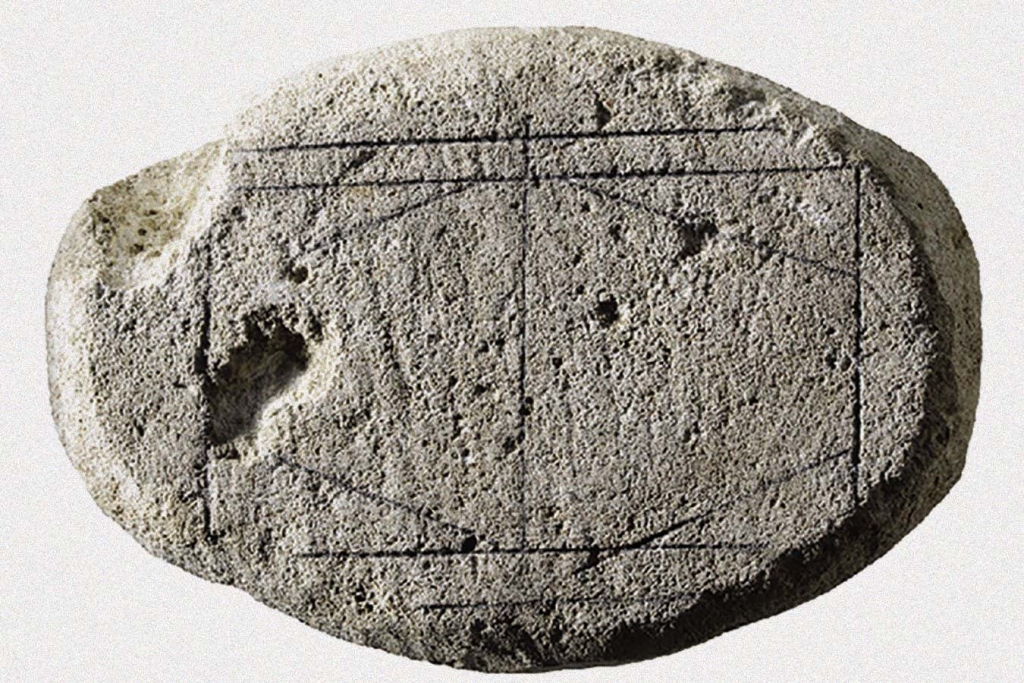
Is this carved rock an ancient Roman board game?
Mysterious Roman Board Game Discovered: AI Unlocks Secrets of Ancient Past
In a groundbreaking archaeological revelation, researchers have uncovered what appears to be a previously unknown Roman board game, thanks to the power of artificial intelligence. A flat stone, discovered in the Netherlands, bears a mysterious geometric pattern that has puzzled experts for years. Now, cutting-edge AI simulations have shed light on its potential purpose, revealing it to be an early example of a blocking game—a type of game not documented in Europe until centuries later.
The stone, measuring 212 by 145 millimeters, was found at the Roman town of Coriovallum, now buried beneath present-day Heerlen in the Netherlands. Its surface features a geometric pattern of straight lines, and archaeologists noticed unusual wear patterns on the stone. This wear, particularly concentrated along one diagonal line, suggested that it might have been used for a game involving sliding pieces.
Walter Crist, an archaeologist at Leiden University, initially approached the discovery with skepticism. “I was a bit skeptical at first because it’s a pattern I had not seen before,” Crist admitted. However, upon closer inspection, he found evidence of wear consistent with the movement of game pieces along the carved lines. This led him to collaborate with computer scientists to use AI to simulate how the stone might have been used.
Using a specialized AI system called Ludii, the team ran thousands of simulations, testing various rule sets from ancient board games across Europe. The AI pitted two agents against each other, exploring different numbers of starting pieces and rule variations. The results were astonishing: nine similar blocking games could have produced the distinctive wear pattern observed on the stone.
The researchers have tentatively named the game Ludus Coriovalli, or “the game from Coriovallum.” This discovery is particularly significant because blocking games in Europe are typically documented from the Middle Ages onwards. If Ludus Coriovalli is indeed a blocking game, it pushes back the evidence of such games in Europe by several centuries.
While some experts remain cautious, the AI-driven approach has opened new doors for understanding ancient games. “It’s an interesting approach,” said Ulrich Schädler of the University of Fribourg in Switzerland. However, he noted that the geometric pattern on the stone seems imprecise and that this is the only known instance of such a pattern, which is unusual for game boards.
Crist acknowledges the uncertainty but suggests that the game might have been a prototype or one that was typically played using marks scratched in the earth, leaving no traces. The discovery also hints at the possibility that blocking games may have existed earlier in South and East Asia, though dating such games remains challenging.
The use of AI in archaeology is proving to be a game-changer. By combining archaeological evidence with advanced computational methods, researchers can uncover hidden aspects of ancient cultures. “Combining archaeological and AI methods like this could provide glimpses of other mysterious ancient games,” said Tim Penn of the University of Reading, UK.
This discovery not only sheds light on the recreational activities of the Romans but also highlights the potential of AI in unraveling the mysteries of the past. As technology continues to evolve, who knows what other secrets of ancient civilizations might be unlocked?
Tags & Viral Phrases:
- Ancient Roman board game discovered
- AI unlocks secrets of mysterious stone
- Ludus Coriovalli: The game from Coriovallum
- Blocking games in ancient Europe
- Roman leisure and recreation
- AI in archaeology: A game-changer
- Mysterious geometric patterns on ancient stones
- Roman games pushed back centuries
- AI simulations reveal ancient gameplay
- Archaeological breakthrough with AI
- Roman town of Coriovallum
- Heerlen, Netherlands: A Roman treasure
- Ludii AI system revolutionizes archaeology
- Ancient games and modern technology
- Roman culture and entertainment
- Uncovering the past with AI
- The power of artificial intelligence in history
- Roman board games: A new discovery
- Ancient civilizations and their games
- AI and archaeology: A perfect match
,


Leave a Reply
Want to join the discussion?Feel free to contribute!