
It May Be Safe to Nuke an Earthbound Asteroid After All, Simulation Suggests : ScienceAlert
Humanity’s Last Stand: Could Nukes Save Earth From an Asteroid Apocalypse?
Picture this: a massive asteroid, bigger than a city, hurtling toward Earth at 40,000 miles per hour. Hollywood has shown us countless times how humanity might respond—cue the dramatic montage of astronauts drilling into the space rock and planting a nuclear bomb. But what if the real solution is even more explosive?
A groundbreaking new study from researchers at the University of Oxford and nuclear deflection startup Outer Solar System Company (OuSoCo) suggests that nuking an incoming asteroid might actually be our best bet for planetary defense—and it’s not just science fiction anymore.
The Surprising Strength of Space Rocks
Here’s where things get interesting. Scientists have discovered that asteroids are far tougher than we ever imagined. When subjected to intense impacts, these cosmic boulders don’t shatter—they actually grow stronger. It’s like nature’s version of “what doesn’t kill you makes you stronger,” but on an apocalyptic scale.
This counterintuitive finding could revolutionize how we approach planetary defense. Instead of fragmenting into countless deadly pieces that would rain down on Earth, a nuked asteroid might remain largely intact, with its trajectory altered just enough to miss our pale blue dot.
The Science Behind the Boom
The research team used a revolutionary approach to study how asteroids respond to extreme stress. They took a sample from the Campo del Cielo iron meteorite—a 4,000-year-old space rock that crashed into Argentina—and subjected it to intense proton beam pulses at CERN’s Super Proton Synchrotron facility.
What they discovered was mind-blowing. The meteorite didn’t just absorb the impact—it transformed. It softened, flexed, and then surprisingly re-strengthened itself. Even more fascinating, it displayed what scientists call “strain-rate dependent damping,” meaning the harder you hit it, the better it becomes at dissipating that energy.
Why This Changes Everything
This isn’t just academic curiosity—it’s potentially life-or-death information. Current asteroid deflection models make assumptions about how space rocks behave under stress, but these assumptions can be off by a factor of seven. That’s the difference between successfully saving Earth and accidentally creating a cosmic shotgun blast of asteroid fragments.
The real-time, non-destructive nature of this study provides unprecedented insight into how asteroids actually respond to extreme conditions. It explains why laboratory experiments often show different results than what we observe when meteorites actually enter Earth’s atmosphere.
The Nuclear Option: Not Your Average Hollywood Explosion
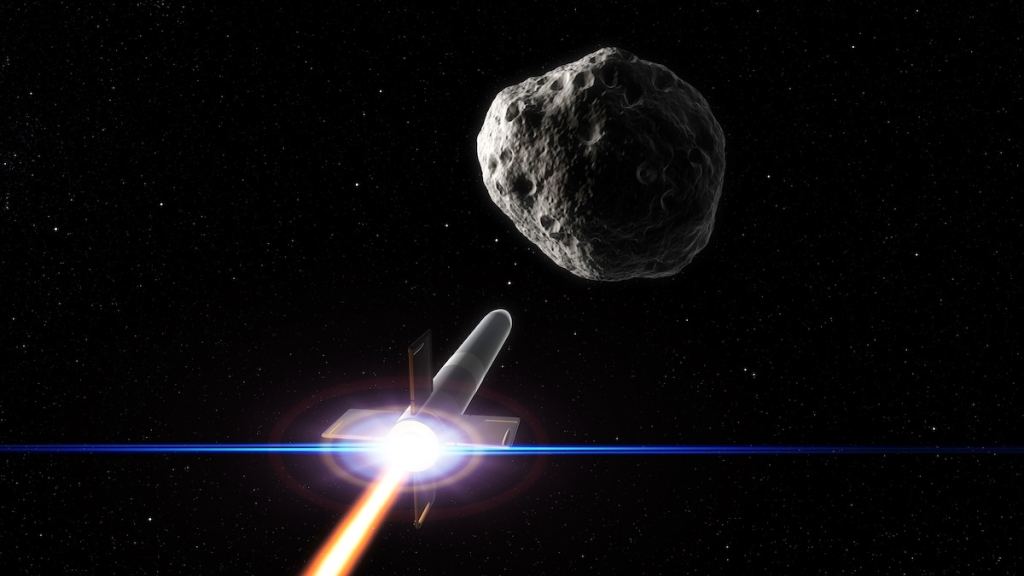
Before you imagine Bruce Willis strapping on a spacesuit, let’s be clear: the nuclear option for asteroid deflection wouldn’t involve drilling into the asteroid and planting explosives. Instead, physicists propose a “standoff nuclear detonation”—detonating a nuclear device near the asteroid to vaporize part of its surface.
This vaporization creates a powerful jet of material that acts like a rocket engine, pushing the asteroid off course. It’s elegant in its simplicity and terrifying in its implications.
The Clock is Ticking
While the thought of nuking an asteroid might seem extreme, the reality is that we need options. The 2013 Chelyabinsk meteor that exploded over Russia injured over 1,500 people and damaged thousands of buildings. That rock was only about 20 meters across—tiny compared to the extinction-level events that have hit Earth in the past.
NASA and other space agencies are actively tracking potentially hazardous asteroids, but the sobering truth is that we might not have years of warning. Some asteroids are discovered only weeks before their closest approach to Earth.
The Ultimate Insurance Policy
This research represents humanity’s growing understanding of how to protect our planet from cosmic threats. It’s not about fear-mongering—it’s about preparation. Just as we buy insurance for our homes and cars, developing the capability to deflect asteroids is essentially planetary insurance.
The study, published in Nature Communications, represents a crucial step forward in our ability to defend Earth. Whether through kinetic impactors like NASA’s successful DART mission or nuclear deflection techniques, we’re developing the tools we might one day need to save civilization itself.
The Bottom Line
Could humanity nuke an incoming asteroid to save Earth? According to this groundbreaking research, the answer is increasingly looking like “yes”—and that nuclear option might be more viable than we ever imagined. The space rocks are tougher than we thought, which paradoxically makes them better candidates for nuclear deflection.
As we continue to explore our solar system and track potential threats, one thing becomes clear: the fate of our planet might one day depend on our willingness to think big, act boldly, and yes—possibly push the nuclear button when Earth itself is on the line.
Tags: asteroid deflection, nuclear planetary defense, space rock strength, CERN particle accelerator, DART mission, planetary protection, cosmic threats, extinction prevention, space exploration, Earth defense systems, meteorite research, nuclear standoff detonation, asteroid impact simulation, space rock mechanics, planetary insurance
Viral Sentences:
- Scientists discover asteroids get STRONGER when you hit them—nature’s ultimate plot twist
- Nuking an asteroid might actually SAVE Earth, not destroy it further
- The nuclear option for asteroid defense is NOT what Hollywood showed you
- Space rocks are tougher than concrete, steel, and possibly your ex’s heart
- Humanity might need to “nuke it from orbit” to be sure—and science says it could work
- Asteroids that survive impacts become the ultimate cosmic badasses
- The fate of civilization could depend on understanding how space rocks flex
- Nuclear deflection: because sometimes you need to fight fire with bigger fire
- Earth’s insurance policy might involve the most powerful explosions known to humanity
- Space rocks that get hit harder actually become better at taking hits—what?
- The ultimate planetary defense strategy involves standing off and letting it rip
- Asteroids are basically the universe’s version of “whatever doesn’t kill me makes me stronger”
- Scientists used CERN’s particle accelerator to basically play cosmic whack-a-mole
- The nuclear option for asteroids is more elegant than you think—and more terrifying
- Earth might need its own version of “move that bus” but with nuclear explosions
- Space rocks are teaching us that sometimes the best defense is a good offense
- The future of planetary defense involves understanding how materials behave under apocalyptic stress
- Asteroids are proving that resilience isn’t just a human trait—it’s cosmic
- The nuclear option might be our best bet because space rocks are tougher than we thought
- Humanity’s backup plan for saving Earth involves some seriously big booms
,


Leave a Reply
Want to join the discussion?Feel free to contribute!