
It’s been 25 years since my jaw first dropped at 3DMark2001’s Nature test but hoo boy, have 3D graphics changed since then
25 Years of Graphics Evolution: From 3DMark2001 to Today’s Photorealistic Worlds
A Quarter Century of Visual Revolution
Twenty-five years ago, Finnish software company MadOnion released 3DMark2001, a benchmark tool that would become legendary in PC gaming history. Launched alongside Nvidia’s groundbreaking GeForce 3 series, this tool showcased the revolutionary potential of shaders in DirectX-powered games. For many of us who lived through that era, it marked the beginning of an incredible journey through the evolution of computer graphics.
Today, as we look back at those early tests, the contrast with modern gaming visuals is nothing short of breathtaking. What seemed cutting-edge then now appears almost primitive, yet it’s fascinating to trace how far we’ve come in just 25 years.
Test 1: The Bouncing Truck Through a Destroyed Land
The very first graphics test in 3DMark2001 follows a beefy truck bouncing through a post-apocalyptic landscape, dodging attacks from gigantic stomping robots. With approximately 68,000 triangles per frame, this was considered a serious workout for graphics cards in 2001. Today, that same number of polygons might be used just for a single vehicle in a modern game like Forza Horizon 5.
The texture memory usage tells an even more dramatic story: 3DMark2001 used around 16 MB per frame in that first test, whereas contemporary games use several hundred times more. This exponential growth in data requirements reflects not just raw power increases, but the fundamental shift in what we expect from our virtual worlds.
The Draw Distance Revolution
One of the most significant changes since 2001 has been the explosion of draw distance and environmental detail. Back then, 3D games were severely limited in how much detail they could show in a scene, constrained by early GPU capabilities. Modern open-world games like Forza Horizon 5, Assassin’s Creed Shadows, and countless RPGs give us richly detailed landscapes with vistas that aren’t just backdrops—they’re explorable, interactive environments.
If you can see it in today’s games, chances are you can go there, interact with it, or at least examine it closely. This level of environmental completeness was simply impossible in the early 2000s.
Test 2: The Medieval Town Under Dragon Attack
The second graphics test transports us to a medieval-like town under siege by a scantily-clad, low-polygon warrior riding a fire-breathing dragon. While some elements still hold up reasonably well—thanks to the roughly 100,000 triangles per frame—the character models instantly reveal the test’s age.
The fleeing townspeople are particularly telling: their extremely low polygon counts and basic animations make them look like crude approximations of human figures rather than believable characters. Compare this to modern RPGs like Kingdom Come: Deliverance 2, where performance capture, motion capture, and facial animation technology bring every NPC to life with convincing movement and expression.
The Animation Revolution
The third test, inspired by The Matrix’s famous lobby scene, demonstrates another crucial aspect of graphics evolution: animation quality. While this test actually uses fewer triangles (around 42,000) and less texture memory (6 MB per frame) than the previous tests, it was still challenging for 2001 hardware due to floor reflections, dynamic shadows, particle effects, and vertex skinning.
Fast forward to games like Control, which used ray tracing to create unprecedented visual fidelity. However, even with advanced rendering techniques, the fundamental challenge of creating believable animation remains. Modern games use motion capture, performance capture, and sophisticated animation systems to create characters that move and react like real people.
The Nature Test: A Personal Favorite
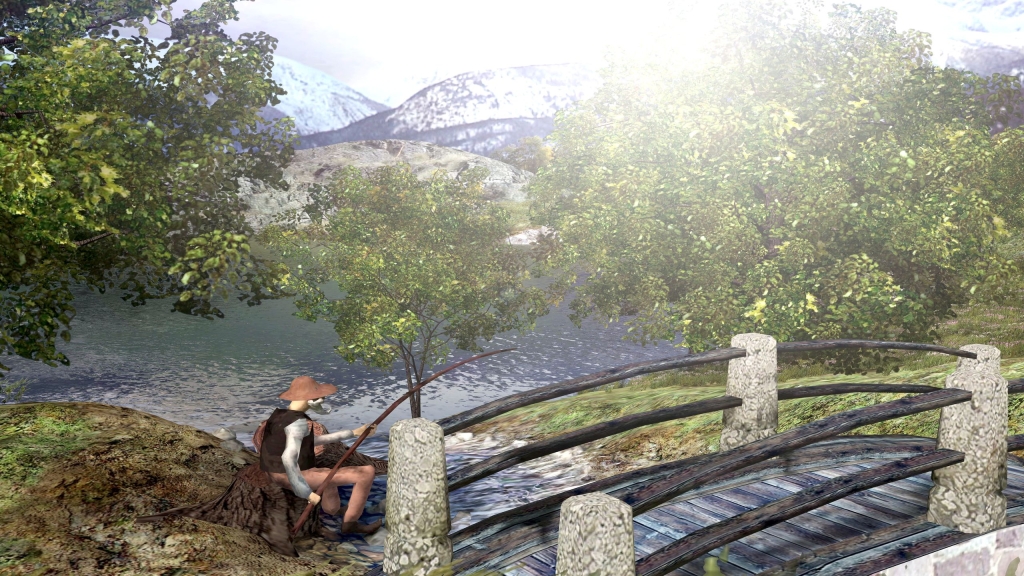
My personal favorite from 3DMark2001 was the Nature scene, which I spent countless hours testing with different graphics cards. During development, MadOnion didn’t have access to shader-capable hardware until very late in the process, so much of this had to be done in software. While the rendering was pixel-perfect, performance was, shall we say, less than optimal.
This test used vertex shaders for leaf and tree movement, butterfly animations, and the fisherman’s motion, plus pixel shaders for water surface reflections using cube maps. Simple by today’s standards, but revolutionary at the time.
The Crysis Moment
Just six years after 3DMark2001, Crysis arrived and essentially set the bar for nature scenes in games for years to come. The game’s “Can it run Crysis?” meme became legendary because its highest settings were designed for future hardware—developer Crytek wanted to ensure the game wouldn’t age quickly.
Modern games like Assassin’s Creed Shadows show how far we’ve come in rendering trees, foliage, and water effects. While the forests in these games feel more real than ever, creating perfect water reflections and realistic foliage movement remains challenging. Sometimes, the old-school techniques from 2001 can feel more immediately impressive than the physically correct but less visually striking modern approaches.
The Scale of Progress
The numbers tell a compelling story: we’ve gone through approximately 15 generations of graphics processors in 25 years. Even a current $250 entry-level graphics card would make the best rendering systems from 2001 look utterly obsolete by comparison.
Today’s games use millions of triangles, gigabytes of textures, and months of motion capture to create worlds that feel real, lived-in, and open for exploration. The complexity of modern game development is staggering—studios now need to employ actors, directors, motion capture technicians, and countless other specialists to achieve the level of realism we’ve come to expect.
What’s Next?
While the sense of excitement over each new rendering technology has somewhat diminished over the years—partly because progress has become more incremental and partly because we’re approaching photorealistic limits—there’s still plenty to be excited about. Ray tracing, AI-enhanced graphics, and new rendering techniques continue to push boundaries.
Looking ahead another 25 years, it’s mind-boggling to consider what graphics might look like. Will we achieve true photorealism? Will real-time global illumination become standard? How will AI transform content creation? The possibilities are endless.
A Nostalgic Look Back
It’s always valuable to look back at what seemed absolutely incredible at the time but now appears incredibly basic. Those early benchmarks weren’t just technical demonstrations—they were windows into a future that was rapidly approaching. They inspired a generation of developers, artists, and gamers to push the boundaries of what was possible.
From 68,000 triangles to millions, from 16 MB of textures to gigabytes, from basic animations to performance capture—the journey of graphics evolution over 25 years represents one of the most remarkable technological transformations in computing history. And if the past is any indication, the next 25 years will be just as revolutionary.
Tags & Viral Phrases:
- Graphics evolution 2001-2026
- 3DMark2001 vs modern games
- PC gaming graphics revolution
- DirectX 8 shaders
- GeForce 3 legacy
- Ray tracing comparison
- Forza Horizon 5 graphics
- Kingdom Come: Deliverance 2 animation
- Crysis meme history
- Assassin’s Creed Shadows foliage
- Graphics card generations
- Photorealistic gaming
- Motion capture technology
- Real-time rendering
- Game development complexity
- Visual fidelity evolution
- Polygon count growth
- Texture memory expansion
- Draw distance improvement
- Environmental detail revolution
- Vertex and pixel shaders
- Water reflection technology
- Open-world graphics
- Gaming hardware progress
- 25 years of graphics
- Benchmark tool history
- DirectX graphics evolution
- GPU technology advancement
- Real-time global illumination
- AI in game graphics
- Next-gen gaming visuals
- Graphics card comparison
- Game engine evolution
- Visual effects progress
- 3D rendering history
- Gaming graphics timeline
- Hardware requirements growth
- Software rendering vs hardware
- Animation technology progress
- Character model evolution
- Environmental rendering
- Graphics processing units
- Gaming industry transformation
- Visual computing advancement
- Computer graphics history
- Digital art evolution
- Interactive entertainment graphics
- Gaming technology milestones
- Graphics benchmark legacy
- Visual computing revolution
,


Leave a Reply
Want to join the discussion?Feel free to contribute!