
Just pull a string to turn these tile patterns into useful 3D structures
Revolutionary Algorithm Enables One-Pull Deployment of Complex 3D Structures
In a groundbreaking advancement that could transform everything from medical devices to space habitats, researchers have developed an algorithm that turns flat, 2D patterns into complex 3D structures with a single pull of a string. This innovative approach promises to revolutionize how we design, transport, and deploy structures across multiple industries.
The Science Behind the Breakthrough
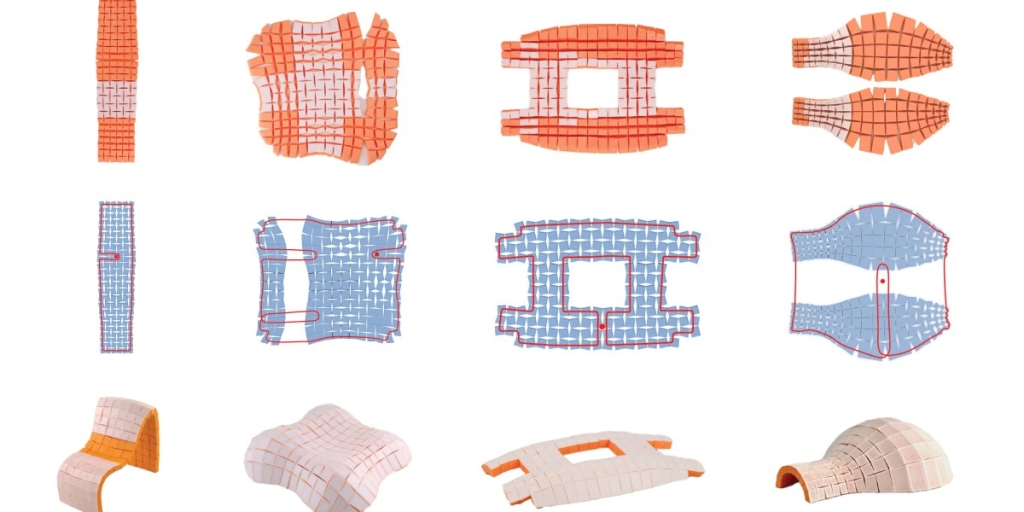
The core innovation lies in a sophisticated two-step algorithm that calculates the optimal path for a single string to transform a flat pattern into a predetermined 3D shape. The algorithm first determines the minimum number of points where the string must lift to create the desired form, then calculates the shortest path connecting these lift points while ensuring all necessary boundary areas are included to guide the structure into its final configuration.
What makes this approach particularly elegant is how it minimizes friction along the string path. By optimizing for smooth actuation, the structure can be deployed with just one continuous pull—eliminating the need for complex mechanical systems, multiple actuators, or manual manipulation of individual components.
Reversible and Versatile Design
The actuation mechanism is designed to be easily reversible, allowing structures to return to their flat configuration when needed. This reversibility opens up numerous possibilities for reusable and reconfigurable designs.
The manufacturing flexibility is equally impressive. The patterns can be produced using various fabrication methods including 3D printing, CNC milling, molding, or other manufacturing techniques. This versatility means the technology can be adapted to different scales and materials depending on the application.
Transformative Applications Across Industries
The potential applications for this technology span an extraordinary range of fields and scales. For medical applications, imagine portable splints that can be shipped flat and deployed in emergency situations, or posture correctors that can be customized to individual patients and then activated with a simple pull.
In robotics, the technology could enable foldable robots that compress into flat packages for transport, then expand into complex shapes to navigate tight spaces or perform specific tasks. These could be invaluable for search and rescue operations, industrial inspections, or even extraterrestrial exploration.
Perhaps most exciting are the implications for space exploration. The researchers specifically mention modular space habitats that could be deployed by robots on Mars—structures that could be compactly stored during launch and transit, then expanded into functional habitats once on the surface. This could dramatically reduce launch costs and increase the feasibility of long-term space missions.
From Tiny Medical Devices to Architectural Structures
The researchers have demonstrated the technology’s versatility by creating objects across a remarkable size spectrum. They’ve designed personalized medical items including splints and posture correctors, as well as larger structures like an igloo-shaped portable shelter. Perhaps most impressively, they’ve fabricated a human-scale chair, proving the technology works at everyday furniture dimensions.
The scalability is one of the most promising aspects of this innovation. The same principles could be applied to create tiny structures that are actuated inside the human body for medical procedures, or to architectural frameworks that require cranes for deployment on construction sites. This massive range—from microscopic to monumental—demonstrates the fundamental nature of the breakthrough.
Simplicity as a Key Advantage
According to Akib Zaman, the lead author and a graduate student in electrical engineering and computer science, the elegance of the system lies in its simplicity. “The user just needs to provide their intended design, and then our method optimizes it in such a way that it holds the shape after just one pull on the string, so the structure can be deployed very easily,” Zaman explains.
This simplicity is crucial for real-world adoption. By eliminating the need for complex mechanical systems or multiple actuation points, the technology becomes accessible to designers and engineers across different fields and expertise levels. The straightforward “design, optimize, deploy” workflow could accelerate innovation in deployable structures.
Future Directions and Possibilities
The research team isn’t stopping with their current achievements. They’re actively exploring designs at both ends of the size spectrum—from microscopic medical devices to massive architectural structures. Additionally, they’re working on developing self-deploying mechanisms that wouldn’t require human or robotic actuation at all.
This self-deployment capability could be particularly transformative for applications in hazardous environments or remote locations where human intervention isn’t possible or practical. Imagine structures that automatically deploy when exposed to specific environmental conditions, or that use stored energy to transform themselves without any external input.
The Bigger Picture
This technology represents a convergence of several important trends in engineering and design: the push for more efficient transportation and storage, the desire for simpler and more reliable deployment mechanisms, and the growing interest in transformable and adaptable structures.
By solving the fundamental challenge of how to reliably transform 2D patterns into complex 3D structures with minimal complexity, this research opens doors to innovations we’re only beginning to imagine. From emergency shelters that can be air-dropped and deployed in minutes to medical devices that can be shipped globally and activated on-site, the implications are profound.
The work also highlights the power of algorithmic design in solving physical engineering challenges. By using computational methods to optimize the string path and lift points, the researchers have created a solution that would be extremely difficult to discover through traditional trial-and-error approaches.
As this technology continues to develop and find applications, it could fundamentally change how we think about the relationship between flat and three-dimensional forms—potentially leading to a new era of deployable, transformable, and adaptable structures that seamlessly transition between compact storage and functional deployment.
Tags: deployable structures, one-pull actuation, transformable design, 3D printing innovation, space habitats, medical devices, foldable robotics, algorithmic design, friction optimization, reversible mechanisms, scalable technology, self-deploying systems, modular construction, emergency shelters, extraterrestrial habitats, computational geometry, CNC fabrication, smart materials, portable architecture, transformable furniture
Viral Sentences:
- Transform any flat pattern into a 3D structure with just one pull
- Space habitats that deploy themselves on Mars with a single tug
- Medical devices that ship flat and activate when needed
- Robots that fold flat to enter tight spaces, then expand to work
- Furniture that transforms from a sheet to a chair instantly
- Emergency shelters that deploy in minutes without tools
- The future of construction: buildings that assemble themselves
- Revolutionizing space travel with compact, deployable habitats
- One string, infinite possibilities: the simplicity of complex deployment
- From your pocket to full size: the magic of transformable design
- Architecture meets origami: buildings that fold and unfold
- The end of complicated mechanical systems for structure deployment
- Medical breakthroughs in portable, deployable devices
- Engineering meets art: beautiful structures that transform
- The ultimate space-saving solution: flat-to-3D technology
- Deploy anywhere, anytime: the power of algorithmic design
- Building the future, one pull at a time
- When simplicity meets sophistication: the elegance of one-pull deployment
- The technology that’s changing how we think about space and form
- From concept to reality: deployable structures are here
,

Leave a Reply
Want to join the discussion?Feel free to contribute!