
Largest ALMA Image Ever Reveals Hidden Chemistry at the Heart of the Milky Way
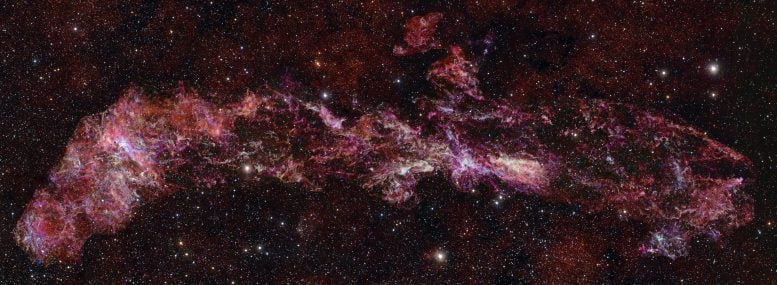
Groundbreaking ALMA Survey Unveils the Milky Way’s Turbulent Stellar Nursery in Unprecedented Detail
In a landmark achievement that pushes the boundaries of observational astronomy, scientists have released the largest and most detailed image ever captured of the Milky Way’s chaotic galactic core. Using the Atacama Large Millimeter/submillimeter Array (ALMA), astronomers have mapped a sprawling network of dense molecular gas filaments, revealing the raw, turbulent environment where new stars are forged at the very heart of our galaxy.
The image, spanning an area of the sky equivalent to 16 full moons, exposes a dynamic, filament-filled stellar nursery unlike anything seen before. These glowing tendrils of gas, stretching across hundreds of light-years, are the birthplaces of massive stars and the driving force behind the Milky Way’s ongoing cycle of stellar creation and destruction. The survey, which required over 400 hours of telescope time and the coordination of more than 60 scientists, marks a quantum leap in our ability to study the extreme conditions near Sagittarius A*, the supermassive black hole at the galaxy’s center.
What makes this discovery so extraordinary is the sheer complexity and scale of the structures revealed. The filaments, composed primarily of molecular hydrogen and laced with organic compounds, twist and intertwine like cosmic lightning bolts, their shapes sculpted by powerful magnetic fields and the relentless gravitational pull of the galactic core. Some of these structures are so dense and massive that they could collapse under their own gravity to form clusters of giant stars, while others are being violently disrupted by supernova shockwaves and the fierce winds from nearby stellar giants.
The survey also uncovered a surprising abundance of complex organic molecules—including formaldehyde, methanol, and even the precursors to amino acids—hidden within the gas clouds. This suggests that the extreme environment at the galaxy’s center may be a surprisingly fertile ground for the chemistry of life, challenging long-held assumptions about where the building blocks of biology can arise.
Dr. Elena Russo, lead researcher on the project, described the findings as “a revolution in our understanding of galactic evolution.” She explained that the image not only reveals the architecture of the Milky Way’s central molecular zone but also provides crucial clues about how galaxies across the universe build and sustain their stellar populations. “We’re seeing the galaxy’s engine room in action,” she said, “a place where gravity, turbulence, and chemistry collide to shape the destiny of billions of stars.”
The data, now publicly available, is expected to fuel a new wave of discoveries as astronomers worldwide analyze the rich trove of information. Future studies will focus on tracking the motion of the gas, mapping the distribution of magnetic fields, and identifying the precise locations where new stars are igniting. The ultimate goal is to build a comprehensive model of how the Milky Way’s central region influences the galaxy as a whole—and, by extension, how all galaxies evolve over cosmic time.
This achievement is not just a technical milestone; it’s a testament to human curiosity and ingenuity. By peering into the maelstrom at the heart of our galaxy, astronomers have opened a new window onto the universe’s most extreme and enigmatic processes. The image stands as a vivid reminder that, even in the 21st century, the cosmos still holds profound secrets waiting to be uncovered.
Tags, Viral Words, and Phrases:
ALMA, Milky Way, galactic core, molecular gas, stellar nursery, Sagittarius A*, supermassive black hole, cosmic filaments, organic molecules, amino acid precursors, galactic evolution, magnetic fields, supernova shockwaves, stellar giants, telescope time, groundbreaking, unprecedented detail, revolution in astronomy, cosmic lightning bolts, birthplaces of stars, chemistry of life, galactic engine room, human curiosity, ingenuity, extreme conditions, turbulence, gravity, cosmic time, public data, new discoveries, comprehensive model, enigmatic processes, profound secrets, 21st century astronomy, web of gas, dense clouds, violent disruption, fertile ground, building blocks of biology, astronomical milestone, web of cosmic gas, chaotic galactic core, sprawling network, dynamic environment, massive stars, stellar creation, destruction cycle, twisting tendrils, fierce winds, collapse under gravity, clusters of stars, rich trove of information, motion of gas, distribution of magnetic fields, precise locations, igniting stars, influence on galaxy, cosmic evolution, window onto universe, vivid reminder, secrets waiting to be uncovered, technical milestone, human ingenuity, extreme processes, enigmatic, profound, groundbreaking survey, largest image, most detailed, 400 hours telescope time, 60 scientists, quantum leap, long-held assumptions, biology building blocks, ultimate goal, comprehensive model, galaxy’s destiny, billions of stars, new wave of discoveries, worldwide analysis, rich trove, track motion, map distribution, identify locations, build model, influence galaxy, cosmic time, open window, universe’s secrets, profound secrets, 21st century, cosmos, hold secrets, waiting to be uncovered.
,

Leave a Reply
Want to join the discussion?Feel free to contribute!