
Largest-Ever Radio Map of The Sky Reveals 13.7 Million Hidden Objects : ScienceAlert
Astronomers Unveil Largest-Ever Radio Sky Survey: 13.7 Million Cosmic Objects Revealed
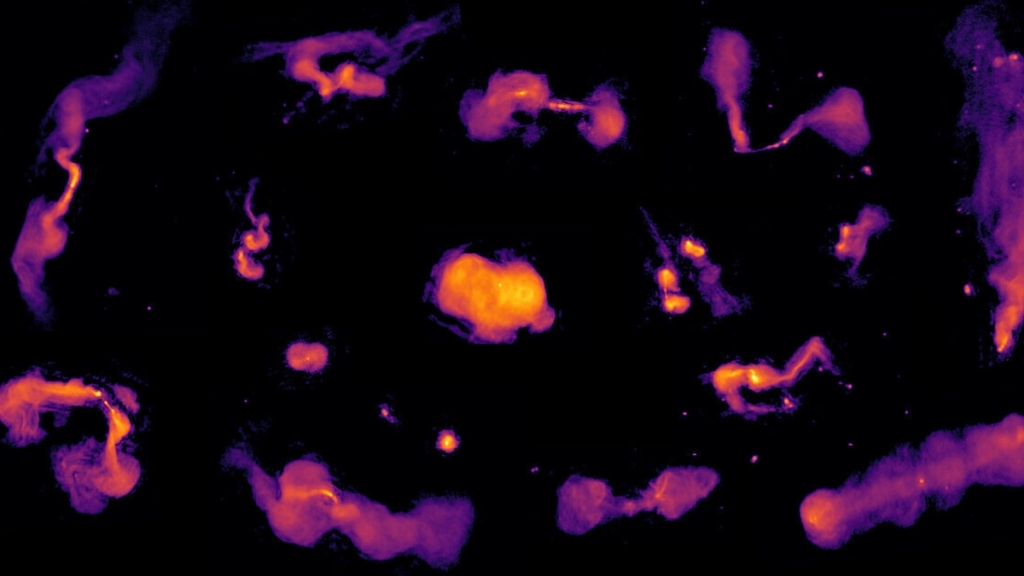
In a groundbreaking astronomical achievement, scientists have released the most comprehensive radio sky survey ever conducted, revealing nearly 13.7 million celestial objects in wavelengths of light invisible to the human eye. This monumental data release from the LOFAR Two-metre Sky Survey (LoTSS-DR3) provides an unprecedented window into the radio universe, fundamentally changing how we perceive our cosmic neighborhood.
The survey, which covers 88 percent of the northern sky, represents over a decade of meticulous observations and data processing. Astronomers have cataloged an astonishing array of cosmic phenomena, from the familiar structures of our own Milky Way to the most distant and energetic objects in the observable universe.
“This data release brings together more than a decade of observations, large-scale data processing, and scientific analysis by an international research team,” explains Timothy Shimwell, lead author and astronomer at ASTRON and Leiden University in the Netherlands. The survey’s third data release alone comprises approximately 13,000 hours of observations, making it the largest and most sensitive low-frequency radio survey ever conducted.
The survey was made possible by the LOw Frequency ARray (LOFAR), a technological marvel that bears little resemblance to traditional radio telescopes. Rather than a single massive dish, LOFAR consists of approximately 20,000 antennas distributed across 52 individual stations—38 in the Netherlands and 14 across other European countries. When combined, these stations create a virtual radio telescope the size of Europe, spanning more than 1,000 kilometers.
The scale of data processing required for this survey is staggering. The research team handled 18.6 petabytes of data—equivalent to millions of hours of high-definition video. Processing this enormous dataset required over 20 million core hours of computing time on one of Europe’s most powerful supercomputers at the Jülich Supercomputing Centre in Germany.
“The volume of data we handled was immense and required continuous processing and monitoring over many years,” notes Alexander Drabent, an astronomer at Thuringian State Observatory and software developer for LOFAR. “For this sky survey, it was the first time that such large amounts of data had to be stored, processed, and made accessible as part of an astronomical observation project.”
The data itself is remarkable not just for its volume but for its complexity. LOFAR doesn’t simply capture static images of the sky. To create a single image, researchers must combine signals from 70,000 antennas, digitizing, transporting, and merging 13 terabits of raw data per second—equivalent to more than 300 DVDs every second.
What makes this survey truly revolutionary is the unique perspective it offers on the universe. Radio waves can penetrate through cosmic dust and gas that would otherwise obscure our view, revealing structures and phenomena invisible to optical telescopes. The survey has captured everything from the eerie radio glow of the Andromeda Galaxy—which appears as a ghostly cosmic eye in LOFAR’s images—to the violent jets of plasma ejected by supermassive black holes.
Among the most exciting discoveries are galaxies being dramatically reshaped by powerful jets from supermassive black holes, resembling cosmic “Death Star” beams. The survey has also revealed supernova-produced magnetic fields that accelerate particles with thousands of times more energy than Earth’s most powerful particle accelerators.
The implications of this data release extend far beyond astronomy. By making the entire dataset publicly available, the research team has opened the floodgates for countless new studies across multiple scientific disciplines. Previous LOFAR releases have already yielded remarkable discoveries, including images containing 25,000 supermassive black holes.
This achievement also serves as a crucial stepping stone toward even more ambitious projects. LOFAR acts as a precursor to the Square Kilometre Array Observatory (SKAO), an international collaboration to build the world’s largest telescope arrays in South Africa and Australia. The techniques and technologies developed for LOFAR are directly informing the design and operation of these next-generation facilities.
The survey represents a triumph of international collaboration, involving hundreds of researchers from dozens of institutions across Europe and beyond. It demonstrates how modern astronomy has evolved into a truly global endeavor, requiring expertise in everything from antenna design and signal processing to data management and astrophysical interpretation.
As the astronomical community begins to mine this treasure trove of data, we can expect countless new discoveries in the coming years. From understanding the formation and evolution of galaxies to probing the nature of dark matter and dark energy, the LoTSS-DR3 survey provides an invaluable resource for addressing some of the most fundamental questions in science.
The release of this data marks not just a milestone in radio astronomy but a transformation in how we observe and understand the universe. By revealing the cosmos in radio light, astronomers have given us a new way to see the invisible structures that shape our universe—from the magnetic fields threading through galaxies to the powerful engines at the hearts of distant quasars.
Tags: LOFAR, radio astronomy, cosmic survey, supermassive black holes, galaxy evolution, astronomical data, Square Kilometre Array, dark matter, dark energy, cosmic jets, interstellar magnetic fields, Andromeda Galaxy, Milky Way, astronomical imaging, data processing, European astronomy, space science, cosmic phenomena, radio waves, telescope arrays
Viral Sentences:
- Astronomers just mapped 13.7 million cosmic objects in wavelengths humans can’t see
- The universe looks completely different in radio light—and it’s mind-blowing
- This telescope array is the size of Europe and sees through cosmic dust
- 18.6 petabytes of data processed—that’s millions of hours of HD video
- Supermassive black holes are blasting galaxies with “Death Star” beams
- The Andromeda Galaxy looks like a ghostly cosmic eye in radio waves
- Particles accelerated with thousands of times more energy than Earth’s colliders
- The largest radio sky survey ever will change how we see the universe
- Astronomers can now see through the dusty hearts of galaxies
- This data release is a goldmine for discoveries we haven’t even imagined yet
- The next generation of telescopes is being built right now
- International collaboration just mapped 88% of the northern sky
- Radio astronomy just got a massive upgrade—here’s what changed
- These images reveal the invisible structures shaping our universe
- The cosmic web is more complex than we ever imagined
- This survey proves we’re living in the golden age of astronomy
- The universe is full of surprises when you look at it the right way
- From black holes to baby stars, radio waves tell the whole story
- This data will fuel discoveries for decades to come
- Astronomy just leveled up—are you ready for what we’ll find?
,


Leave a Reply
Want to join the discussion?Feel free to contribute!