
Let’s talk about Ring, lost dogs, and the surveillance state
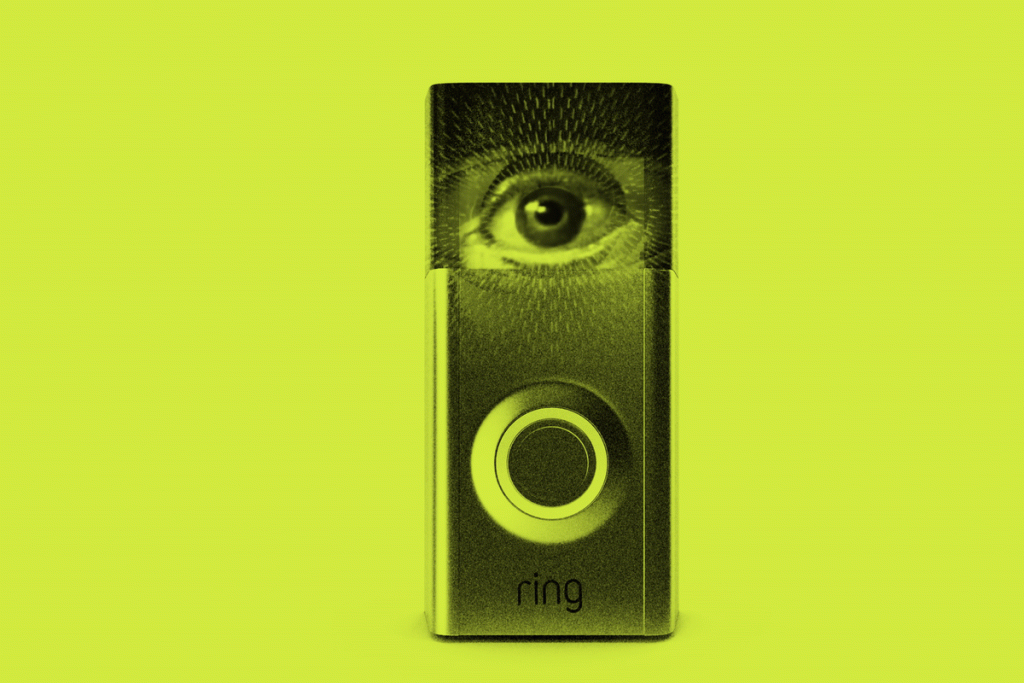
Ring’s AI Vision: The Controversial Quest to Virtually Eliminate Neighborhood Crime
In a recent interview that has sent shockwaves through the tech and privacy communities, Ring CEO Jaime Siminoff outlined an ambitious vision for the company’s future that hinges on artificial intelligence and widespread adoption of Ring devices. Siminoff’s statements suggest Ring is moving beyond its current role as a smart doorbell manufacturer toward becoming a comprehensive neighborhood surveillance and crime prevention system.
The AI Transformation
When asked to explain his vision, Siminoff drew an intriguing parallel between Ring’s AI ambitions and an idealized neighborhood security model. “When you put AI into it, now, all of a sudden, you have this human element that AI gives you,” he explained. “I do see a path where we can actually start to take down crime in a neighborhood to call it close to zero.”
The CEO’s vision centers on creating what he calls a “digital neighborhood watch” that operates with the efficiency and knowledge of a team of dedicated security guards. “If you had a neighborhood where you had unlimited resources, so every house had security guards and those security guards were people that worked the same house for 10 years or 20 years,” Siminoff mused, “what would happen?”
According to Siminoff, this hypothetical neighborhood would function like a well-oiled machine where everyone knows everyone else, and anomalies are quickly identified and addressed. A lost dog would be found almost immediately because everyone in the neighborhood would be connected and aware. The challenge, as Siminoff sees it, is bringing this level of community awareness and responsiveness into the digital realm.
The Privacy Dilemma
Not everyone is convinced that Siminoff’s vision is desirable, let alone achievable. When interviewer Nilay Patel challenged the premise, asking whether such a neighborhood might be considered dystopian, Siminoff pushed back. “I think the model is that doing crime in a neighborhood like that is not profitable,” he argued. “I don’t think that crime is a good thing.”
However, Patel’s concerns about private security forces and HOA-controlled neighborhoods resonate with many privacy advocates who worry about the implications of ubiquitous surveillance. The idea of “private cops on every corner” funded by HOA fees raises questions about equity, privacy, and the nature of community safety.
The Technical Implementation
So how exactly does Ring plan to achieve this ambitious goal? According to Siminoff, the key lies in moving beyond simple motion detection to intelligent, context-aware monitoring. “Right now, we just say motion detection, motion detection, motion detection,” he explained. “It’s funny, when I started Ring… motion detection was an amazing invention.”
But with AI, Siminoff argues, Ring can evolve from simply alerting users to any movement to providing intelligent notifications about what actually matters. “We shouldn’t be telling you about motion detection; we should be telling you what’s there, when you should look at it, when it matters, and we shouldn’t be bothering you all the time.”
This represents a significant shift in how Ring devices function. Instead of constant notifications about every car, dog, or person that passes by, the AI would learn to distinguish between normal neighborhood activity and potential threats or concerns. The system would effectively act as an intelligent filter, only alerting users when something truly requires their attention.
The Broader Implications
Ring’s vision raises profound questions about the future of community safety, privacy, and the role of technology in our daily lives. While the promise of virtually eliminating crime is undoubtedly appealing, the means by which Ring proposes to achieve this goal has sparked intense debate.
Critics worry about the potential for abuse, the erosion of privacy, and the creation of a surveillance state at the neighborhood level. There are also concerns about the digital divide and whether such systems would be available only to affluent communities that can afford the technology and associated fees.
Supporters, on the other hand, see Ring’s vision as a natural evolution of community safety measures. They argue that if the technology can genuinely reduce crime and make neighborhoods safer, particularly for vulnerable populations like children, then the benefits may outweigh the privacy concerns.
The Path Forward
As Ring continues to develop its AI capabilities and expand its product line, the debate over the proper balance between security and privacy is likely to intensify. Siminoff’s vision represents a bold step into uncharted territory, one that could fundamentally reshape how we think about neighborhood safety and community interaction.
Whether Ring’s AI-powered neighborhood watch becomes a reality remains to be seen. But one thing is clear: the conversation about the role of technology in our communities is far from over, and Ring is positioning itself at the center of this crucial debate.
Tags and Viral Phrases:
- Ring AI crime prevention
- Neighborhood surveillance revolution
- Smart doorbell technology
- Community safety AI
- Privacy vs security debate
- Ring CEO Jaime Siminoff interview
- Digital neighborhood watch
- Crime elimination technology
- Smart home security evolution
- AI-powered community monitoring
- The future of neighborhood safety
- Ring’s ambitious vision
- Controversy in smart home tech
- Privacy advocates sound alarm
- The surveillance state debate
- Ring’s game-changing AI
- Neighborhood crime rate zero
- Smart security guard technology
- The digital divide in safety
- Ring’s controversial mission
- AI transforms home security
- The end of neighborhood crime?
- Ring’s privacy concerns
- Smart home tech controversy
- The HOA surveillance model
- Ring’s dystopian vision?
- Community safety reimagined
- The Ring effect on crime
- AI neighborhood monitoring
- The future of community watch
,


Leave a Reply
Want to join the discussion?Feel free to contribute!