
LIGO May Have Detected The First Primordial Black Hole, Scientists Say : ScienceAlert
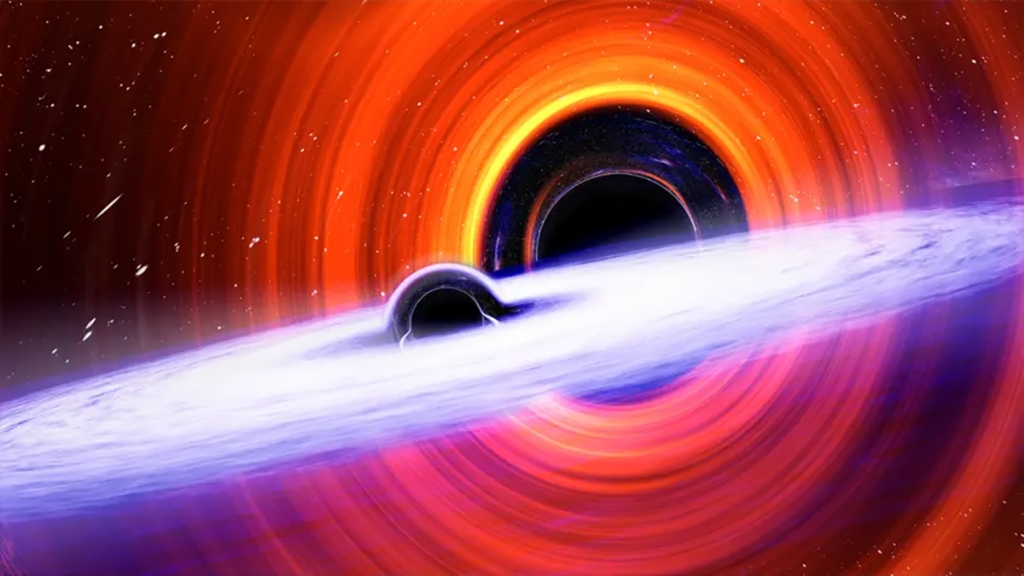
Breaking: Scientists May Have Detected First-Ever Primordial Black Hole—A Cosmic Relic from the Dawn of Time
In a discovery that could rewrite the history of the cosmos, astrophysicists Alberto Magaraggia and Nico Cappelluti from the University of Miami believe they may have detected the first direct evidence of a primordial black hole (PBH)—a mysterious object theorized to have formed in the first second after the Big Bang.
Unlike the black holes born from collapsing stars, primordial black holes are thought to have emerged from dense pockets of subatomic matter in the infant Universe. For decades, they’ve remained purely theoretical—until now.
The potential breakthrough came via the Laser Interferometer Gravitational-Wave Observatory (LIGO), which picked up a gravitational wave signal in December 2025. The signal, dubbed S251112cm, suggests a cosmic collision in which one of the objects had less than a single solar mass—far too small to be a typical stellar black hole.
“This is incredibly exciting,” says Cappelluti. “The most common black holes form as the result of a supernova, the death of a massive star. Their masses can range from a few times the Sun’s mass to billions of solar masses. Primordial black holes, on the other hand, are expected to have much lower masses—potentially even asteroid-sized.”
Gravitational waves, the ripples in spacetime first predicted by Einstein and detected by LIGO in 2015, are often triggered by massive cosmic collisions. But this signal was different. The subsolar mass object defies conventional black hole formation theories, pointing instead to a primordial origin.
Magaraggia and Cappelluti didn’t stop at observation. They ran detailed simulations to estimate how frequently such PBHs should appear in the Universe—and how often LIGO should detect them. The results? Strikingly consistent with LIGO’s observations since 2015.
“We attempted to estimate how many primordial black holes may exist in the Universe and how many of them LIGO should be able to detect,” Magaraggia explains. “And our results are encouraging. We predict that subsolar black holes like the one LIGO may have observed should indeed be rare, consistent with how infrequently such events have been seen so far.”
Still, the team urges caution. “LIGO picked up what is very strong evidence that these types of black holes exist, but we’ll need to detect another such signal or even several others to get the smoking-gun confirmation that they are real,” Cappelluti adds. “What is clear is that they cannot be excluded as being real.”
If confirmed, this discovery could have profound implications—not just for black hole science, but for our understanding of dark matter. Many astrophysicists believe PBHs could account for a significant portion of the Universe’s missing mass, potentially solving one of cosmology’s greatest mysteries.
Like all black holes, PBHs trap light, making them invisible to telescopes. They’re also expected to be much smaller than their stellar counterparts—some possibly no bigger than an asteroid. Spotting them is like finding needles in a cosmic haystack.
But the hunt is about to get easier. Upcoming instruments like the European Space Agency’s Laser Interferometer Space Antenna (LISA), set to launch in 2035, will open new frontiers in gravitational wave astronomy, potentially revealing a hidden population of primordial black holes.
“This could be the first direct observation of a PBH,” the team says. “And if so, it’s a window into the earliest moments of our Universe.”
The research is slated for publication in The Astrophysical Journal and is currently available on arXiv.
Tags: primordial black holes, LIGO, gravitational waves, Big Bang, dark matter, cosmic discovery, subsolar black holes, spacetime, astrophysics, University of Miami, Alberto Magaraggia, Nico Cappelluti, LISA, ESA, black hole formation, theoretical physics
Viral Phrases:
- “First direct evidence of a primordial black hole”
- “Cosmic relic from the dawn of time”
- “Gravitational wave signal defies all expectations”
- “Black holes smaller than asteroids?”
- “The Universe’s missing mass mystery may be solved”
- “Einstein’s ripples reveal ancient secrets”
- “A window into the first second after the Big Bang”
- “LIGO’s groundbreaking cosmic collision”
- “Astrophysicists on the brink of a historic discovery”
- “The hunt for invisible cosmic needles”
,


Leave a Reply
Want to join the discussion?Feel free to contribute!