
Mars’s gravity may help control Earth’s cycle of ice ages
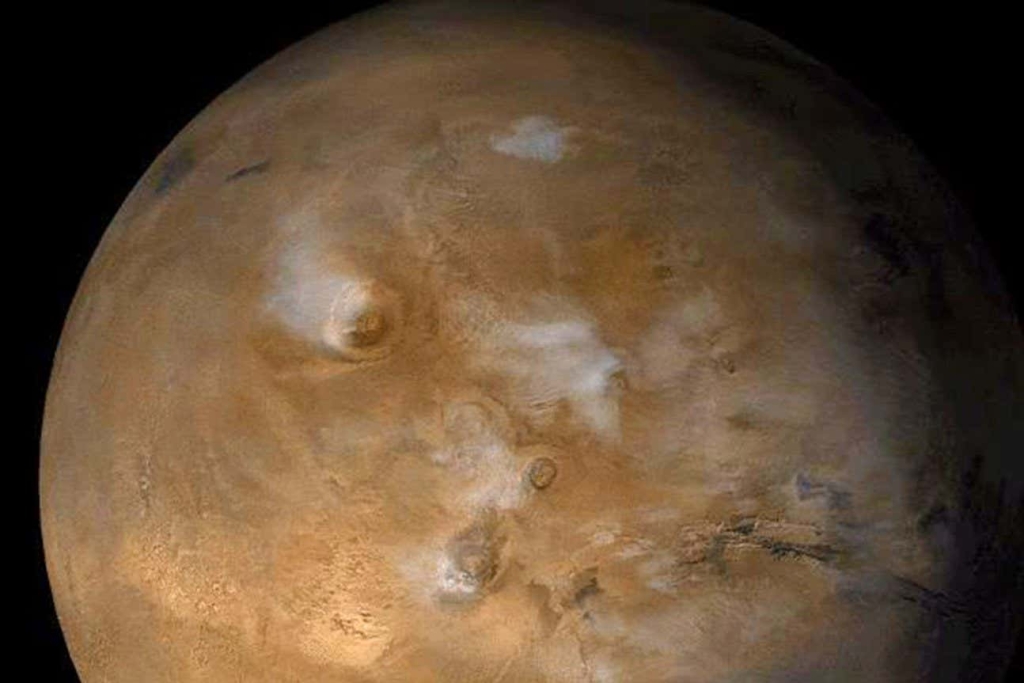
The Red Planet’s Hidden Power: How Mars Secretly Shapes Earth’s Climate—And Why It Matters for Finding Alien Worlds
In a stunning revelation that’s sending shockwaves through the planetary science community, researchers have uncovered that Mars—despite being just a fraction of Earth’s size—exerts a surprisingly powerful influence on our planet’s climate cycles. This discovery doesn’t just change how we understand our own backyard; it fundamentally alters how we’ll search for habitable worlds beyond our solar system.
When a Tiny Planet Packs a Climate Punch
“We came to this research with deep skepticism,” admits Stephen Kane, planetary astrophysicist at the University of California, Riverside. “Mars is only about one-tenth Earth’s mass. How could something so small have such profound effects on our climate?”
The answer, it turns out, is: significantly more than anyone expected.
Kane and his team ran thousands of sophisticated computer simulations, tweaking Mars’s mass from 100 times its actual size down to complete removal from the solar system. What they discovered challenges everything we thought we knew about planetary interactions.
The Grand Cycle: Mars’s 2.4 Million Year Climate Lever
Earth’s climate operates on multiple timescales, governed by the gravitational dance between our planet, the Sun, and our celestial neighbors. One of the most critical is the “grand cycle”—a 2.4-million-year pattern where Earth’s orbital ellipse stretches and compresses, dramatically affecting how much solar radiation reaches our surface.
Remove Mars from the equation entirely, and this grand cycle vanishes. Gone. Poof. Along with it disappears another crucial 100,000-year eccentricity cycle that helps regulate the timing and intensity of ice ages.
“It’s not that Earth would lack ice ages without Mars,” Kane explains. “But the entire landscape of climate frequency and intensity would be fundamentally altered. The rhythm of our planet’s climatic heartbeat would change.”
The Venus-Jupiter Exception: Mars Isn’t All-Powerful
Interestingly, not all climate cycles bow to Mars’s influence. A 405,000-year eccentricity cycle, primarily governed by the gravitational pulls of Venus and Jupiter, remains remarkably stable regardless of Mars’s mass. This finding suggests that while Mars punches above its weight class, it doesn’t control the entire cosmic climate show.
Earth’s Tilt: Mars as the Stabilizing Force
Perhaps even more surprisingly, Mars appears to act as a stabilizing force on Earth’s axial tilt—the wobble that gives us our seasons. Earth’s axis normally oscillates over a 41,000-year period, but the simulations revealed that Mars’s presence dampens this variation. Increase Mars’s mass, and the wobble becomes even more stable. Shrink it, and the tilt variations become more chaotic.
This stabilization effect could have profound implications for life’s development on Earth, suggesting that Mars’s presence may have helped create the relatively stable conditions necessary for complex life to evolve.
The Exoplanet Hunting Revolution
This discovery sends immediate shockwaves through the search for habitable exoplanets. For years, astronomers have focused on finding Earth-sized planets in the “Goldilocks zone” of distant stars—not too hot, not too cold. But Kane’s research suggests we’ve been missing a crucial piece of the puzzle.
“We really need to understand the orbital architectures of exoplanet systems in incredible detail,” emphasizes Sean Raymond, planetary scientist at the University of Bordeaux. “The presence and mass of smaller planets could be the difference between a world that’s occasionally habitable and one that’s consistently life-friendly.”
The Detection Challenge: Why We’ve Been Blind
Here’s the catch: detecting small planets like Mars around distant stars is extraordinarily difficult with current technology. Most exoplanet detection methods—like the transit method or radial velocity measurements—struggle to identify planets much smaller than Neptune around stars beyond our immediate neighborhood.
“This is more of a warning than anything else,” Kane cautions. “We can’t ignore these smaller objects, even though they’re incredibly difficult to find, because they’re having a bigger impact than we ever imagined.”
The Cosmic Butterfly Effect
The implications extend far beyond climate science. If a planet just 11% of Earth’s mass can so dramatically influence our climate cycles, what does that mean for the stability of other planetary systems? Could the presence or absence of small planets be the difference between a stable, life-supporting world and one that’s climatically chaotic?
What Earth Might Have Been
While we can’t say exactly what Earth would be like without Mars or with a supersized version, the changes would be profound. Ice ages would occur on different schedules. Seasons might be more extreme or more mild. The entire rhythm of Earth’s climatic variations would shift.
The Search Redefined
As astronomers continue their quest to find Earth-like worlds capable of supporting life, Kane’s research suggests a new priority: understanding not just the habitable planet itself, but the entire planetary system surrounding it. A true Earth analog might require not just the right distance from its star, but also the right configuration of smaller planetary neighbors.
The Future of Climate Science
This research opens up entirely new avenues for climate science. Could understanding Mars’s influence on Earth help us better predict long-term climate changes? Could it provide insights into past climate events that shaped the evolution of life on our planet?
The Bigger Picture
What makes this discovery particularly fascinating is how it challenges our assumptions about scale and influence in planetary systems. In the cosmic dance of gravity and orbital mechanics, size doesn’t always correlate with impact. Sometimes, the smallest dancers lead the most important moves.
Tags: Mars climate influence, planetary climate cycles, exoplanet habitability, grand cycle, axial tilt stabilization, orbital mechanics, climate science breakthrough, habitable zone redefined, small planet impact, cosmic climate patterns, Earth-Mars relationship, planetary system architecture, ice age timing, climate rhythm, gravitational interactions, astrobiology implications, space exploration priorities, planetary detection challenges, cosmic butterfly effect, climate stability factors
Viral Phrases: “Mars punches above its weight class in climate science,” “The tiny planet with an outsized climate punch,” “When small planets make big differences,” “The cosmic dance that shapes our seasons,” “Why size doesn’t matter in planetary influence,” “The hidden climate lever no one saw coming,” “Mars: Earth’s unexpected climate guardian,” “The planetary system architecture that makes life possible,” “How a tenth-Earth-mass planet controls our ice ages,” “The climate secret that changes everything about finding alien worlds,” “Why astronomers need to start caring about Mars-sized planets,” “The gravitational whisper that shapes Earth’s climate roar,” “When planetary detection methods miss the most important players,” “The cosmic butterfly effect nobody predicted,” “How Mars keeps Earth’s seasons from going haywire”
,


Leave a Reply
Want to join the discussion?Feel free to contribute!