
Massive Quantum Leap: New Tech Could Enable 100,000-Qubit Computers
Massive Quantum Leap: New Tech Could Enable 100,000-Qubit Computers
In a groundbreaking development that could redefine the future of computing, physicists at Columbia University have unveiled a revolutionary technique poised to dramatically scale up quantum computing capabilities. By combining optical tweezers with metasurfaces, the research team has demonstrated the ability to trap and manipulate over 1,000 atoms simultaneously—a feat that could pave the way for quantum computers boasting up to 100,000 qubits.
Quantum computing, long hailed as the next frontier in technology, promises to solve problems far beyond the reach of classical computers. However, the field has been constrained by the limited number of qubits—quantum bits—that current systems can reliably manage. Today’s most advanced quantum computers, developed by tech giants like Google and IBM, operate with roughly 1,000 qubits. While impressive, this number falls short of the scale needed to outperform classical machines in practical applications.
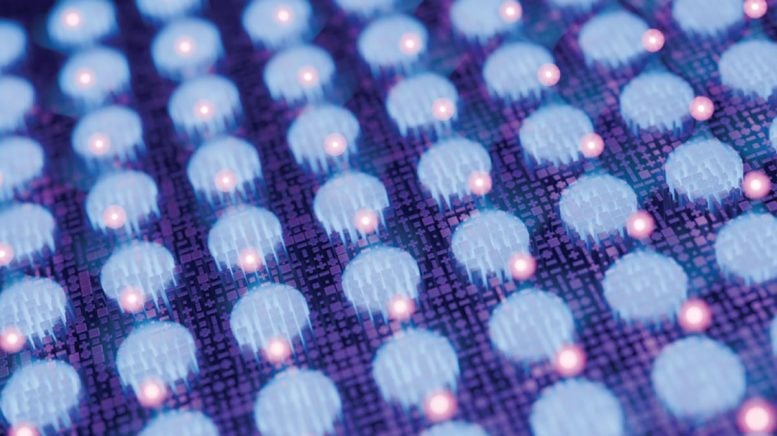
The breakthrough by Columbia University’s Sebastian Will and his team could change that. Their innovative approach leverages optical tweezers—highly focused laser beams that can manipulate individual atoms—paired with metasurfaces, ultra-thin optical devices that can shape and control light with unprecedented precision. This combination allows for the simultaneous trapping and control of thousands of atoms, each of which can serve as a qubit.
“This is a game-changer,” said Will, whose research was published in the journal Nature. “By scaling up the number of qubits, we’re not just improving quantum computers—we’re fundamentally expanding what they can achieve. This could unlock solutions to problems in cryptography, drug discovery, climate modeling, and beyond.”
The implications of this discovery are staggering. A quantum computer with 100,000 qubits could simulate complex molecular interactions with unparalleled accuracy, revolutionizing fields like materials science and pharmaceuticals. It could also crack encryption codes that currently secure global communications, spurring advancements in cybersecurity. Moreover, such systems could optimize logistics, financial modeling, and artificial intelligence in ways that were previously unimaginable.
The team’s method is not just about increasing numbers; it’s also about precision and scalability. Optical tweezers have long been used in quantum experiments, but their integration with metasurfaces represents a significant leap forward. Metasurfaces enable the creation of intricate light patterns that can trap and manipulate atoms with extraordinary accuracy, reducing errors and increasing the stability of qubits. This stability is crucial for maintaining quantum coherence—the delicate state that allows qubits to perform complex calculations.
While the current experiment successfully trapped over 1,000 atoms, the researchers believe their technique could be scaled to handle hundreds of thousands of qubits. This scalability is a critical step toward building quantum computers that can truly rival classical systems in both power and practicality.
The announcement has sent ripples through the tech community, with experts hailing it as a pivotal moment in the race to achieve quantum supremacy. “This is the kind of innovation that could accelerate the timeline for practical quantum computing by years, if not decades,” said Dr. Emily Chen, a quantum computing researcher at MIT who was not involved in the study.
As the world watches with bated breath, the Columbia team is already looking ahead. They plan to refine their technique, explore new materials for metasurfaces, and collaborate with industry leaders to bring their vision to life. If successful, their work could mark the beginning of a new era in computing—one where the impossible becomes possible.
Tags & Viral Phrases:
- Quantum computing breakthrough
- 100,000-qubit computers
- Optical tweezers and metasurfaces
- Sebastian Will Columbia University
- Future of computing
- Quantum supremacy
- Game-changing technology
- Revolutionary quantum tech
- Scaling up qubits
- Next-gen quantum computers
- Unlocking quantum potential
- Cryptography revolution
- Drug discovery quantum leap
- Climate modeling quantum
- AI and quantum computing
- Practical quantum computing
- Quantum coherence stability
- Tech innovation 2023
- Quantum computing race
- Metasurfaces quantum tech
,


Leave a Reply
Want to join the discussion?Feel free to contribute!