
Mesa KosmicKrisp Driver Is Coming To iOS, More Performance & Vulkan 1.4 Expected
KosmicKrisp Unleashes the Future of Vulkan on Apple Silicon with Groundbreaking Roadmap
The tech world is buzzing with excitement as LunarG’s revolutionary KosmicKrisp project continues to redefine what’s possible for Vulkan graphics on Apple hardware. What started as an ambitious vision has evolved into a powerhouse solution that’s transforming how developers approach cross-platform graphics rendering on Apple Silicon.
From Humble Beginnings to Technological Marvel
When LunarG first unveiled KosmicKrisp last year, it was positioned as a novel approach to bring Vulkan support to macOS through Apple’s Metal API. The concept was elegantly simple yet technically profound: create a Vulkan implementation that leverages Metal’s capabilities rather than trying to force traditional graphics APIs onto Apple’s ecosystem.
The initial focus on macOS made perfect sense, given Apple’s dominant position in the creative professional market. However, what’s truly remarkable is how quickly this project has evolved from a proof-of-concept into a mature, production-ready solution that’s now fully integrated into the Mesa graphics stack.
The Apple Silicon Advantage
KosmicKrisp represents a fundamental shift in how we think about graphics on Apple Silicon. Unlike previous attempts that tried to bridge incompatible architectures, KosmicKrisp was designed from the ground up specifically for Apple’s M-series chips. This architectural alignment means the implementation can take full advantage of Apple Silicon’s unique capabilities, from unified memory architecture to the Neural Engine’s computational power.
The decision to focus exclusively on Apple Silicon rather than maintaining compatibility with Intel hardware might seem limiting at first glance, but it’s actually a brilliant strategic move. By eliminating the need to support legacy architectures, the KosmicKrisp team can optimize every aspect of the implementation for modern hardware, resulting in performance that simply wouldn’t be possible with a one-size-fits-all approach.
The Google Connection: Android Emulator Gets a Major Boost
One of the most fascinating aspects of KosmicKrisp’s development is its connection to Google’s Android Emulator project. The fact that much of this work has been funded by Google speaks volumes about the project’s importance in the broader tech ecosystem. For developers working on cross-platform applications, having a high-performance Vulkan implementation on macOS means they can test and develop Android applications with unprecedented fidelity and performance.
This partnership between LunarG and Google represents a perfect example of how open-source collaboration can create solutions that benefit the entire industry. The Android Emulator on Mac has historically been a pain point for developers, often suffering from performance issues that made testing cumbersome. KosmicKrisp promises to change all that, potentially making MacBooks the preferred development platform for Android applications.
The Coexistence Strategy: KosmicKrisp Meets MoltenVK
Perhaps one of the most interesting revelations from Richard S. Wright Jr’s presentation was the discussion of how KosmicKrisp coexists with MoltenVK on macOS. For those unfamiliar, MoltenVK has been the go-to solution for Vulkan on Apple platforms for years, but it was primarily designed to support Intel hardware and older macOS versions.
The dual-implementation approach is actually quite clever. Developers who need to support a wide range of Apple hardware can use MoltenVK for Intel machines while taking advantage of KosmicKrisp’s superior performance on Apple Silicon. This flexibility ensures that applications can maintain broad compatibility while still delivering optimal performance on modern hardware.
The Roadmap: What’s Coming Next
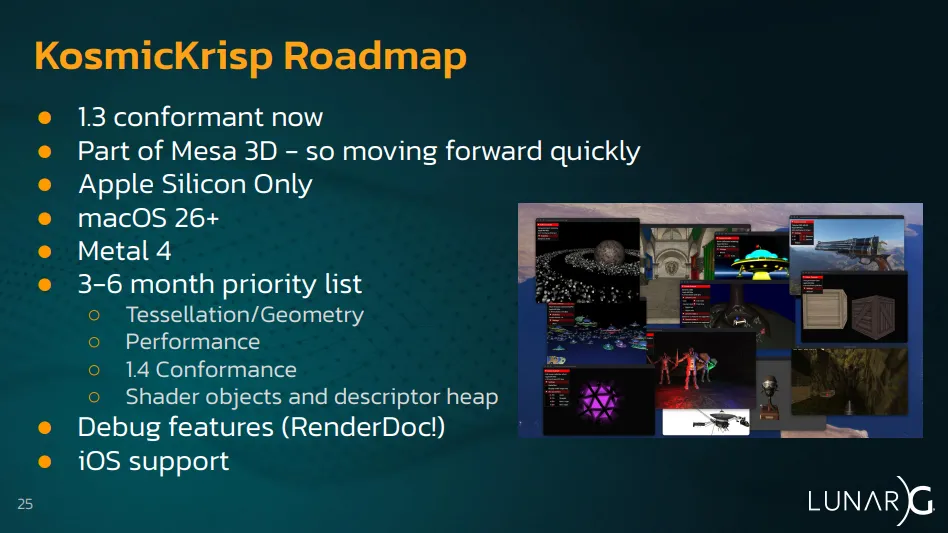
The roadmap unveiled at Vulkanised 2026 reveals an ambitious set of goals that will push KosmicKrisp even further into the spotlight. Over the next six months, the team is focusing on several critical areas that will significantly enhance the implementation’s capabilities.
Tessellation and Geometry Support
The addition of tessellation and geometry shader support represents a major milestone for KosmicKrisp. These features are essential for modern game engines and professional graphics applications that rely on advanced rendering techniques. The inclusion of this support means that KosmicKrisp will be able to handle the most demanding graphics workloads, from AAA game development to complex scientific visualization.
Performance Optimizations
While KosmicKrisp already delivers impressive performance, the team isn’t resting on their laurels. The planned optimizations will likely focus on reducing draw call overhead, improving memory management, and better utilizing Apple Silicon’s hardware acceleration features. These improvements could result in performance gains that make Apple Silicon even more attractive for graphics-intensive applications.
Vulkan 1.4 Conformance
Achieving full Vulkan 1.4 conformance is crucial for KosmicKrisp’s long-term success. This compliance ensures that applications written to the Vulkan specification will work correctly and predictably on Apple hardware. As more developers adopt Vulkan as their primary graphics API, having a conformant implementation becomes increasingly important.
Shader Objects and Descriptor Heap Support
These advanced features are particularly exciting for developers working on complex graphics applications. Shader objects provide more flexibility in how shaders are managed and compiled, while descriptor heaps offer more efficient ways to handle resources in graphics pipelines. Together, these features will enable developers to create more sophisticated and performant applications.
iOS Support: The Next Frontier
Perhaps the most exciting aspect of the roadmap is the planned expansion to iOS. Bringing KosmicKrisp to Apple’s mobile platform opens up entirely new possibilities for mobile game development and graphics applications. iOS devices, particularly the latest iPad Pro models with M-series chips, have impressive graphics capabilities that have been somewhat underutilized due to API limitations.
The addition of iOS support could transform how developers approach mobile graphics, potentially making Vulkan the standard API for high-performance mobile applications on Apple devices.
Enhanced Debug Features
The focus on improved debugging capabilities demonstrates LunarG’s commitment to making KosmicKrisp a professional-grade tool. Better debugging tools mean developers can identify and resolve issues more quickly, leading to more stable and performant applications.
The Broader Impact on the Tech Ecosystem
KosmicKrisp’s success has implications that extend far beyond just Apple hardware. By providing a high-performance, conformant Vulkan implementation, it helps solidify Vulkan’s position as a truly cross-platform graphics API. This is particularly important as the industry moves toward more heterogeneous computing environments where applications need to run seamlessly across different hardware architectures.
The project also showcases the power of open-source development in solving complex technical challenges. What began as a specialized solution for a specific platform has grown into a technology that benefits developers across the entire ecosystem.
Looking Ahead: A Bright Future for Vulkan on Apple
As KosmicKrisp continues to evolve, it’s clear that LunarG’s investment in this technology is paying off in significant ways. The combination of Apple Silicon’s impressive hardware capabilities with a purpose-built Vulkan implementation creates a compelling platform for graphics development.
The next year promises to be particularly exciting as the team works through their ambitious roadmap. With iOS support on the horizon and continued performance improvements, KosmicKrisp is well-positioned to become the de facto standard for Vulkan on Apple platforms.
Video Presentation and Further Resources
For those wanting to dive deeper into the technical details, Richard S. Wright Jr’s presentation from Vulkanised 2026 provides an excellent overview of KosmicKrisp’s current capabilities and future direction. The embedded video and accompanying slide deck offer valuable insights for developers interested in leveraging this technology.
Tags: #KosmicKrisp #Vulkan #AppleSilicon #Mesa #LunarG #Graphics #Metal #iOS #macOS #GameDevelopment #CrossPlatform #OpenSource #Technology #Innovation #Performance #FutureTech
Viral Sentences: KosmicKrisp is revolutionizing Vulkan on Apple Silicon, Google funding brings Android Emulator to new heights, Apple Silicon exclusive design means unmatched performance, iOS support coming soon will transform mobile gaming, tessellation and geometry shaders unlock next-gen graphics, Vulkan 1.4 conformance ensures future-proof compatibility, shader objects and descriptor heaps enable cutting-edge applications, MoltenVK coexistence strategy provides perfect compatibility solution, LunarG’s roadmap reveals ambitious vision for graphics future, open-source collaboration creates industry-wide benefits, M-series chips finally get their perfect graphics companion, developers rejoice as debugging tools get major upgrade, cross-platform development just got a whole lot easier, professional graphics applications find their Apple home, tech ecosystem transformed by purpose-built implementation, performance optimizations promise to shatter expectations, mobile graphics revolution begins with iOS expansion, AAA game developers gain powerful new tool, scientific visualization reaches new levels of fidelity, heterogeneous computing made simple with Vulkan standard.
,

Leave a Reply
Want to join the discussion?Feel free to contribute!