
Moons Around Rogue Planets Could Have The Conditions to Support Life : ScienceAlert
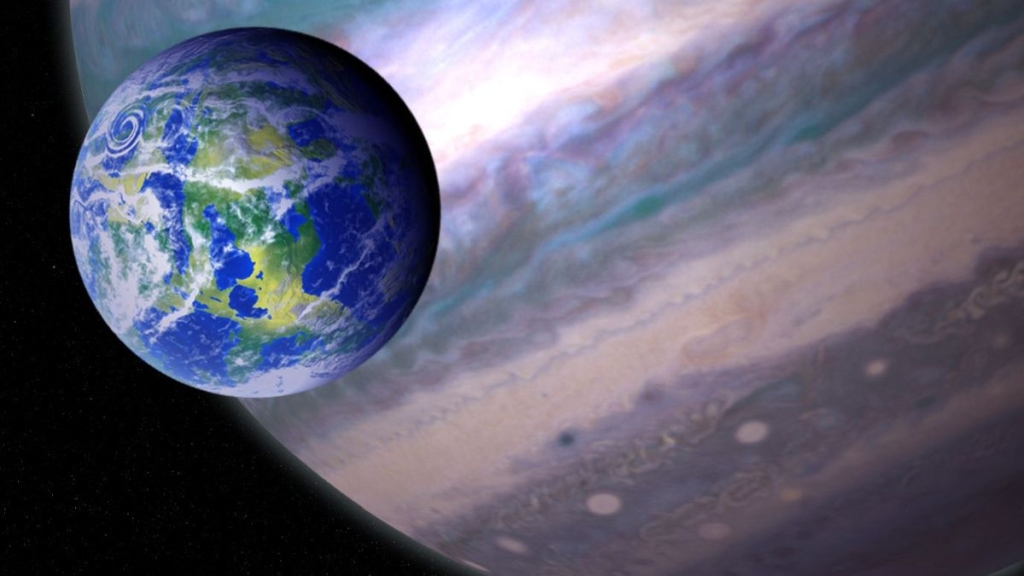
Title: Rogue Planets’ Hidden Gems: Moons That Could Host Life for Billions of Years
In the vast, cold expanse of interstellar space, where stars are absent and darkness reigns, a groundbreaking study has unveiled a stunning possibility: rogue planets—worlds untethered from any star—may harbor moons capable of sustaining life for billions of years. This revelation challenges our understanding of habitability and opens a new frontier in the search for extraterrestrial life.
The research, led by astrophysicist David Dahlbüdding of the Max Planck Institute for Extraterrestrial Physics in Germany, delves into the potential of exomoons—moons orbiting planets outside our solar system. These moons, drifting alongside their rogue planet hosts, could maintain liquid water, a fundamental prerequisite for life, thanks to a unique combination of factors.
At the heart of this discovery is the interplay between a thick hydrogen atmosphere and internal heating generated by tidal forces. As a rogue planet ejects from its star’s orbit, its gravitational interaction with its moon creates tidal stresses. These stresses generate heat within the moon, which, when trapped by a dense hydrogen atmosphere, could create conditions warm enough to sustain liquid water for up to 4.3 billion years. This duration is nearly as long as Earth’s current age, providing ample time for complex life to emerge, evolve, and thrive.
“This discovery draws a fascinating parallel to early Earth, where asteroid impacts may have created the conditions for life,” Dahlbüdding explains. The study suggests that these distant moons could serve as cosmic laboratories, offering insights into the origins and resilience of life in the universe.
Rogue planets themselves are not considered ideal candidates for hosting life. Without a star to provide warmth, they are frigid and inhospitable. However, the presence of a moon changes the equation. The moon’s orbit, altered during the planet’s ejection from its star, becomes more elliptical, intensifying tidal forces and generating internal heat. This heat, combined with a hydrogen-rich atmosphere, creates a greenhouse effect that traps warmth, potentially allowing liquid water to persist.
The choice of hydrogen as the primary atmospheric component is crucial. Unlike carbon dioxide, which condenses in extremely cold environments and allows heat to escape, hydrogen remains gaseous even in the harshest conditions. Under high pressure, hydrogen molecules collide and form complexes that absorb and trap thermal radiation, effectively maintaining a stable, warm environment.
This finding builds on previous research that explored the habitability of exomoons with carbon dioxide atmospheres. While carbon dioxide can sustain liquid water for up to 1.6 billion years, it falls short of the time required for the evolution of complex life. Earth, for instance, took nearly 3 billion years to develop multicellular organisms. Hydrogen, however, extends this window to 4.3 billion years, significantly increasing the likelihood of life’s emergence and development.
The implications of this study are profound. It suggests that life could exist in environments far removed from the traditional “habitable zones” around stars. Rogue planets and their moons could represent a vast, untapped reservoir of potential life in the universe. With trillions of rogue planets estimated to exist in the Milky Way alone, the possibilities are staggering.
Yet, many questions remain. While the study provides a compelling theoretical framework, detecting and studying these exomoons presents significant challenges. Current technology is not yet capable of probing the atmospheres of these distant worlds. However, future advancements in telescopic and observational techniques may bring us closer to confirming their existence and habitability.
As Dahlbüdding and his team note, “In future work, we will explore habitable configurations beyond a hydrogen-dominated atmosphere and test whether they are stable and can trap sufficient heat.” This ongoing research promises to deepen our understanding of the conditions necessary for life and expand the boundaries of where we might find it.
The findings, published in the Monthly Notices of the Royal Astronomical Society, mark a significant step forward in astrobiology and planetary science. They remind us that the universe is full of surprises and that the search for life must extend beyond the familiar confines of star systems. Rogue planets and their moons may hold the key to unlocking some of the most profound mysteries of existence.
Tags: rogue planets, exomoons, habitability, interstellar space, hydrogen atmosphere, tidal heating, liquid water, astrobiology, extraterrestrial life, cosmic exploration.
Viral Sentences:
- “Rogue planets could host life for billions of years—no star required!”
- “Moons drifting in the void might be the universe’s best-kept secret for life.”
- “Hydrogen atmospheres: the key to unlocking life in the darkest corners of space.”
- “From chaos to cosmos: how rogue planets could harbor thriving ecosystems.”
- “The universe just got a lot more interesting—and habitable!”
,


Leave a Reply
Want to join the discussion?Feel free to contribute!