
Moore Threads unveils new Huagang GPU architecture at MUSA Developer Conference · TechNode
Moore Threads Unveils Huagang Architecture at MUSA Conference, Paving the Way for AI and HPC Dominance
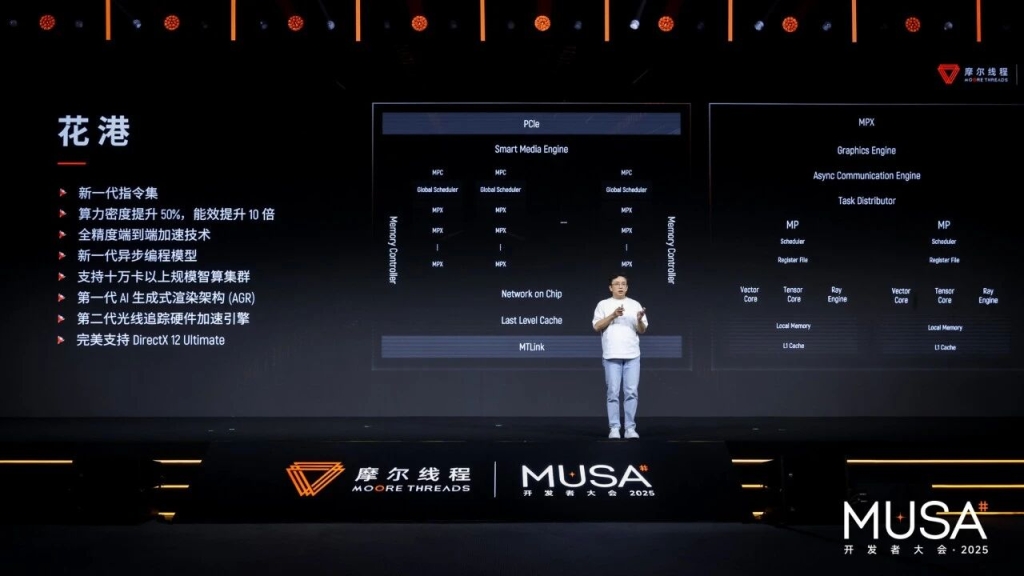
In a bold move to cement its position in the global AI and high-performance computing (HPC) landscape, Chinese chipmaker Moore Threads has unveiled its next-generation GPU architecture, Huagang, at its inaugural MUSA developer conference. The announcement, made on Saturday, marks a significant milestone for the company as it seeks to challenge established players in the GPU market with cutting-edge technology and ambitious scalability goals.
The Huagang architecture is designed to deliver unparalleled performance and efficiency, supporting full-precision computing across a wide range of formats, from FP4 to FP64. This versatility ensures that the architecture can handle a diverse array of workloads, from AI training and inference to complex scientific simulations. According to Moore Threads, the Huagang architecture achieves a 50% increase in compute density compared to its predecessors, while simultaneously improving energy efficiency by an impressive tenfold. These advancements position the architecture as a formidable contender in the race for AI and HPC supremacy.
At the heart of the Huagang architecture lies Moore Threads’ self-developed MTLink high-speed interconnect technology. This innovative solution enables the architecture to scale seamlessly to intelligent computing clusters of up to 100,000 GPUs. Such scalability is critical for meeting the demands of large-scale AI and HPC applications, where massive parallelism and low-latency communication are essential. By leveraging MTLink, Moore Threads aims to provide a robust and efficient platform for enterprises and researchers seeking to push the boundaries of computational power.
In addition to the Huagang architecture, Moore Threads also introduced two new chips based on this groundbreaking design. The first, Huashan, is an integrated processor tailored for AI training and inference tasks. With its focus on AI workloads, Huashan is poised to become a key enabler for enterprises looking to deploy advanced machine learning models at scale. The second chip, Lushan, is a graphics rendering chip designed to deliver exceptional visual performance for gaming, simulation, and other graphics-intensive applications. Together, these chips represent a comprehensive ecosystem that addresses the diverse needs of modern computing.
The unveiling of the Huagang architecture and its accompanying chips comes at a time when the global demand for AI and HPC solutions is surging. As industries across the board—from healthcare and finance to automotive and entertainment—increasingly rely on AI-driven insights and high-performance simulations, the need for powerful and efficient computing platforms has never been greater. Moore Threads’ latest innovations position the company as a key player in this rapidly evolving landscape, offering solutions that combine cutting-edge performance with scalability and energy efficiency.
Moreover, the company’s focus on developing proprietary technologies, such as the MTLink interconnect, underscores its commitment to reducing reliance on foreign suppliers and fostering technological independence. This approach aligns with broader trends in China’s tech industry, where domestic innovation is increasingly seen as a strategic imperative. By pushing the boundaries of GPU architecture and delivering solutions that rival those of established global players, Moore Threads is not only advancing its own ambitions but also contributing to the growth of China’s semiconductor ecosystem.
As the MUSA developer conference showcased, Moore Threads is not just a chipmaker—it is a visionary company with a clear roadmap for the future of computing. The Huagang architecture, with its impressive performance metrics and scalability, is a testament to the company’s engineering prowess and its ability to deliver solutions that meet the demands of tomorrow’s AI and HPC applications. With the launch of Huashan and Lushan, Moore Threads has further solidified its position as a comprehensive provider of computing solutions, catering to both the AI and graphics markets.
Looking ahead, the success of the Huagang architecture will depend on its adoption by developers, enterprises, and researchers. Moore Threads’ ability to build a robust ecosystem around its technology—through software tools, developer support, and strategic partnerships—will be critical in driving widespread adoption. As the company continues to innovate and expand its offerings, it is poised to play a pivotal role in shaping the future of AI and HPC.
In conclusion, the unveiling of the Huagang architecture at the MUSA developer conference represents a significant leap forward for Moore Threads and the broader Chinese tech industry. With its focus on performance, efficiency, and scalability, the architecture is well-positioned to meet the growing demands of AI and HPC applications. As Moore Threads continues to push the boundaries of what is possible in GPU technology, it is clear that the company is a force to be reckoned with in the global tech arena.
#MooreThreads #Huagang #GPUArchitecture #AI #HPC #MTLink #Huashan #Lushan #TechInnovation #ChineseTech #Semiconductors #ComputingPower #DeveloperConference #FutureOfAI #HighPerformanceComputing #TechNews #Innovation #TechTrends,


Leave a Reply
Want to join the discussion?Feel free to contribute!