
More ISA Differences Come To Light With The New AMD GFX1170 “RDNA 4m”
AMD’s GFX1170 Target in LLVM Reveals RDNA 4m’s Growing Identity as a Mobile-First Graphics Architecture
In a development that’s sending ripples through the open-source graphics community, AMD’s GFX1170 GPU target—first spotted earlier this month in the AMDGPU LLVM backend—has begun to reveal its true nature as a mobile-optimized variant of RDNA 4, now officially tagged as “RDNA 4m.” What started as a modest set of feature additions has rapidly evolved into a clearer picture of AMD’s strategy for its next-generation mobile graphics architecture.
The Evolution of GFX1170: From Curiosity to Clarity
When the GFX1170 target first appeared in the AMDGPU LLVM backend, it was marked as an APU/SoC part belonging to the GFX11 series—the family traditionally associated with RDNA3 graphics. However, the “RDNA 4m” designation immediately raised eyebrows among developers and enthusiasts alike. Was this merely marketing terminology, or did it signal something more substantive about AMD’s mobile graphics roadmap?
The answer appears to be increasingly leaning toward the latter. Recent commits to the LLVM project have introduced a series of instruction set architecture (ISA) changes that are pushing GFX1170 further away from its RDNA3 roots and closer to the RDNA4 specification found in the GFX12 series.
WMMA and SWMMAC Instructions: The AI/ML Connection
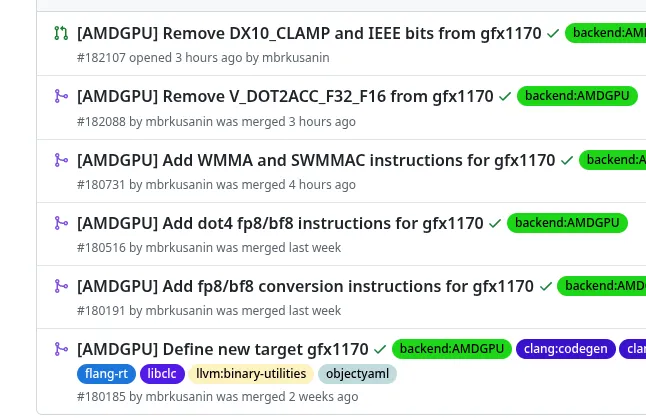
The most significant recent development came with the addition of new WMMA (Wave Matrix Multiply Accumulate) and SWMMAC instructions specifically for the GFX1170 target. These instructions, merged just today, introduce WMMA128bInsts that differentiate GFX1170 and GFX12 from the existing WMMA256bInsts used by GFX11.
This architectural distinction is far from trivial. WMMA instructions are crucial for matrix multiplication operations, which form the backbone of modern AI and machine learning workloads. By aligning GFX1170’s capabilities more closely with RDNA4’s instruction set, AMD appears to be positioning its mobile graphics solutions for the AI/ML workloads that are increasingly demanding on both desktop and mobile platforms.
The separation of these instruction sets also suggests that AMD is treating GFX1170 as a distinct architecture rather than a simple derivative of RDNA3, despite its placement in the GFX11 family. This architectural clarity will likely benefit developers who need to optimize their code for specific hardware capabilities.
The Dot Product Departure: Streamlining for Mobile
In another telling move, the V_DOT2ACC_F32_F16 instruction has been dropped from the GFX1170 series. This instruction, used for the dot product of packed FP16 values with accumulation to a destination, was already removed from RDNA4. Now, GFX1170 is following suit, further cementing its alignment with the RDNA4 instruction set.
The removal of this instruction from mobile-focused hardware makes sense from a power efficiency standpoint. Mobile GPUs operate under strict thermal and power constraints, and streamlining the instruction set by removing less commonly used operations can lead to more efficient silicon implementation and better performance per watt.
IEEE and DirectX 10 Compatibility: Modern Standards for Modern Hardware
An open merge request, filed just hours ago, proposes dropping both the DX10_CLAMP and IEEE bits from the GFX1170 series. The amdgpu-ieee mode, which specifies whether functions expect the IEEE field of the mode register to be set, and the amdgpu-dx10-clamp mode, which handles DirectX 10 behavior around NaN (Not a Number) values in vector ALU operations, are both being phased out.
RDNA4 had already dropped DX10_CLAMP support, and now GFX1170 is following this modern approach. This shift away from legacy DirectX 10 compatibility modes reflects AMD’s focus on contemporary graphics APIs and standards, which is particularly relevant for mobile devices that typically run newer operating systems and applications.
What This Means for the Future of Mobile Graphics
The cumulative effect of these changes paints a picture of GFX1170 as a genuinely distinct mobile-first architecture rather than a rebranded or slightly modified version of existing technology. The instruction set refinements, the focus on AI/ML capabilities through WMMA improvements, and the shedding of legacy compatibility modes all point toward hardware designed from the ground up for modern mobile computing workloads.
However, one significant question remains unanswered: which APUs and SoCs will actually feature this RDNA 4m graphics IP? AMD has been notably quiet about specific product plans, leaving enthusiasts and industry watchers to speculate about potential applications in everything from mainstream laptops to handheld gaming devices and possibly even smartphones.
The mobile graphics market is becoming increasingly competitive, with Intel’s integrated graphics making significant strides and ARM-based competitors like Apple’s M-series chips setting new performance benchmarks. AMD’s RDNA 4m strategy through GFX1170 could be a crucial element in maintaining competitiveness in this space, particularly if it delivers the promised improvements in power efficiency and AI/ML performance that mobile computing increasingly demands.
As the LLVM backend continues to evolve and more details emerge about GFX1170’s capabilities, the graphics community will be watching closely to see how this mobile-focused architecture performs in real-world applications and which devices will be the first to showcase its capabilities.
Tags: #AMD #RDNA4m #GFX1170 #LLVM #MobileGraphics #AI #ML #WMMA #SWMMAC #GPUArchitecture #APU #SoC #OpenSource #Graphics #Gaming #Performance #Efficiency
Viral Sentences:
- AMD’s GFX1170 is not just RDNA3 with a new coat of paint—it’s RDNA 4m in the making!
- Mobile graphics just got a serious upgrade with AMD’s WMMA128bInsts for AI workloads
- The future of mobile computing is here, and it’s powered by AMD’s RDNA 4m architecture
- Goodbye legacy, hello efficiency: AMD drops DX10_CLAMP and IEEE bits from GFX1170
- GFX1170’s ISA changes reveal AMD’s master plan for next-gen mobile graphics
- RDNA 4m is coming to mobile, and it’s bringing AI/ML capabilities that will blow your mind
- AMD’s mobile graphics revolution is quietly happening in the LLVM backend
- GFX1170 proves that mobile doesn’t mean compromise when it comes to graphics performance
- The instruction set wars are heating up, and AMD’s RDNA 4m is ready for battle
- Mobile gamers, rejoice! AMD’s RDNA 4m is optimized for your favorite pastime
- GFX1170’s WMMA improvements could be the key to unlocking mobile AI’s true potential
- AMD’s strategic move to align GFX1170 with RDNA4 shows they’re serious about mobile dominance
- The dot product may be gone, but GFX1170’s efficiency gains are here to stay
- LLVM developers are the unsung heroes making RDNA 4m a reality for millions of mobile users
- GFX1170 is proof that sometimes the biggest innovations happen behind the scenes in open-source code
,


Leave a Reply
Want to join the discussion?Feel free to contribute!