
Museums incorporate “scent of the afterlife” into Egyptian exhibits
Ancient Egyptian Embalming Secrets Unearthed: Scientists Recreate the Scent of Eternity
In a groundbreaking fusion of archaeology and modern perfumery, researchers have successfully reconstructed the scent used in ancient Egyptian embalming rituals—offering a breathtaking sensory bridge to one of history’s most fascinating civilizations.
The Science Behind the Scent
A team of interdisciplinary scientists, led by archaeologist Barbara Huber, has achieved what many thought impossible: capturing the olfactory essence of ancient Egyptian mummification practices. By analyzing residue samples from canopic jars and embalming vessels, the team identified a complex cocktail of ingredients that formed the sacred fragrance used to prepare pharaohs and nobility for their journey to the afterlife.
The chemical analysis revealed an extraordinary blend of materials: beeswax, plant oils, animal fats, bitumen (a naturally occurring petroleum substance), and resins from coniferous trees including pines and larches. The fragrance profile was further enriched with vanilla-scented coumarin—found in cinnamon and pea plants—and benzoic acid, common in fragrant resins and gums derived from trees and shrubs.
“This wasn’t just any scent,” explains Huber. “The resulting fragrance combined a strong pine-like woody scent of the conifers, mixed in with a sweeter undertone of the beeswax and the strong smoky scent of the bitumen.”
From Laboratory to Museum Experience
What makes this discovery particularly revolutionary is how the team translated their findings into an immersive museum experience. Working with renowned perfumer Carole Calvez, they developed a systematic workflow for incorporating authentic ancient scents into modern exhibitions.
“The real challenge lies in imagining the scent as a whole,” Calvez notes. “Biomolecular data provide essential clues, but the perfumer must translate chemical information into a complete and coherent olfactory experience that evokes the complexity of the original material, rather than just its individual components.”
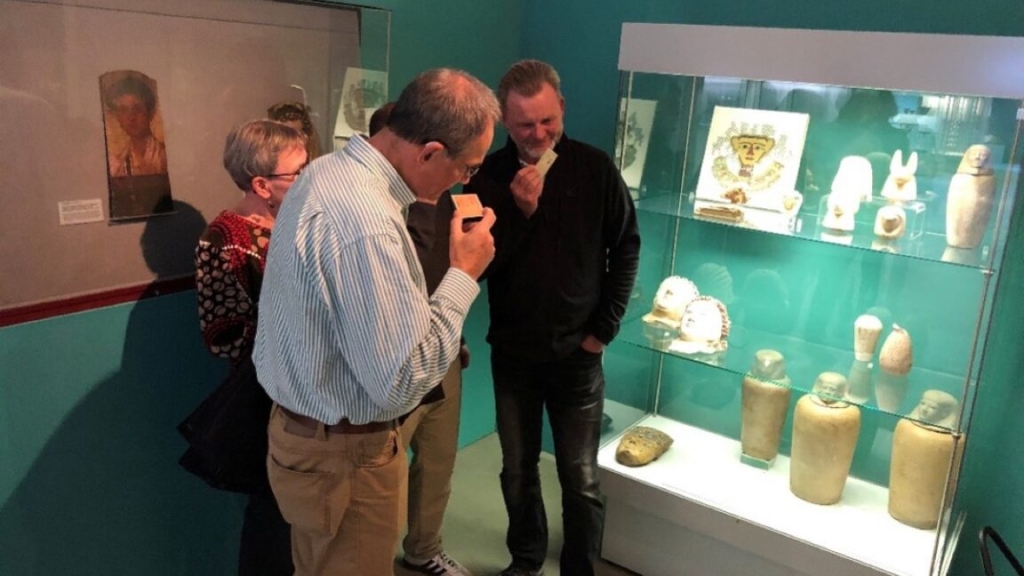
The team created two innovative delivery methods for museum settings. First, they developed portable scented cards distributed during guided tours at the Museum August Kestner in Hanover, Germany. These cards allowed visitors to experience the ancient fragrance while learning about the artifacts and embalming practices.
More ambitiously, they constructed a permanent scent station at the Moesgaard Museum in Aarhus, Denmark. This installation represents a paradigm shift in how museums engage visitors, moving beyond visual and textual information to create a truly multi-sensory historical experience.
“The scent station transformed how visitors understood embalming,” says Steffen Terp Laursen, curator at Moesgaard Museum. “Smell added an emotional and sensory depth that text labels alone could never provide.”
Cultural and Historical Significance
This research represents far more than a novel museum exhibit. The ability to recreate ancient scents offers unprecedented insights into Egyptian cultural practices and beliefs. The specific combination of ingredients wasn’t arbitrary—each component held symbolic and practical significance in Egyptian cosmology.
Bitumen, with its preservative properties and distinctive aroma, was associated with the protective qualities needed for the deceased’s journey. The coniferous resins symbolized eternal life, while beeswax represented purity and transformation. The careful balance of these elements reflects the Egyptians’ sophisticated understanding of both chemistry and spirituality.
The research also demonstrates how modern scientific techniques can breathe new life into ancient practices. Advanced analytical methods, including gas chromatography and mass spectrometry, allowed researchers to identify trace compounds that had survived thousands of years, providing chemical fingerprints of long-lost rituals.
Future Applications and Implications
This pioneering work opens exciting possibilities for archaeological research and museum curation. The methodology developed by Huber and her team could be applied to other ancient cultures and practices, potentially reconstructing lost perfumes, incenses, and ritual scents from civilizations across the globe.
For museums, this represents a powerful new tool for engagement. As institutions increasingly compete for visitor attention in the digital age, multi-sensory experiences offer compelling ways to connect people with history. The emotional impact of smell—directly linked to memory and emotion in the human brain—creates lasting impressions that visual displays alone cannot achieve.
The research also has implications for our understanding of ancient trade networks. The ingredients used in Egyptian embalming came from across the Mediterranean and beyond, suggesting sophisticated trade relationships and cultural exchanges that shaped the ancient world.
Technical Details and Publication
The team’s findings were published in the journal Frontiers in Environmental Archaeology, with the workflow methodology detailed in a paper outlining their efficient process for museums to incorporate scents into exhibits. A companion study in the Journal of Archaeological Science provided additional chemical analysis of the embalming residues.
DOI: 10.3389/fearc.2025.1736875
DOI: 10.1016/j.jas.2026.106490
The Scent of Eternity
What began as a scientific investigation into ancient embalming practices has evolved into something far more profound—a sensory time machine that allows modern humans to breathe in the same air that surrounded Egypt’s greatest pharaohs as they embarked on their eternal journey.
This achievement reminds us that history isn’t just something to be studied; it’s something to be experienced. Through the careful work of scientists, perfumers, and museum professionals, the ancient Egyptians have shared one of their most sacred secrets, allowing us to literally inhale a piece of eternity.
As visitors around the world encounter these recreated scents, they’re not just learning about history—they’re smelling it, feeling it, and connecting with it in ways that transcend time and culture. In the end, perhaps the most remarkable aspect of this discovery is how it transforms our relationship with the past, making ancient Egypt not just visible, but vividly, memorably alive.
Tags: Ancient Egypt, embalming, mummification, archaeology, scent reconstruction, museum innovation, sensory experience, historical research, perfumery, cultural heritage, scientific breakthrough, Egyptian afterlife, biomolecular analysis, immersive exhibits, historical preservation, ancient technology, museum curation, olfactory archaeology, Egyptian rituals, eternal fragrance
Viral Phrases: “Smell the past like never before,” “Breathe in eternity,” “The scent that preserved pharaohs,” “From lab to nose: ancient Egypt comes alive,” “Science meets soul in Egyptian fragrance breakthrough,” “Experience history through your nose,” “The aroma of immortality,” “When chemistry meets culture,” “Egyptian secrets unlocked through scent,” “The fragrance that defied time,” “Archaeological innovation that literally smells amazing,” “Museum experience revolutionized by ancient aroma,” “The smell of the afterlife revealed,” “Egyptian embalming secrets finally unveiled,” “Scent of the pharaohs discovered,” “Ancient fragrance recreated after 3,000 years,” “The nose knows: Egyptian history comes alive,” “From canopic jars to your nostrils,” “The aromatic journey to eternity,” “Egyptian mystery solved through smell,” “The fragrance that bridged millennia,” “Scent of eternity captured in modern museum,” “Egyptian embalming decoded through chemistry,” “The smell that saved souls,” “Ancient aroma recreated for modern noses,” “The fragrance of pharaohs finally revealed,” “Egyptian secrets unveiled through scent,” “The smell of immortality,” “Egyptian embalming fragrance reconstructed,” “The scent that preserved history,” “Egyptian afterlife aroma recreated,” “The smell that transcended time,” “Egyptian fragrance mystery solved,” “The scent of eternal life,” “Egyptian embalming secrets revealed through smell,” “The fragrance that defied death,” “Egyptian aroma reconstructed after millennia,” “The scent that connected civilizations,” “Egyptian embalming fragrance decoded,” “The smell that preserved pharaohs,” “Egyptian afterlife scent recreated,” “The fragrance that bridged ancient and modern,” “Egyptian embalming aroma unveiled,” “The scent that told ancient stories,” “Egyptian fragrance secrets revealed,” “The smell that connected us to eternity,” “Egyptian embalming fragrance reconstructed for modern experience.”
,


Leave a Reply
Want to join the discussion?Feel free to contribute!