
Mysterious Stone in US Backyard Turned Out to Be an Archaeological Treasure : ScienceAlert
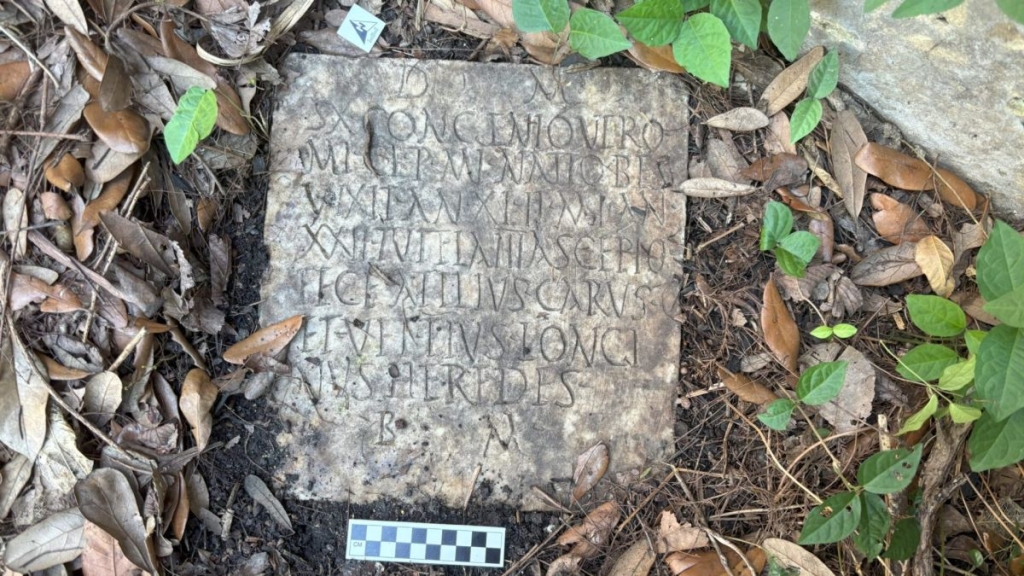
In the heart of New Orleans, where jazz notes linger in the air and Spanish moss drapes over centuries-old oaks, an archaeological discovery has shaken the world of history and mystery alike. What began as a routine backyard renovation turned into an extraordinary journey across time, continents, and war-torn history. A seemingly ordinary marble slab, half-buried beneath tangled vines and forgotten debris, has revealed itself to be a 2,000-year-old Roman funerary stone—an artifact that once honored a Thracian soldier who served in the mighty legions of ancient Rome.
The story unfolds in the historic Carrollton neighborhood, where anthropologist Daniella Santoro and her husband Aaron Lopez were tending to their garden, hoping to breathe new life into a space long neglected by time. As they cleared away the overgrowth, their shovels struck something solid—something that didn’t belong in a New Orleans backyard. There, half-buried and cloaked in earth, lay a marble tablet etched with Latin inscriptions. The words “Dis Manibus”—”to the spirits of the dead”—immediately caught Santoro’s trained eye, sending a shiver down her spine. For a moment, she wondered if they had stumbled upon an old grave, a relic of some forgotten burial ground.
But this was no ordinary grave marker. The Latin text, carefully carved into the stone, told a story that spanned nearly two millennia. It commemorated Sextus Congenius Verus, a Thracian soldier who served 22 years in the Roman legions before his death at the age of 42. Commissioned by his heirs, Atilius Carus and Vettius Longinus, the stone was a testament to a life lived in service to one of history’s greatest empires. Yet, how did it end up here, in a city thousands of miles from Rome, nestled in the humid embrace of Louisiana?
The mystery deepened as Santoro reached out to experts. Archaeologists Susann Lusnia of Tulane University and D. Ryan Gray of the University of New Orleans were among the first to examine the inscription. Their analysis confirmed what Santoro had suspected: this was no mere replica or decorative piece. It was an authentic Roman funerary stone, a relic of a bygone era. Further research revealed that the stone had once been part of the collection at the National Archaeological Museum of Civitavecchia, Italy, a port town where it had stood in a small cemetery for centuries.
The museum, however, was not immune to the ravages of history. During World War II, it suffered heavy damage from Allied bombing, and countless artifacts were lost or displaced. Among them was the stone honoring Sextus Congenius Verus. Its exact measurements, as recorded by the museum, matched those of the tablet found in Santoro and Lopez’s garden, confirming its identity beyond doubt.
But the question remained: how did it travel from wartime Italy to suburban Louisiana? The answer lies in the life of Charles Paddock Jr., a soldier stationed in Italy during World War II. According to Erin Scott O’Brien, the former owner of the Carrollton house, Paddock Jr. brought the stone back to the United States as a memento of his time abroad. It passed through generations, eventually finding its way into O’Brien’s possession. She, in turn, gifted it to Santoro and Lopez when they moved into the home, unaware of its true significance.
“We planted a tree and said this is the start of our new house. Let’s put it outside in our garden,” O’Brien told Preservation in Print. “I just thought it was a piece of art. I had no idea it was a 2,000-year-old relic.”
The discovery has captivated historians, archaeologists, and the public alike. It is a reminder of the enduring impact of war on cultural heritage, as well as the unexpected ways in which history can resurface in the most unlikely of places. The stone’s journey from a Roman cemetery to a New Orleans garden is a testament to the interconnectedness of human history, a thread that weaves through time and space, linking past and present in ways we are only beginning to understand.
Now, thanks to the efforts of the FBI’s Art Crime Team, the stone is set to return to its rightful home. It will be repatriated to the National Archaeological Museum of Civitavecchia, where it will once again stand as a tribute to the life and service of Sextus Congenius Verus. For Santoro, Lopez, and all those who have been touched by this story, it is a bittersweet farewell—a chance to right a historical wrong and honor the legacy of a soldier who lived and died nearly two millennia ago.
As the marble tablet prepares to embark on its final journey, it leaves behind a legacy of curiosity, discovery, and the enduring power of history to surprise and inspire. In a world where the past often feels distant and disconnected, this remarkable find serves as a poignant reminder that the echoes of history are never truly lost—they are simply waiting to be uncovered.
#RomanArtifact #NewOrleansDiscovery #Archaeology #AncientRome #HistoricalMystery #FBIArtCrime #RomanLegions #ThracianSoldier #WWIIHistory #CulturalHeritage #MarbleTablet #LatinInscription #NationalArchaeologicalMuseum #Civitavecchia #CarrolltonNeighborhood #GardenDiscovery #TimeTravel #HistoryUncovered #ArtifactRepatriation #AncientInscriptions #RomanEmpire #HistoricalJourney #UnearthingHistory #ArchaeologicalFind #LatinText #RomanSoldier #WWIIArtifacts #HistoricalArtifact #AncientHistory #CulturalDiscovery
“2,000-year-old Roman stone found in New Orleans backyard!” “Ancient artifact uncovered in suburban garden!” “Latin inscription reveals forgotten Roman soldier!” “WWII relic returns home after 80 years!” “Archaeologists stunned by backyard discovery!” “Roman tombstone travels from Italy to Louisiana!” “FBI Art Crime Team repatriates ancient artifact!” “Thracian soldier honored in New Orleans garden!” “Marble tablet tells story of Roman legionnaire!” “Historical mystery solved after decades!” “Ancient Rome meets modern New Orleans!” “Unearthing history in the most unexpected places!” “WWII soldier’s memento becomes archaeological treasure!” “Latin text bridges 2,000 years of history!” “National Archaeological Museum regains lost artifact!” “Carrollton neighborhood holds ancient secret!” “Roman funerary stone’s incredible journey!” “Anthropologists uncover backyard archaeological treasure!” “Ancient inscription captivates historians worldwide!” “Artifact’s journey from Roman cemetery to American garden!”,


Leave a Reply
Want to join the discussion?Feel free to contribute!