
NASA faces a crucial choice on a Mars spacecraft—and it must decide soon
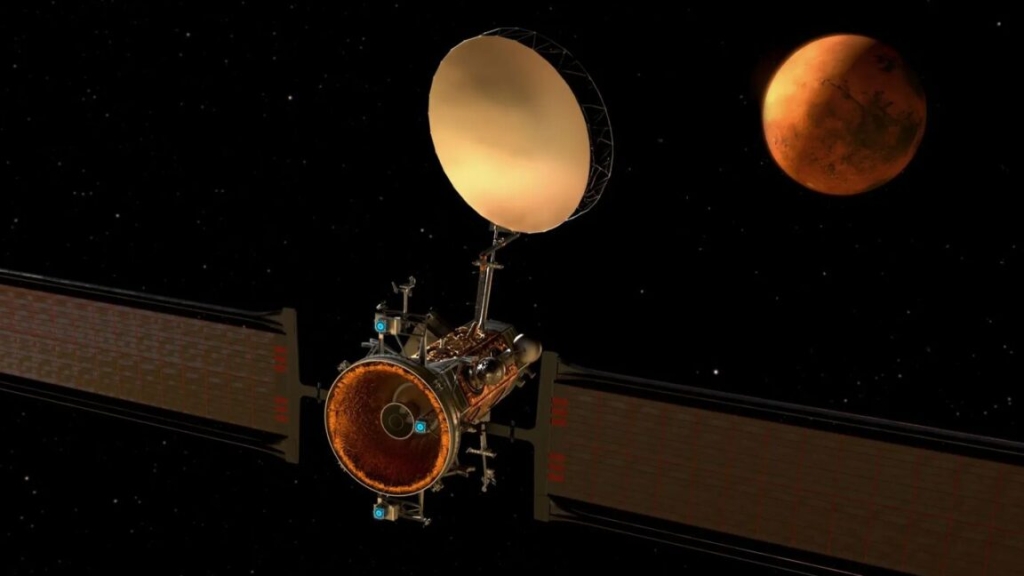
NASA’s Mars Orbiter Race Heats Up as Congress and Elon Musk’s Ally Clash Over Mission Scope
The future of Mars exploration is hanging in the balance as NASA finds itself caught between congressional directives and the vision of Jared Isaacman, President Trump’s pick to lead the agency. At the heart of the controversy is a seemingly straightforward mission: building a telecommunications orbiter for Mars. But as with most things in space policy, nothing is ever quite that simple.
Congressional Mandate vs. Scientific Ambition
Senator Ted Cruz’s legislation, which passed with bipartisan support, allocates $700 million for a Mars telecommunications orbiter to be launched by September 30, 2028. The language is clear—this is a communications satellite, plain and simple. However, this narrow interpretation has sparked a heated debate within NASA’s leadership.
Some agency officials argue that the legislation’s language specifically calls for a telecommunications orbiter only, making it “difficult, if not impossible” to run a procurement competition for anything beyond a straightforward communications satellite within the tight timeline. This interpretation would limit NASA to a single-purpose spacecraft designed primarily to relay communications between Earth and Mars missions.
NASA’s Official Stance
In response to inquiries from Ars Technica, NASA has clarified its position. “NASA will procure a high-performance Mars telecommunications orbiter that will provide robust, continuous communications for Mars missions,” a spokesperson stated. The agency emphasized its commitment to “collaborating with our commercial partners to advance deep space communications and navigation capabilities, strengthening US leadership in Mars infrastructure and the commercial space sector.”
This official position suggests NASA is leaning toward a straightforward telecommunications orbiter, at least for now. However, the situation remains fluid as key decisions loom on the horizon.
The Isaacman Factor
Jared Isaacman, the billionaire entrepreneur nominated to become NASA’s next administrator, has yet to decide whether the orbiter should include scientific instruments. This decision could fundamentally alter the mission’s scope and complexity.
Isaacman’s background as a commercial spaceflight pioneer and his close ties to Elon Musk’s SpaceX have led many to speculate that he might push for a more ambitious approach. His potential influence could expand the mission beyond pure telecommunications to include scientific payloads that would enhance our understanding of Mars.
Funding Flexibility and Options
NASA isn’t limited to the $700 million allocated in the Cruz bill. The agency’s fiscal year 2026 budget includes $110 million for unspecified “Mars Future Missions,” plus a substantial funding wedge that could support a Mars commercial payload delivery program.
This funding flexibility opens up several strategic options:
-
Single Telecom Orbiter: Stick to the congressional mandate and procure a single-purpose communications satellite from one company.
-
Enhanced Telecom Orbiter: Request a communications satellite with the capability to add scientific instruments, offering more value but potentially exceeding the original budget.
-
Multi-Orbiter Competition: Create a competitive procurement by tapping into the $700 million from the Cruz bill while augmenting it with other Mars funding sources, potentially supporting multiple orbiters with different capabilities.
Industry Response and Competition
The competitive landscape for this mission is shaping up to be intense. A recent government notice revealed that NASA plans to limit competition to vendors that satisfy the statutory qualifications outlined in the Cruz legislation. The eligible companies include:
- Blue Origin
- L3Harris
- Lockheed Martin
- Northrop Grumman
- Rocket Lab
- SpaceX
- Quantum Space
- Whittinghill Aerospace
This diverse field represents a mix of established aerospace giants and innovative newcomers, setting the stage for a high-stakes competition that could reshape the commercial space sector’s role in Mars exploration.
Timeline Pressures and Strategic Implications
With a launch deadline of September 30, 2028, time is not on NASA’s side. The agency must make critical decisions about mission scope, procurement strategy, and funding allocation within the next few months. These choices will have lasting implications for US leadership in Mars exploration and the commercial space sector’s growth.
The telecommunications orbiter represents more than just a communications relay—it’s the foundation for future Mars infrastructure. A robust communications network is essential for supporting human missions, robotic explorers, and scientific investigations on the Red Planet.
The Broader Context
This debate occurs against the backdrop of renewed interest in Mars exploration, driven by both government agencies and private companies. NASA’s Artemis program aims to return humans to the Moon as a stepping stone to Mars, while companies like SpaceX have articulated ambitious plans for Mars colonization.
The telecommunications orbiter decision could signal NASA’s broader strategy for Mars exploration. Will the agency take a conservative approach focused on immediate needs, or will it embrace a more ambitious vision that positions the US for long-term leadership in deep space exploration?
Looking Ahead
As NASA navigates this complex decision-making process, several factors will likely influence the outcome:
-
Political pressure: Congress has made its preferences clear through legislation, but NASA administrators have significant latitude in implementation.
-
Commercial interests: The eight eligible companies will undoubtedly lobby for favorable treatment and opportunities to showcase their capabilities.
-
Scientific community input: Researchers will advocate for including scientific instruments that could maximize the mission’s scientific return.
-
Budget realities: While additional funding sources exist, NASA must balance this mission against other priorities in its portfolio.
The coming weeks and months will be critical as NASA finalizes its approach to the Mars telecommunications orbiter. Whatever decision emerges will shape not only this specific mission but also the trajectory of Mars exploration for years to come.
Tags
Mars telecommunications orbiter, NASA Mars mission, Ted Cruz legislation, Jared Isaacman NASA administrator, commercial space competition, Blue Origin Mars, SpaceX Mars, Lockheed Martin space, Rocket Lab NASA contract, deep space communications, Mars infrastructure, US space leadership, 2028 Mars launch, space procurement competition, quantum space Mars, whittinghill aerospace NASA, L3Harris space systems, Northrop Grumman NASA, Mars exploration funding, commercial payload delivery
Viral Sentences
NASA’s Mars orbiter decision could define the next decade of Red Planet exploration. The $700 million congressional mandate is just the beginning of what could become a multibillion-dollar Mars infrastructure program. Jared Isaacman’s NASA leadership could mean a fundamental shift in how America approaches Mars. Eight major companies are competing for what could be the most important Mars mission since the rovers. The September 2028 deadline is creating unprecedented pressure on NASA’s procurement process. This isn’t just about communications—it’s about establishing US dominance in deep space. The telecom orbiter could be the backbone of future human missions to Mars. NASA’s funding flexibility suggests this mission might be much bigger than Congress intended. The commercial space sector is about to get its biggest Mars opportunity yet. This decision will impact everything from robotic missions to eventual human colonization of Mars.
,

Leave a Reply
Want to join the discussion?Feel free to contribute!