
NASA has shuffled its Artemis rockets. But what of the lunar landers?
NASA Rethinks Lunar Orbit Strategy as Artemis Timeline Pressures Mount
In a significant shift for NASA’s Artemis program, engineers are exploring a new, highly elliptical lunar orbit that could dramatically simplify the path from Orion to the Moon’s surface. Dubbed EPO/CoLA (Elliptic Pre-Orbit/Cislunar Low-Altitude), this orbit brings spacecraft as close as 100 kilometers above the lunar surface—less than a third of the altitude of the International Space Station above Earth—before swinging out to a distant 6,500 kilometers at its farthest point.
The orbital geometry is more than a technical curiosity. For many potential landing sites, a Human Landing System (HLS) vehicle departing from EPO/CoLA could perform a single, efficient burn to drop into a much lower orbit, shaving precious fuel and time off the journey. This orbital sweet spot could become the staging point for Artemis IV and beyond, especially as NASA looks for ways to compress the multi-year cadence of Moon missions.
The architecture is evolving in real time. Jared Isaacman, the billionaire entrepreneur recently nominated to lead NASA, has signaled that the Space Launch System’s (SLS) upper stage will be “standardized” for Artemis IV and future flights. That standardization likely means swapping out the current Interim Cryogenic Propulsion Stage (ICPS) for United Launch Alliance’s more powerful Centaur V. With greater propulsive capability, Orion could potentially reach an orbit even closer to the Moon than EPO/CoLA, further reducing the energy needed for the final descent.
These orbital tweaks are part of a broader scramble to accelerate Artemis without sacrificing safety or mission objectives. The central tension remains the same: getting a reliable, ready-to-fly lander to the Moon as quickly as possible.
Starship’s Bottleneck: Refueling in Low Earth Orbit
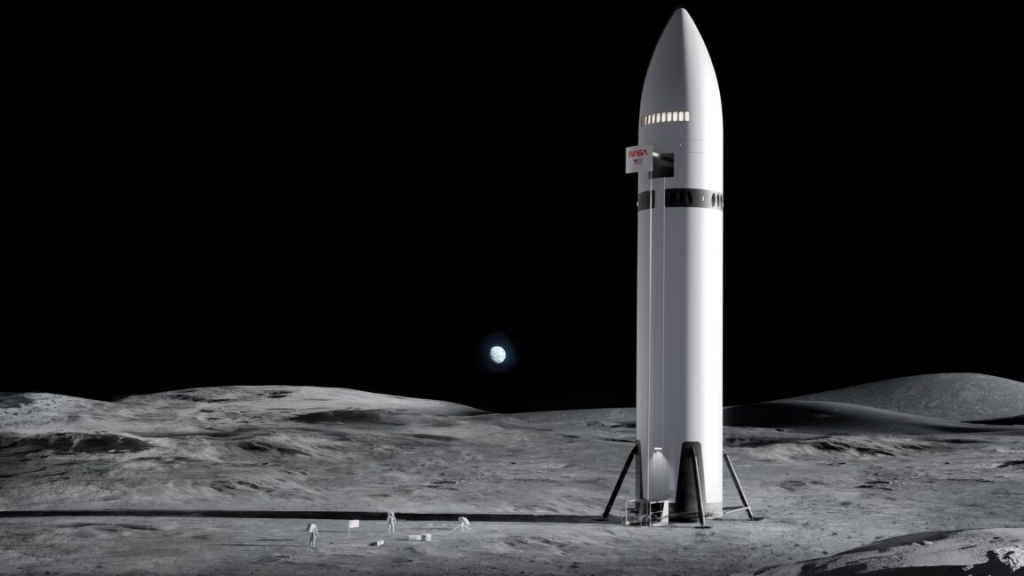
The most ambitious lunar lander on the table is SpaceX’s Starship-derived Human Landing System. But Starship’s Achilles’ heel isn’t its engines or its heat shield—it’s the need to launch and rendezvous with a fleet of uncrewed tanker flights in low Earth orbit. Each lunar mission could require a dozen or more tanker launches to transfer enough propellant for Starship to make the Earth-Moon transit, loiter in lunar orbit, and return.
Last November, Ars Technica examined potential workarounds, including an optimized, expendable Starship tanker stage designed to maximize propellant delivery per flight. The concept would trade reusability for raw throughput, potentially cutting the total number of launches. But when Ars raised the idea with Elon Musk, the SpaceX founder dismissed it. Once Starship reaches high flight rates, he argued, launching a dozen or more tankers per lunar mission will not be a major impediment.
That position has shaped SpaceX’s current HLS strategy. Rather than proposing radical redesigns, the company is signaling it will prioritize HLS development within the broader Starship program. In other words, if NASA wants to accelerate Artemis, SpaceX’s answer is to double down on building and flying more Starships—sooner.
The Clock Is Ticking
For NASA, the calculus is straightforward: every month shaved off the development and testing timeline brings the Artemis IV landing closer to reality. EPO/CoLA and a more capable SLS upper stage could buy back some of that time by making the journey from Orion to the surface more efficient. But ultimately, the lander contractors—especially SpaceX—must deliver a vehicle that can perform under the harsh conditions of deep space.
The next few years will reveal whether these incremental orbital optimizations, combined with a scaled-up Starship production cadence, are enough to keep Artemis on track. If they are, the Moon may see its first human visitors since 1972 far sooner than many expected.
Tags: NASA, Artemis, EPO/CoLA, lunar orbit, Human Landing System, Starship, SpaceX, SLS, Centaur V, ULA, Jared Isaacman, lunar architecture, deep space, propellant transfer, orbital mechanics
Viral Phrases: “Apollo on steroids,” “Moon rush 2.0,” “The new space race heats up,” “Lunar orbit reimagined,” “Starship’s fuel dilemma,” “Accelerating Artemis,” “From blueprint to bootprints,” “The 100 km leap,” “Propellant ballet in orbit,” “Moon missions, supercharged”
,


Leave a Reply
Want to join the discussion?Feel free to contribute!