
NASA Spots Sun-like Star Inflating Massive Bubble
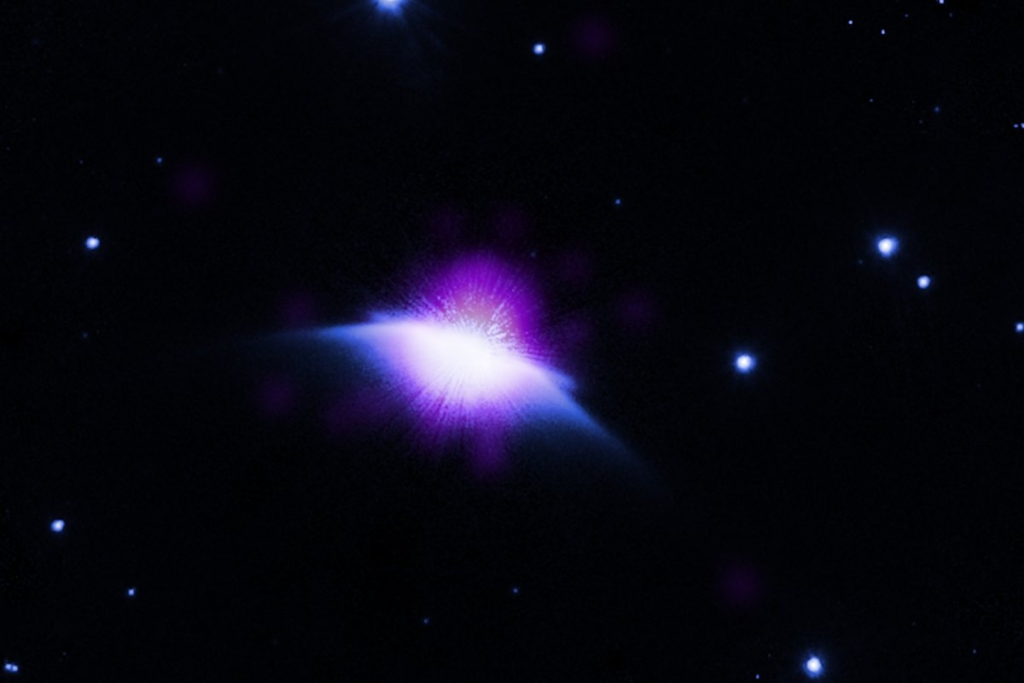
Astronomers using NASA’s Chandra X-ray Observatory have detected an extraordinary cosmic phenomenon: a young Sun-like star blowing a massive protective bubble through space. This groundbreaking discovery offers an unprecedented glimpse into the early life of stars and provides valuable insights into how our own solar system might have formed its protective shield billions of years ago.
The star, designated HD 61005 and located just 120 light-years from Earth, has been nicknamed “The Moth” due to its distinctive wing-like appearance when observed in infrared wavelengths. This celestial youngster, at approximately 100 million years old, is still in its stellar adolescence compared to our middle-aged Sun, which has been shining for about 5 billion years.
What makes this discovery particularly fascinating is that HD 61005 is remarkably similar to our Sun in terms of mass and temperature, making it an ideal cosmic laboratory for studying stellar evolution. The star’s powerful stellar winds are creating an astrosphere – a vast bubble of hot gas that completely envelops the star itself. This bubble extends an impressive 200 astronomical units in diameter, which is 200 times the distance between Earth and our Sun.
The detection of this astrosphere marks a significant milestone in astronomy, as it represents the first time such a structure has been observed around a Sun-like star anywhere in the universe. This achievement was made possible through the advanced capabilities of the Chandra X-ray Observatory, which can detect the high-energy emissions from the hot gas within the astrosphere.
What’s particularly intriguing about The Moth is how its astrosphere maintains its spherical shape despite the star’s journey through space. As HD 61005 moves through a dense region of cosmic dust and gas, its powerful stellar winds – which travel three times faster than the Sun’s and are 25 times denser – effectively plow through the surrounding material, creating the distinctive wing-like structures visible in infrared observations.
This discovery has profound implications for our understanding of stellar evolution and the formation of planetary systems. The astrosphere serves as a protective shield, similar to our own heliosphere, which extends far beyond Pluto and helps protect our solar system from harmful cosmic radiation and interstellar particles.
Lead researcher Carey Lisse from Johns Hopkins University emphasizes the significance of this finding: “We have been studying our Sun’s astrosphere for decades, but we can’t see it from the outside. This new Chandra result about a similar star’s astrosphere teaches us about the shape of the Sun’s, and how it has changed over billions of years as the Sun evolves and moves through the galaxy.”
The comparison between HD 61005 and our Sun reveals some startling contrasts. If our solar system were located in the same region of space as The Moth, our heliosphere would only extend out to the orbit of Saturn. Conversely, if HD 61005 were placed in our solar system’s location, its astrosphere would be ten times wider than our Sun’s current protective bubble.
This discovery also sheds light on the dynamic nature of stellar systems. The powerful stellar winds that create these astrospheres play a crucial role in shaping the surrounding space and protecting developing planetary systems from harmful radiation and particles from deep space. Understanding these processes helps astronomers better comprehend how habitable environments might develop around other stars.
The study of HD 61005 provides valuable data for modeling the evolution of our own solar system. As our Sun ages and moves through different regions of the galaxy, its heliosphere has likely undergone significant changes, much like what we’re observing with this younger star system.
This research represents a significant step forward in our understanding of stellar evolution and the complex interactions between stars and their surrounding environments. It demonstrates how studying other star systems can provide crucial insights into our own cosmic neighborhood’s past, present, and future.
The discovery also highlights the importance of continued investment in space-based observatories like Chandra, which enable us to detect and study these subtle but significant cosmic phenomena. As our observational capabilities continue to improve, we can expect to uncover even more fascinating details about the life cycles of stars and the formation of planetary systems.
Tags: #AstrosphereDiscovery #SunLikeStar #ChandraObservatory #StellarWinds #CosmicBubble #SpaceScience #AstronomyBreakthrough #HD61005 #TheMothStar #Heliosphere #StellarEvolution #NASA #SpaceExploration #CosmicPhenomena #Astrophysics #SpaceResearch #StarFormation #InterstellarMedium #SpaceTelescope #AstronomicalDiscovery
Viral Phrases:
– “Blowing bubbles in space”
– “Young star flexes its stellar muscles”
– “Cosmic butterfly emerges”
– “Space’s protective shield revealed”
– “Stellar adolescence captured on camera”
– “The Moth takes flight through space”
– “Bubble-blowing star teaches us about our Sun”
– “Space’s most impressive bubble bath”
– “Stellar winds shape cosmic landscapes”
– “A glimpse into our solar system’s past”
– “Space’s bubble-blowing champion”
– “The shield that protects entire star systems”
– “When stars throw their weight around”
– “Cosmic bubbles bigger than our entire solar system”
– “The stellar winds that shape galaxies”
– “Space’s bubble-blowing baby star”
– “The protective cocoon of stars”
– “When stars create their own space weather”
– “The cosmic bubble that could swallow our solar system”
– “Stellar winds: the architects of space”,

Leave a Reply
Want to join the discussion?Feel free to contribute!