
New Apple model recreates 3D objects with realistic lighting effects
Apple’s Revolutionary AI Breakthrough: LiTo Model Transforms 3D Object Reconstruction from Single Images
In a stunning development that’s sending shockwaves through the tech world, Apple’s research team has unveiled LiTo (Surface Light Field Tokenization), an AI model that can reconstruct stunningly accurate 3D objects from just a single 2D image—complete with realistic reflections, highlights, and complex lighting effects that maintain perfect consistency across all viewing angles.
The Game-Changing Technology Explained
This breakthrough represents a quantum leap in computer vision and 3D modeling. While traditional methods require multiple images from different angles to build a 3D model, Apple’s LiTo accomplishes this feat with just one photograph, making it exponentially more practical for real-world applications.
The secret sauce? Apple’s researchers have mastered the art of latent space representation—a sophisticated mathematical framework that compresses complex visual information into efficient numerical representations. Think of it as teaching AI to “understand” objects the way humans do, capturing not just the shape but how light interacts with surfaces from every possible perspective.
How LiTo Works: The Science Behind the Magic
At its core, LiTo leverages what researchers call “surface light field tokenization.” Here’s what makes it revolutionary: the model doesn’t just guess at 3D structure—it learns to represent both the geometry of an object AND how its appearance changes based on viewing direction and lighting conditions.
The process works in two phases. First, an encoder compresses all the visual information from a single image into a compact latent representation. This isn’t just compression—it’s intelligent abstraction that captures the essence of how the object should look from any angle. Then, a decoder reconstructs the complete 3D model, generating not only the shape but also predicting exactly how reflections, highlights, and other view-dependent effects should appear.
Training the AI: Thousands of Objects, One Breakthrough
Apple’s team trained LiTo using thousands of synthetic objects rendered from 150 different viewing angles under three distinct lighting conditions. But here’s where it gets clever: instead of feeding the AI every possible view, they randomly sampled small subsets of this data, forcing the model to learn robust representations that could generalize to any viewing condition.
The result? A model that can take a single 2D image and accurately predict the latent representation that corresponds to it, then reconstruct a full 3D model with photorealistic lighting effects that would make Hollywood visual effects artists jealous.
Real-World Performance: LiTo vs. The Competition
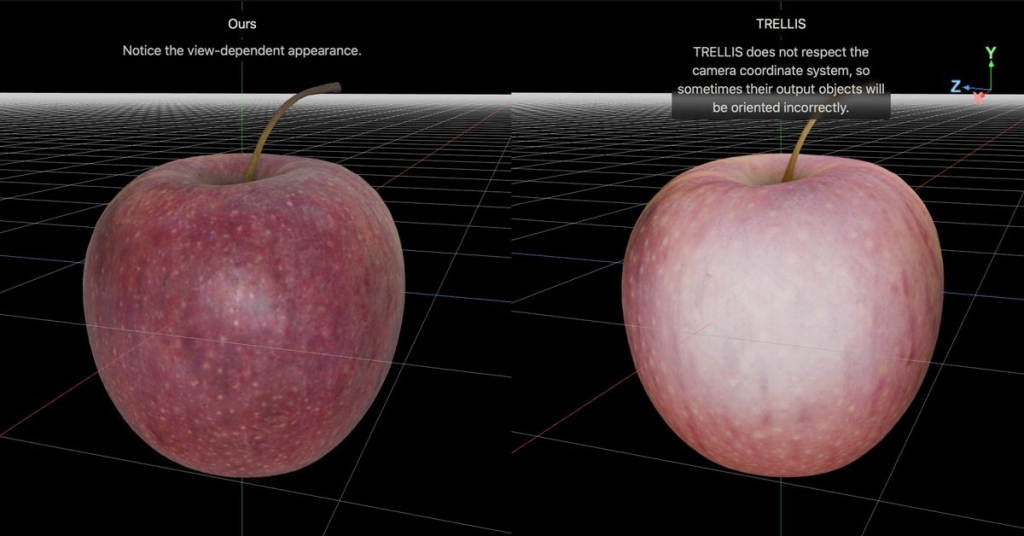
In head-to-head comparisons with existing state-of-the-art models like TRELLIS, LiTo consistently outperforms, particularly in capturing complex view-dependent effects like specular highlights and Fresnel reflections. The differences are striking—where other models produce flat, unconvincing results, LiTo generates objects that look genuinely three-dimensional, with light behaving exactly as it would on real surfaces.
The research team has published interactive comparisons on their project page, allowing anyone to see the dramatic improvements firsthand. From metallic surfaces that gleam realistically to transparent objects with accurate refraction, LiTo handles even the most challenging materials with remarkable fidelity.
Why This Matters: The Future of AI and 3D Content
This technology isn’t just an academic achievement—it’s a potential game-changer for numerous industries. Imagine e-commerce platforms where customers can view products in 3D from any angle using just a single product photo. Consider augmented reality applications that can instantly create 3D models of real-world objects for virtual try-on experiences. Think about content creation tools that make 3D modeling accessible to anyone with a smartphone camera.
For Apple specifically, this research aligns perfectly with their growing AI ambitions and could play a crucial role in future AR/VR devices, spatial computing applications, and even next-generation photography features.
The Technical Deep Dive
For those interested in the nitty-gritty details, the researchers’ paper (available on arXiv) explains how LiTo learns to represent surface light fields as a compact set of latent vectors. By encoding random subsamples of this information, the model develops a unified 3D latent space that captures both geometry and appearance—something previous approaches struggled to achieve simultaneously.
The implications extend far beyond just 3D reconstruction. This approach to latent space representation could influence everything from video compression to scientific visualization, making complex 3D data more accessible and computationally efficient.
What’s Next?
While Apple hasn’t announced specific product plans for LiTo, the technology represents exactly the kind of fundamental AI research that often precedes major product innovations. Given Apple’s strategic focus on spatial computing, augmented reality, and machine learning, it’s not hard to imagine LiTo or similar technologies appearing in future Apple devices and services.
The research also raises fascinating questions about the future of 3D content creation. If a single image is all that’s needed to generate convincing 3D models with realistic lighting, we may be entering an era where 3D content becomes as ubiquitous and easy to create as 2D photographs are today.
Tags: #Apple #AI #MachineLearning #3DModeling #ComputerVision #LatentSpace #AR #VR #SpatialComputing #TechInnovation #Breakthrough #FutureTech #AppleResearch
Viral Sentences:
“This changes everything we thought we knew about 3D reconstruction!”
“Apple just made 3D modeling as easy as taking a photo.”
“The future of AR/VR just got a whole lot brighter.”
“Single image to full 3D model? Apple’s doing the impossible.”
“Prepare for a world where every photo could be a 3D model.”
“This isn’t just incremental improvement—it’s a paradigm shift.”
“The holy grail of 3D reconstruction has been found.”
“Apple’s AI breakthrough will make Hollywood VFX look like child’s play.”
“Get ready for the democratization of 3D content creation.”
“This technology could revolutionize everything from e-commerce to gaming.”
,


Leave a Reply
Want to join the discussion?Feel free to contribute!