
Newborn marsupials seen crawling to mother’s pouch for the first time
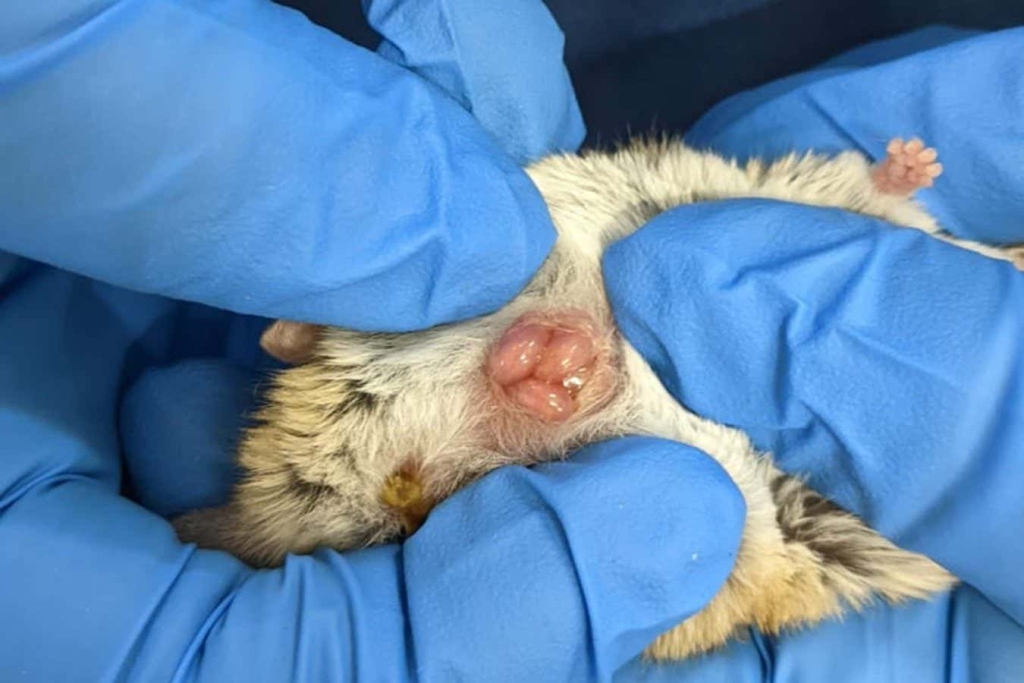
Tiny Marsupial Newborns Filmed Crawling to Pouch for First Time—A Breakthrough in Understanding Prehistoric Mammals
In a stunning scientific first, researchers have captured on film the incredible journey of newborn marsupials—tiny creatures smaller than a grain of rice—as they crawl from birth to their mother’s pouch, revealing secrets that could help bring back extinct species like the Tasmanian tiger.
The Moment That Changed Everything
It was an ordinary day at the University of Melbourne’s marsupial research facility when something extraordinary happened. Brandon Menzies and his team noticed blood in one of their fat-tailed dunnart enclosures—a sign that birth was imminent for these mouse-sized Australian marsupials.
When researchers carefully examined a female dunnart turned upside down, they witnessed something no scientist had ever documented: dozens of newborns, each weighing a mere 5 milligrams (about the weight of a single grain of rice), were already on the move, using their tiny forelimbs to navigate toward their mother’s pouch.
“We just saw the pouch young sort of waving their arms and crawling and wriggling,” Menzies described. “It’s very much a freestyle-swimming type of crawl, or a commando crawl.”
The Incredible 22-Second Footage
Menzies managed to capture 22 seconds of this historic moment before carefully returning the mother to her enclosure. The footage shows the newborns making approximately 120 arm movements per minute—an astonishing feat considering they had only just emerged from the womb after a mere 14-day gestation period.
The timing was crucial. These births occur overnight, and the journey to the pouch takes only about 30 seconds per baby. With multiple young being born over a 12-24 hour period, the window for observation is incredibly narrow.
Why This Discovery Matters
This breakthrough has implications far beyond understanding dunnarts. The fat-tailed dunnart (Sminthopsis crassicaudata) is considered one of the closest living relatives to the extinct Tasmanian tiger (Thylacinus cynocephalus). Researchers are collaborating with Colossal Biosciences in an ambitious attempt to bring back the Tasmanian tiger through gene-editing technology.
Understanding how dunnart newborns develop and navigate could provide crucial insights into the developmental biology of their prehistoric cousin. The Tasmanian tiger, or thylacine, was the largest carnivorous marsupial of modern times before humans drove it to extinction in the early 20th century.
The Brutal Reality of Marsupial Birth
What makes marsupial reproduction so fascinating—and brutal—is that mothers give birth to far more offspring than they can actually feed. Fat-tailed dunnarts can produce up to 17 young but have only 10 teats. This means only the strongest and fastest will survive the journey to the pouch.
For comparison, Tasmanian devils give birth to up to 30 young but have only four teats—an even more competitive scenario that highlights the incredible developmental capabilities of these tiny newborns.
A Developmental Marvel
The fact that these newborns can crawl independently to the pouch after just 10 days of embryonic development is remarkable. Ten days earlier, they were simply a few cells—a zygote. After only 14 days total gestation, they possess the ability to move their arms and navigate to find a teat.
This challenges previous assumptions that marsupial newborns were so small and undeveloped that they must be “squirted” directly into the pouch by the mother. Instead, these tiny creatures are active participants in their own survival from the very first moments of life.
The Science Behind
,


Leave a Reply
Want to join the discussion?Feel free to contribute!