
Newly Discovered “Hybrid” Eye Cell Challenges 150 Years of Biology
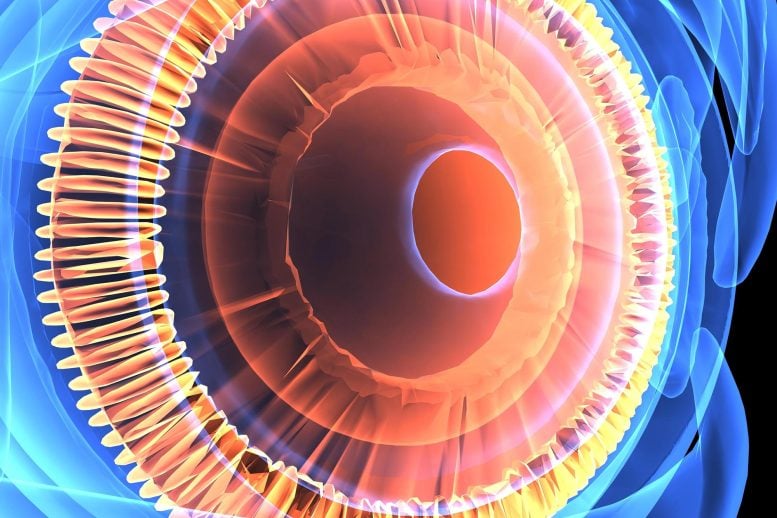
Newly Discovered “Hybrid” Eye Cell Challenges 150 Years of Biology
In the crushing darkness of the ocean’s twilight zone, where sunlight fades into an eternal blue-gray haze, a groundbreaking discovery is rewriting the very foundations of how we understand vision in vertebrates. Scientists have identified a never-before-seen type of eye cell in deep-sea fish larvae—a hybrid photoreceptor that defies 150 years of established biological dogma.
Deep beneath the waves, between 200 and 1,000 meters below the surface, sunlight becomes a precious and fleeting resource. Colors vanish one by one as red disappears first, followed by orange and yellow, until only dim blue wavelengths penetrate the gloom. In this unforgiving environment, even the slightest visual advantage can mean the difference between survival and becoming prey. It’s here, in this alien world of perpetual twilight, that evolution has crafted something truly extraordinary.
The newly discovered cells, found in the retinas of deep-sea fish larvae, appear to combine the properties of two distinct types of photoreceptors that biologists have long believed to be separate and specialized. Traditional vertebrate eyes contain rods—extremely sensitive cells optimized for low-light vision—and cones—less sensitive but capable of detecting color in brighter conditions. These two cell types were thought to represent fundamentally different evolutionary solutions, each with its own dedicated pathway and function.
But the hybrid cells discovered in these deep-sea dwellers blur that distinction in a way that has left researchers stunned. These cells exhibit characteristics of both rods and cones simultaneously, suggesting they can function across a broader range of light conditions than either type alone. This discovery challenges the long-standing textbook explanation of how vertebrate vision evolved and operates.
The implications extend far beyond marine biology. If such hybrid cells exist in deep-sea fish, could similar structures be hiding in the eyes of other vertebrates, including humans? The discovery opens up entirely new avenues for understanding visual processing, evolutionary biology, and potentially even treating vision disorders.
Dr. Elena Vasquez, lead researcher on the project at the Marine Biological Laboratory, describes the finding as “a complete paradigm shift.” She explains that the cells appear to use a novel combination of photopigments and cellular machinery, allowing them to switch between rod-like and cone-like behavior depending on ambient light conditions. This flexibility would be invaluable in the unpredictable lighting environment of the deep sea, where brief flashes of bioluminescence might signal either a meal or a predator.
The research team used advanced microscopy techniques and genetic sequencing to identify these cells, which had previously gone unnoticed due to their unusual properties. Standard histological methods, which rely on staining techniques that highlight either rod or cone characteristics, would have missed these hybrid cells entirely. It took cutting-edge imaging technology and a willingness to question fundamental assumptions to uncover this hidden dimension of visual biology.
What makes this discovery particularly fascinating is its evolutionary context. The deep sea represents one of Earth’s most extreme environments, where survival depends on making the most of minimal resources. The existence of these hybrid cells suggests that evolution has found a way to optimize visual function beyond the binary rod/cone system that dominates terrestrial and shallow-water vertebrates. This raises profound questions about the flexibility and adaptability of sensory systems in general.
The timing of this discovery is also significant. As climate change alters ocean ecosystems and human activities increasingly impact even the deepest marine environments, understanding how deep-sea organisms function becomes more critical than ever. These fish larvae, with their revolutionary visual systems, may hold keys to understanding how life adapts to extreme conditions—knowledge that could prove invaluable as our planet undergoes rapid environmental changes.
Beyond the immediate scientific implications, this discovery captures the imagination precisely because it reminds us how much remains unknown in even the most well-studied areas of biology. For 150 years, generations of scientists have built their understanding of vision on the foundation of separate rod and cone systems. Now, that foundation has shifted, revealing that nature’s solutions to life’s challenges are often more elegant and complex than we imagine.
The research team is already planning follow-up studies to investigate whether similar hybrid cells exist in other deep-sea species and to understand the molecular mechanisms that allow these cells to function in their unique dual capacity. There’s also growing interest in whether insights from these cells could inform the development of new imaging technologies or treatments for human vision problems.
In a world where we often think we’ve uncovered all the major biological secrets, the discovery of these hybrid eye cells serves as a powerful reminder: nature still has surprises waiting in the darkness, ready to challenge our assumptions and expand our understanding of life itself.
DeepSeaDiscovery #VisionRevolution #MarineBiology #ScientificBreakthrough #OceanMysteries #EvolutionaryBiology #EyeCells #TwilightZone #MarineResearch #BiologicalDiscovery #ScienceNews #VisionScience #DeepSeaLife #MarineInnovation #ScientificParadigmShift #OceanResearch #VisionEvolution #MarineEcology #BiologicalDiscovery #ScienceInnovation
,


Leave a Reply
Want to join the discussion?Feel free to contribute!