
Nothing Phone 4a Pro: Powerful camera, metal unibody, Glyph Matrix
Nothing’s Boldest Move Yet: The Phone 4a Pro Redefines Mid-Range Innovation
In a mobile market flooded with predictable upgrades and safe designs, Nothing has once again thrown a grenade into the conversation. At Mobile World Congress 2025, the company unveiled not one but two new devices that challenge everything we expect from mid-range smartphones. While the Nothing Phone 4a follows familiar territory, it’s the Phone 4a Pro that emerges as the true disruptor—a device that proves Nothing isn’t just about aesthetics, but about reimagining what’s possible in this segment.
The Phone 4a: Familiar Territory with a Fresh Coat
Let’s address the elephant in the room first. The Nothing Phone 4a was, by design, extensively leaked before its March 5 debut. The leaks weren’t wrong—they showed a device that comfortably sits in the mid-range sweet spot with a 6.78-inch 120Hz AMOLED display, Qualcomm Snapdragon 7s Gen 4 processor, and a triple-camera system headlined by a 50MP main sensor paired with an impressive 50MP periscope telephoto offering 3.5x optical zoom.
The device comes with 8GB or 12GB of RAM, 128GB or 256GB of storage, and a substantial 5,080mAh battery with 50W fast charging. Available in Pink, White, Black, and Blue, it maintains Nothing’s signature Glyph Bar on the back—a strip of LED lights that can signal notifications, track deliveries, or display battery levels in real-time.
Priced at approximately €350 and launching across Europe, the Phone 4a represents Nothing’s most accessible entry point yet. However, in a move that will disappoint American fans, the company confirmed it won’t be available in the United States—a decision that continues Nothing’s complicated relationship with the world’s largest smartphone market.
The Phone 4a Pro: Where Nothing Gets Radical
If the Phone 4a plays it relatively safe, the Phone 4a Pro is where Nothing’s rebellious spirit truly shines. This isn’t merely a spec-bumped version of its sibling—it’s a fundamentally different device that borrows design language from the flagship Phone 3 while introducing innovations that feel genuinely fresh.
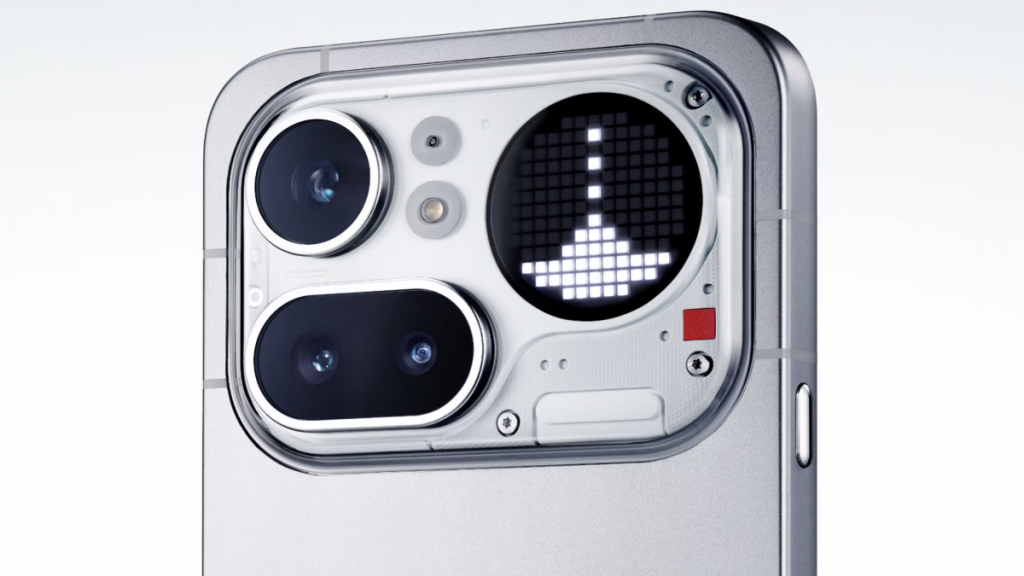
The Pro variant sports a slightly larger 6.83-inch display but houses a more advanced Snapdragon 7 Gen 4 chipset. The camera system receives a significant upgrade with a larger main sensor (though specific megapixel counts remain undisclosed), maintaining the 50MP periscope telephoto and ultrawide configuration. The 32MP front-facing camera ensures selfie quality doesn’t take a backseat.
But the real story lies in the design overhaul. Gone is the plastic chassis of the standard model, replaced by a precision-engineered metal unibody that allows for a remarkably slim 7.95mm profile—making it Nothing’s thinnest smartphone to date. This engineering achievement isn’t just about aesthetics; it represents a fundamental rethinking of what’s possible in mid-range device construction.
The most striking change, however, is the Glyph Matrix. Replacing the familiar Glyph Bar is a circular arrangement of 137 mini-LEDs that transforms the phone’s back into what is essentially a secondary display. This feature, previously reserved for Nothing’s flagship Phone 3, brings flagship-level innovation to the mid-range segment. The Glyph Matrix can display custom animations, notification patterns, and even battery status in ways that feel more sophisticated and versatile than its predecessor.
Available in Black, Silver, and Pink, the Phone 4a Pro carries a $499 price tag and—crucially—will launch in the United States later in March. This marks Nothing’s most aggressive push into the American market yet, suggesting the company sees genuine opportunity despite the challenges.
Design Philosophy: The Nothing Difference
What separates Nothing from countless other smartphone manufacturers isn’t just the Glyph system or the transparent aesthetic—it’s the company’s willingness to evolve its design language with each iteration. While many brands maintain consistent design languages across generations, Nothing treats each release as an opportunity to reinvent.
The progression from Phone 1 to Phone 2 to Phone 3, and now to Phone 4a and 4a Pro, demonstrates a company unafraid to experiment. The Glyph Bar evolved into the Glyph Matrix. The plastic construction gave way to metal unibody designs. Each change feels intentional rather than arbitrary, suggesting a design philosophy that prioritizes innovation over consistency for consistency’s sake.
This approach extends beyond mere aesthetics. Nothing’s semi-naked design philosophy—where internal components are visible through transparent or translucent materials—creates a visual language that’s immediately recognizable yet constantly evolving. It’s a bold strategy in an industry where many manufacturers play it safe, iterating on proven formulas rather than taking risks.
Market Positioning: Challenging Industry Norms
The dual-launch strategy reveals something fascinating about Nothing’s market understanding. By offering both a conventional mid-ranger (Phone 4a) and a genuinely innovative alternative (Phone 4a Pro) at different price points, Nothing is essentially saying: “We understand that not everyone wants cutting-edge design, but for those who do, we have something special.”
This approach challenges the traditional mid-range paradigm where “Pro” typically means “same phone with better specs.” Instead, Nothing has created two distinct products that serve different user needs while maintaining brand cohesion. The Phone 4a appeals to users who want reliable performance in a distinctive package, while the Phone 4a Pro targets those who crave innovation and don’t mind paying a premium for it.
The pricing strategy is equally interesting. At €350, the Phone 4a undercuts many competitors while offering features like periscope telephoto cameras that are typically reserved for higher price brackets. The $499 Phone 4a Pro, meanwhile, positions itself as a genuine alternative to flagship killers, offering unique features that can’t be found elsewhere in this price range.
The Bigger Picture: Nothing’s Growing Ecosystem
The Phone 4a and 4a Pro launches weren’t Nothing’s only announcements at MWC. The company also unveiled new over-ear headphones boasting “unreal battery life”—a product that, while not detailed in our source material, suggests Nothing is building toward a comprehensive ecosystem strategy.
This ecosystem approach makes sense for a company that’s still establishing itself in a market dominated by giants. By creating complementary products that share design language and potentially integrate features, Nothing can build brand loyalty and create switching costs that go beyond individual device satisfaction.
Looking Forward: What This Means for the Industry
Nothing’s approach raises interesting questions about the future of smartphone design and marketing. In an industry where differentiation often comes down to minor spec improvements or camera tweaks, Nothing is betting that genuine innovation and distinctive design can create meaningful market differentiation.
The company’s willingness to bring flagship features like the Glyph Matrix to mid-range devices suggests a democratization of innovation that could pressure competitors to rethink their own product strategies. If Nothing can successfully execute this vision, it could force other manufacturers to consider whether their own mid-range offerings are truly innovative or merely safe, iterative updates.
Moreover, Nothing’s continued focus on the U.S. market with the Phone 4a Pro suggests the company sees long-term potential in a market that has historically been difficult for new entrants. Success here could provide the scale and brand recognition needed to compete more effectively with established players globally.
Conclusion: More Than Just Another Phone Launch
The Nothing Phone 4a and 4a Pro represent more than just two new smartphones—they represent a philosophy about what technology products can and should be. In an industry often criticized for stagnation and lack of genuine innovation, Nothing continues to prove that there’s room for companies willing to take risks and challenge conventions.
The Phone 4a Pro, in particular, stands as a testament to what’s possible when a company prioritizes innovation over playing it safe. By bringing flagship-level design and features to the mid-range segment, Nothing is expanding the boundaries of what consumers can expect at various price points.
Whether this approach will translate to commercial success remains to be seen. But one thing is clear: Nothing has once again made the smartphone conversation more interesting, and in an industry that desperately needs fresh perspectives, that’s a victory in itself.
Tags: Nothing Phone 4a, Nothing Phone 4a Pro, Glyph Matrix, MWC 2025, mid-range smartphones, smartphone innovation, Nothing ecosystem, Snapdragon 7 Gen 4, periscope camera, metal unibody design, transparent design, smartphone design evolution, Nothing headphones, U.S. smartphone market
Viral Sentences: “Nothing proves mid-range phones don’t have to be boring,” “The Glyph Matrix turns your phone’s back into a tiny display,” “7.95mm thin metal unibody in a mid-range phone? Nothing did it,” “Why play it safe when you can reinvent the game? That’s Nothing’s philosophy,” “The Phone 4a Pro: when mid-range meets flagship innovation,” “Nothing’s boldest move yet: making the Pro variant actually different,” “Glyph Matrix: because your notifications deserve to be art,” “Nothing challenges the entire smartphone industry with one launch,” “The Phone 4a Pro proves you don’t need to spend $1000 for cutting-edge design,” “Nothing’s ecosystem play: headphones with ‘unreal battery life’ join the family”
,


Leave a Reply
Want to join the discussion?Feel free to contribute!