
NVIDIA DLSS For Blender Under Review But Licensing Concerns Persist
NVIDIA DLSS Integration Nears Blender, But Licensing Hurdles Loom Large
In a development that has the 3D graphics community buzzing, NVIDIA’s Deep Learning Super Sampling (DLSS) technology is on the verge of officially coming to Blender—but not without significant controversy surrounding its implementation.
The Breakthrough Integration
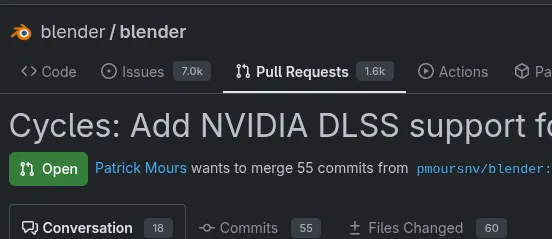
Just a few months after NVIDIA showcased DLSS-powered Blender at SIGGRAPH, the company has submitted a formal pull request to integrate DLSS support directly into Blender’s Cycles rendering engine. The initial focus targets viewport denoising, leveraging NVIDIA’s DLSS Ray Reconstruction technology to deliver what early demonstrations suggest could be “game-changing” improvements in both rendering quality and performance.
The integration follows a similar architectural pattern to Blender’s existing OptiX support, utilizing the system-level NVIDIA driver to load the necessary components. Specifically, the implementation relies on NVIDIA’s NGX driver component—the _nvngx.dll or libnvidia-ngx.so.1 library—which dynamically loads the actual DLSS implementation library (nvngx_dlssd.dll or libnvidia-ngx-dlssd.so.*).
Technical Implementation Details
According to the pull request documentation, the system operates by:
- Detecting CUDA-capable devices on the user’s system
- Verifying driver compatibility (minimum requirement: NVIDIA driver 590+)
- Checking for the presence of the required DLSS implementation library
- Dynamically loading and querying the NGX API for support and initialization
The implementation is sophisticated enough that if DLSS support is unavailable—whether due to missing libraries, outdated drivers, or unsupported hardware—the DLSS denoiser option simply appears greyed out rather than causing errors or crashes.
The Licensing Controversy
Despite the technical elegance of the implementation, Blender’s development team has expressed serious reservations about shipping DLSS with the current distribution mechanism. The core issue centers on how the DLSS binaries are distributed: currently, users must manually place NVIDIA-provided DLLs alongside the Blender executable for the feature to function.
At the recent Blender Render & Cycles Meeting, developers articulated their concerns clearly. While acknowledging that “the results are very impressive,” they emphasized discomfort with the current distribution model. The ideal scenario, according to Blender’s team, would involve integrating DLSS directly into NVIDIA’s driver infrastructure, eliminating the need for separate binary distribution.
This licensing and distribution challenge has prompted discussions about potentially merging the Blender-side implementation while withholding actual distribution—a compromise that would allow technically-savvy users to enable the feature manually while avoiding potential legal or ethical complications for the Blender Foundation.
The Cross-Vendor Alternative
The controversy has also highlighted the broader industry tension between proprietary, vendor-locked technologies and open, cross-platform solutions. Blender’s development team has expressed particular interest in Intel’s upcoming Open Image Denoise 3 (OIDN 3), expected to ship later in 2026.
OIDN 3 promises to deliver an improved high-performance denoiser with several key advantages:
- Open-source licensing that aligns with Blender’s philosophy
- Cross-vendor compatibility supporting both NVIDIA and AMD hardware
- Community-driven development ensuring transparency and broad accessibility
However, developers caution that OIDN 3 remains 6-12 months away from release, and its performance and quality characteristics relative to DLSS remain unproven. The uncertainty surrounding OIDN 3’s capabilities has created a challenging decision point for Blender’s development team.
Industry Implications
This situation encapsulates a broader tension in the 3D graphics and rendering industry. NVIDIA’s DLSS represents cutting-edge technology that demonstrably improves performance and quality, but its proprietary nature and restrictive licensing create barriers to widespread adoption in open-source projects.
The Blender community finds itself at a crossroads: embrace a technically superior but philosophically problematic solution, or wait for an open alternative that may not match DLSS’s capabilities but aligns better with open-source principles.
What’s Next?
The immediate future likely involves further discussion within Blender’s development community about potential compromises. Options under consideration include:
- Merging the implementation without shipping the binaries
- Developing clearer documentation for manual DLSS library installation
- Exploring alternative distribution mechanisms that might satisfy licensing concerns
- Accelerating evaluation of OIDN 3 as a potential replacement
For users eager to experiment with DLSS in Blender today, the pull request represents a promising development, though they’ll need to navigate the manual library installation process and ensure their hardware and drivers meet the requirements.
The outcome of this integration effort could set important precedents for how open-source projects handle proprietary technologies that offer significant technical advantages but pose licensing and philosophical challenges.
Tags: NVIDIA DLSS, Blender integration, Cycles rendering, 3D graphics, AI upscaling, open source controversy, licensing issues, viewport denoising, SIGGRAPH 2024, NGX driver, cross-vendor compatibility, Intel OIDN 3, proprietary technology debate, rendering performance, CUDA support
Viral phrases: “Game-changing performance boost,” “Philosophy vs. performance,” “The great DLSS dilemma,” “Open source at a crossroads,” “NVIDIA’s proprietary puzzle,” “The waiting game for OIDN 3,” “Manual DLL installation headaches,” “Driver dependency drama,” “The future of 3D rendering,” “Tech superiority vs. open principles”
,


Leave a Reply
Want to join the discussion?Feel free to contribute!