
Nvidia’s ‘ChatGPT moment’ for self-driving cars, and other key AI announcements at GTC 2026
Nvidia Unleashes a Wave of Physical AI Innovations at GTC 2026
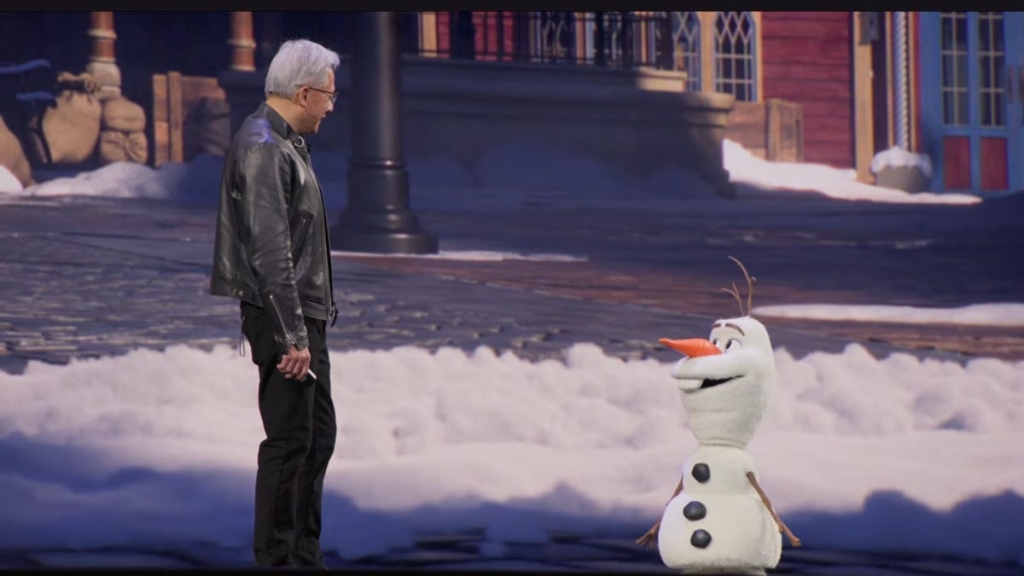
In a sweeping series of announcements at its annual GTC conference, Nvidia has dramatically expanded its ambitions in the realm of physical AI—ushering in a new era of autonomous robots, self-driving cars, and even space-based AI computing. The company’s CEO, Jensen Huang, opened the event with a surprise appearance by a walking, talking robot version of Olaf from Disney’s Frozen, demonstrating the potential for lifelike robotic characters powered by Nvidia’s Jetson platform and trained in the Omniverse simulator.
The Rise of Physical AI
Physical AI—AI systems embedded in machines that navigate real-world environments—has been gaining momentum, and Nvidia is positioning itself at the forefront. From CES 2025 to GTC 2026, the company has unveiled a suite of new models and partnerships aimed at accelerating the deployment of autonomous systems across industries.
New Foundation Models for the Physical World
Nvidia introduced several groundbreaking models:
- Cosmos 3: Generates synthetic worlds to train physical AI for complex environments.
- Isaac GR00T N1.7: An “open reasoning vision language action (VLA) model” for humanoid robots, designed for commercial deployment.
- Alpamayo 1.5: A reasoning VLA model that enhances self-driving vehicle navigation and safety, processing video, motion history, and natural language prompts to generate driving trajectories.
These models are already being used by customers to train autonomous systems and scale humanoid robot deployment.
Autonomous Vehicles: The “ChatGPT Moment” Arrives
Huang declared that the “ChatGPT moment of self-driving cars has arrived.” Nvidia is partnering with Uber to launch a fleet of autonomous vehicles powered by Nvidia’s Drive AV software in 28 cities across four continents by 2028, with Los Angeles and San Francisco starting in 2027. The DRIVE Hyperion-powered fleet will use Alpamayo models and the NVIDIA Halos operating system to accelerate the development of safe, scalable robotaxi services.
The company is also expanding its robotaxi initiative to include automakers like BYD, Hyundai, Nissan, and Geely, alongside existing partners GM, Mercedes, and Toyota.
Edge AI and Space Computing
Nvidia is pushing the boundaries of edge AI with partnerships like T-Mobile and Nokia, using AI radio access network (AI-RAN) infrastructure to enable physical AI in remote or congested areas without disrupting 5G connectivity. This could revolutionize data collection and real-time decision-making in isolated zones.
In a bold leap, Nvidia is also venturing into space computing. Its new platforms, including Vera Rubin, aim to bring AI compute to orbital data centers (ODCs), enabling autonomous space operations and geospatial intelligence. The IGX Thor and Jetson Orin platforms offer the energy-efficient processing required for AI applications in orbit, though the Vera Rubin Space-1 component will be available later.
The Physical AI Data Factory Blueprint
To ensure the reliability and safety of physical AI systems, Nvidia introduced the Physical AI Data Factory Blueprint—an open reference architecture for generating, augmenting, and evaluating training data at scale. Using Nvidia’s Cosmos models, the blueprint automates the creation of synthetic data, including rare edge cases, to train autonomous vehicles and robots more effectively. Uber and Skild AI are already leveraging this technology.
The Big Picture
While advancements in physical AI have consumer-facing applications—like Waymo cars and viral house chore robots—their most immediate impact will be in industrial engineering. More capable, autonomous robots will transform public and industrial landscapes, from roads and factories to theme parks, where robotic characters could soon roam.
As Nvidia continues to push the envelope in physical AI, the line between science fiction and reality is blurring faster than ever. The future, it seems, is not just intelligent—it’s physical.
Tags: Nvidia, GTC 2026, Physical AI, Autonomous Vehicles, Robotaxis, Cosmos 3, Isaac GR00T N1.7, Alpamayo 1.5, Edge AI, Space Computing, AI-RAN, Vera Rubin, Omniverse, Humanoid Robots, Uber, Disney, Olaf, Waymo, T-Mobile, Nokia, Data Factory Blueprint, Synthetic Data, Orbital Data Centers, Industrial Engineering
Viral Phrases: “ChatGPT moment of self-driving cars,” “walking, talking robot Olaf,” “autonomous vehicles in 28 cities,” “space-based AI computing,” “robotic characters at Disneyland,” “edge AI infrastructure,” “orbital data centers,” “AI-RAN partnerships,” “Physical AI Data Factory Blueprint,” “synthetic data for rare edge cases.”
,

Leave a Reply
Want to join the discussion?Feel free to contribute!