
Oldest known rock art is a 68,000-year-old hand stencil with claws
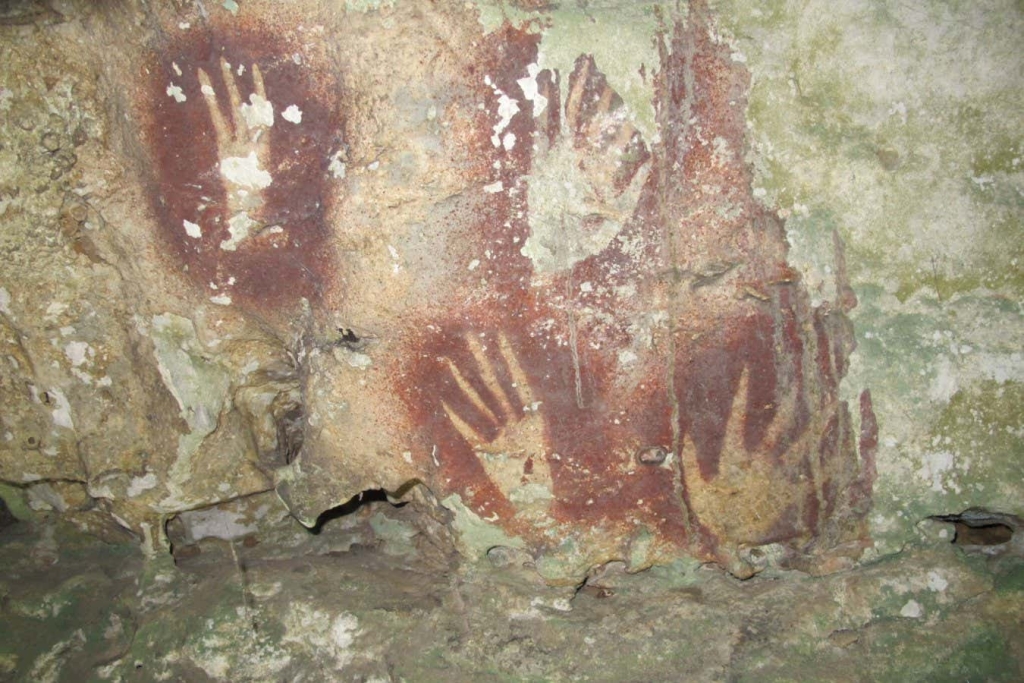
In a groundbreaking discovery that is reshaping our understanding of early human creativity, archaeologists have uncovered what may be the world’s oldest known rock art—a nearly 68,000-year-old hand stencil found in a cave on the Indonesian island of Sulawesi. This remarkable find not only pushes back the timeline for the origins of human artistic expression but also reveals a level of sophistication and imagination that challenges previous assumptions about our ancient ancestors.
The hand stencil, discovered at a site called Liang Metanduno on Muna Island, east Sulawesi, was created by spraying ochre pigment over a hand pressed against the cave wall. What makes this stencil extraordinary is not just its age—67,800 years old, according to uranium-series dating—but the deliberate modifications made by the artist. The stencil shows signs of intentional retouching, with one finger artificially narrowed to appear more claw-like. This artistic choice suggests a playful and creative mindset, transforming a simple handprint into something more symbolic or abstract.
This discovery is particularly significant because it predates the previous record holder for the oldest rock art—a hand stencil in northern Spain, attributed to Neanderthals, dated to 66,700 years ago. The Sulawesi stencil, therefore, represents the oldest known rock art definitively linked to modern humans, Homo sapiens.
Sulawesi has long been recognized as a pivotal location in the human story. The island was likely one of the first stepping stones for early humans migrating from Southeast Asia to Australia, a journey that required advanced seafaring skills. Evidence from the Australian site of Madjedbebe suggests that Homo sapiens reached the continent at least 60,000 years ago. The Sulawesi hand stencil implies that the ancestors of these early Australians were already creating art on the island 68,000 years ago, offering a tantalizing glimpse into their lives and cultural practices.
The stencil’s claw-like modification is particularly intriguing. While the Spanish Neanderthal hand stencil was created using the same basic technique—spraying pigment over a hand—the Sulawesi artist went a step further, altering the image to evoke an animal claw. This suggests a level of abstract thinking and creative imagination not previously associated with such early human art. As archaeologist Adam Brumm of Griffith University notes, “This indicates a playfulness on the part of the modern human artist; altering an otherwise ‘ordinary’ hand stencil in this manner is a sign of creative imagination and abstract thinking that is not evident in the human hand mark left behind by the Neanderthal.”
The discovery also highlights the importance of Sulawesi as a cultural and artistic hub in the ancient world. In 2024, the same research team announced the discovery of the world’s oldest known representational art on the island—a pig painting accompanied by human-like figures, dated to at least 51,200 years ago. The new hand stencil pushes the timeline for artistic expression in the region back even further, suggesting that Sulawesi was a cradle of human creativity long before the arrival of modern humans in Europe or Australia.
The implications of this discovery extend beyond the history of art. It provides valuable insights into the cognitive and cultural capabilities of early humans, shedding light on their ability to think symbolically and express themselves through visual means. It also raises questions about the routes taken by early humans as they migrated across the globe, with Sulawesi playing a crucial role in the story of human dispersal.
As researchers continue to explore the caves of Sulawesi, they are uncovering a wealth of new rock art sites, each offering a unique window into the lives of our ancient ancestors. These discoveries are not only rewriting the history of human art but also deepening our understanding of the origins of creativity and the shared heritage of humanity.
In a world where technology and innovation often dominate the headlines, the discovery of the Sulawesi hand stencil serves as a powerful reminder of the enduring power of human creativity. It is a testament to the ingenuity and imagination of our ancestors, whose artistic expressions continue to inspire and captivate us thousands of years later.
Tags: #AncientArt #Sulawesi #RockArt #HumanOrigins #Archaeology #CreativeImagination #PrehistoricArt #HomoSapiens #CavePaintings #CulturalHeritage #ArtisticExpression #EarlyHumans #SymbolicThinking #MigrationRoutes #AustralianAncestors #Neanderthals #OchrePigment #HandStencils #AbstractArt #HumanCreativity
Viral Phrases:
- “The world’s oldest known rock art just got older!”
- “A 68,000-year-old hand stencil that’s rewriting history!”
- “Ancient art meets modern science in Indonesia!”
- “From handprints to claw-like designs—early humans were creative geniuses!”
- “Sulawesi: The cradle of human artistic expression!”
- “This hand stencil is older than you think—and it’s got claws!”
- “The oldest art in the world is hiding in a cave in Indonesia!”
- “Neanderthals vs. Homo sapiens: Who made the first art?”
- “A playful twist on ancient handprints—early humans were full of surprises!”
- “The journey from Southeast Asia to Australia starts here!”
- “Art, migration, and imagination—unraveling the story of our ancestors!”
- “This 68,000-year-old stencil is proof that creativity is timeless!”
- “The oldest art in the world is more than just a handprint—it’s a masterpiece!”
- “Sulawesi’s caves are a treasure trove of human history!”
- “The claw-like hand stencil that’s changing everything we know about early art!”
- “From ochre to imagination—how early humans transformed a handprint into art!”
- “The oldest art in the world is a testament to human ingenuity!”
- “This ancient stencil is a window into the minds of our ancestors!”
- “The oldest art in the world is hiding in plain sight—in a cave in Indonesia!”
- “A 68,000-year-old masterpiece that’s rewriting the story of human creativity!”
,


Leave a Reply
Want to join the discussion?Feel free to contribute!