
Peek inside NASA’s Mars habitat where humans train for life on the red planet
NASA’s Mars Simulation: Inside the 150-Day Isolation Experiment That Could Shape the Future of Space Travel
In a groundbreaking experiment that’s capturing the imagination of space enthusiasts worldwide, NASA has revealed intimate details of its Mars simulation habitat, where four brave volunteers have now spent 150 days living in complete isolation from the outside world. This extraordinary mission, taking place at NASA’s Johnson Space Center in Houston, represents a crucial step toward humanity’s ultimate goal of setting foot on the Red Planet.
The Mars Dune Alpha habitat, a meticulously designed 1,700-square-foot facility, has become home to Ross Elder, Ellen Ellis, Matthew Montgomery, and James Spicer since they sealed themselves inside on October 19, 2025. These four individuals have voluntarily embarked on what could be described as the most realistic Mars simulation ever attempted on Earth.
A Day in the Life of a Mars Analog Astronaut
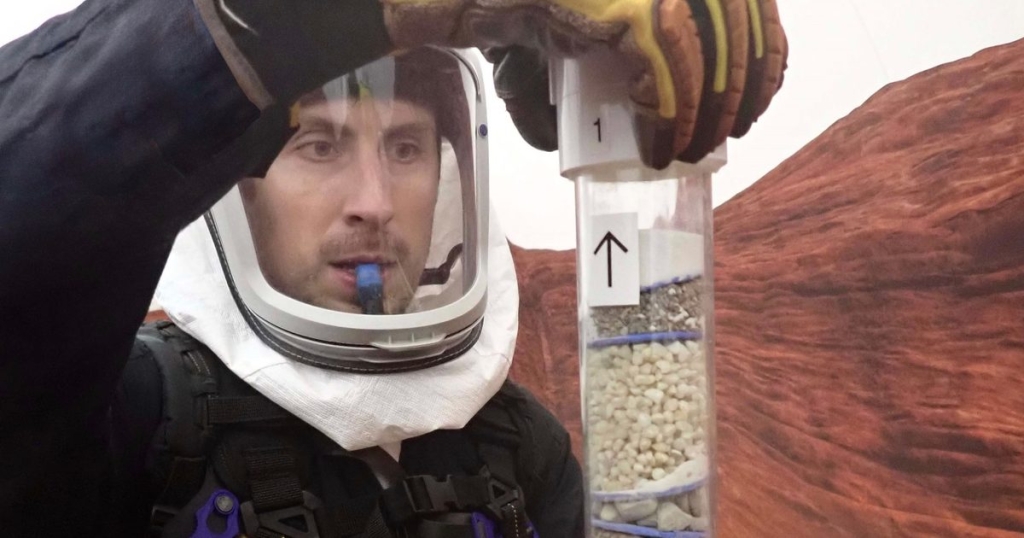
The daily routine inside Mars Dune Alpha is nothing short of fascinating. Recent photographs released by NASA show the crew members engaged in various activities that mirror what life would be like on a real Mars mission. Elder and Montgomery are pictured conducting scientific research, while Ellis joins them for what appears to be a casual game of table tennis – a reminder that even in the most extreme environments, human beings need moments of recreation and social interaction.
The habitat itself is a marvel of engineering, featuring nine distinct rooms, a shared bathroom facility, and a communal area for meals and social gatherings. Each crew member enjoys their own private bedroom, providing a crucial personal space for rest and reflection. An adjacent simulation area replicates the Martian surface, allowing the volunteers to practice “Mars walks” and other extravehicular activities they’ll need to master for the real mission.
The Psychological Challenge: Living on “Mars Time”
One of the most intriguing aspects of this simulation is how it replicates the communication challenges that would exist on an actual Mars mission. With a 22-minute delay each way for communications with Earth, the crew must operate with a level of autonomy that few humans have ever experienced. This delay can stretch to complete communication blackouts, forcing the team to rely entirely on their own decision-making capabilities.
“We may be unable to expect input from Mission Control back in Houston when time-critical emergencies arise,” Elder explained before entering the habitat. “It’s critical for the crew to rely on our teamwork, skills, decision making, and quick action to ensure the safety and success of the mission.”
This level of isolation and self-reliance is perhaps the most psychologically demanding aspect of the experiment. The crew must maintain not only their physical health but also their mental well-being while cut off from friends, family, and the familiar comforts of Earth.
Scientific Research and Daily Challenges
Throughout their stay, the volunteers are subjected to rigorous scientific monitoring. NASA researchers are carefully tracking both physical and mental responses to the confined environment, collecting data that will be invaluable for planning future Mars missions. The crew faces simulated challenges such as resource shortages, equipment malfunctions, and the need to grow their own food.
The agricultural component of the mission is particularly interesting. The crew must tend to crops, learning how to sustain themselves through farming in a controlled environment – a crucial skill for any future Mars colony. This aspect of the mission also provides a psychological benefit, giving the volunteers a connection to living things and a sense of purpose beyond their immediate survival.
The Bigger Picture: NASA’s Mars Ambitions
This simulation is part of NASA’s broader strategy to prepare for human missions to Mars, which the agency hopes to launch in the 2030s. However, many experts believe that timeline may be optimistic, with some suggesting that the first human mission to Mars might not occur until the 2040s or even later.
The data collected from this and similar experiments will be crucial in determining whether humanity is truly ready for such an ambitious undertaking. Questions about crew composition, habitat design, life support systems, and psychological support all need to be answered before we can confidently send humans on a multi-year journey to another planet.
The Human Element: Why This Matters
What makes this experiment particularly compelling is the human story behind it. These four volunteers have essentially volunteered to be test subjects in one of the most ambitious isolation experiments in history. They’re sacrificing a year of their lives, along with contact with the outside world, to help advance human space exploration.
Their commitment raises profound questions about what drives human exploration. What motivates someone to spend a year in isolation, knowing they’re contributing to a goal they may never personally achieve? The answer likely lies in the same spirit of adventure and discovery that has driven explorers throughout human history.
Looking Ahead: The Road to Mars
As the crew approaches the halfway point of their mission, with their scheduled exit date of October 31, 2026, the scientific community eagerly awaits the data they’ll provide. This experiment, known as CHAPEA (Crew Health and Performance Exploration Analog), is just one of several analog missions NASA is conducting to prepare for Mars.
The success of this mission could accelerate plans for human Mars exploration, while any significant challenges could force a reassessment of timelines and strategies. Either way, the information gathered will be invaluable for ensuring that when humans do finally set foot on Mars, they’ll be as prepared as possible for the challenges that await them.
As we watch these four pioneers live out their Martian adventure here on Earth, we’re reminded that every giant leap for mankind begins with small, brave steps by individuals willing to push the boundaries of human experience. The Mars Dune Alpha habitat may be on Earth, but for Ross Elder, Ellen Ellis, Matthew Montgomery, and James Spicer, it’s become a portal to humanity’s future among the stars.
Tags: #NASA #MarsMission #SpaceExploration #MarsSimulation #CHAPEA #JohnsonSpaceCenter #MarsHabitat #SpaceTravel #FutureOfSpace #HumanSpaceflight #Mars2030s #AnalogMission #SpaceScience #IsolationExperiment #DeepSpace #MartianLife #SpaceResearch #AstronautTraining #SpaceTechnology #HumanitysFuture
Viral Phrases: “Living on Mars time”, “22-minute communication delay”, “Mars walks on Earth”, “The ultimate isolation experiment”, “Gateway to the Red Planet”, “Year-long space simulation”, “Pioneers of Martian living”, “The psychology of space isolation”, “Growing food on simulated Mars”, “Teamwork in deep space conditions”, “The future of human space exploration”, “Earth’s closest thing to Mars”, “Volunteers for the stars”, “Mars mission countdown begins”, “Inside NASA’s Mars dream”, “The ultimate test of human endurance”, “Preparing for humanity’s next giant leap”, “Life in a Martian bubble”, “The psychology of space travel”, “Earth’s Mars training ground”,


Leave a Reply
Want to join the discussion?Feel free to contribute!