
Perseverance’s radar revealed ancient subsurface river delta on Mars
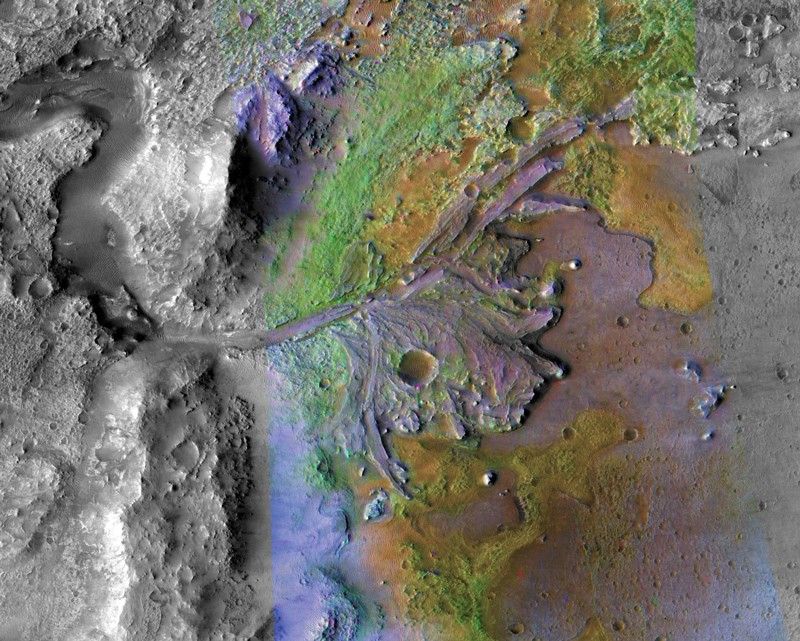
NASA’s Perseverance Rover Uncovers Hidden Martian Delta: A Potential Treasure Trove of Ancient Life
In a groundbreaking discovery that could reshape our understanding of Mars’ ancient past, NASA’s Perseverance rover has detected a previously unknown river delta buried deep beneath the surface of Jezero Crater. This hidden geological feature, potentially older than the already-studied Western Delta, offers a tantalizing new target in the search for signs of ancient microbial life on the Red Planet.
Since its dramatic landing in Jezero Crater in February 2021, Perseverance has been meticulously exploring the remnants of what was once a vast Martian lakebed. The rover’s primary focus has been on the Western Delta, a fan-shaped formation created by a river flowing into the crater billions of years ago. However, a recent analysis of data from Perseverance’s ground-penetrating radar, known as RIMFAX (Radar Imager for Mars Subsurface Experiment), has revealed an even more ancient delta lying beneath the surface.
Emily L. Cardarelli, an astrobiologist at the University of California, Los Angeles, and the lead researcher interpreting the RIMFAX imagery, expressed excitement about the find. “I think it’s a promising place to look for signs of biosignatures at depth,” Cardarelli stated. “Microbial life could have potentially developed in those types of environments.”
The discovery of this buried delta is a testament to the power of Perseverance’s scientific instruments. RIMFAX continuously fires radar waves into the Martian ground, collecting data every time the rover travels 10 centimeters. When these radio waves encounter boundaries between different types of rock, ice, or sediment layers, some of the signal bounces back. By analyzing the timing and intensity of these reflections, scientists can construct a detailed two-dimensional, vertical slice of the subsurface – essentially creating a sonogram of the Martian crust.
The data collection process that led to this discovery spanned from September 2023 to February 2024, covering over 250 Martian sols (a sol is a Martian day, slightly longer than an Earth day). During this period, Perseverance traversed a geological zone known as the Margin unit. This expansive deposit flanks the inner rim of Jezero’s inlet valley, occupying the space between the western fan deposits and the crater rim.
The Margin unit is particularly intriguing to scientists due to its rich content of magnesium carbonates. This mineral composition was one of the primary reasons Jezero Crater was chosen as Perseverance’s landing site. On Earth, carbonates are exceptionally good at preserving the chemical fingerprints of life. As Cardarelli explains, “You can think of the Cliffs of Dover, for example, that are all carbonate—they have tons of fossils in them.”
The presence of these carbonates in the Margin unit suggests that it could be an ideal location for preserving evidence of ancient Martian life. The newly discovered buried delta, lying within this unit, potentially offers an even more promising target for future exploration.
This discovery opens up new avenues for Mars research and the search for extraterrestrial life. The buried delta likely formed during a period of Mars’ history when the planet was warmer and wetter, conditions that could have supported microbial life. If such life existed, it’s possible that traces of it could be preserved in the sediments of this ancient delta, protected from the harsh radiation and surface conditions that have likely destroyed any evidence on the Martian surface.
The implications of this find extend beyond the immediate search for life. Understanding the geological history of Mars, including the formation and evolution of river deltas, can provide crucial insights into the planet’s climate history and its potential to have supported life in the past. This knowledge is not only vital for our understanding of Mars but also contributes to our broader understanding of planetary evolution and the conditions necessary for life to emerge and thrive.
As Perseverance continues its mission, scientists are eager to further investigate this buried delta. Future plans may include drilling into the subsurface to collect samples for more detailed analysis. These samples could potentially be returned to Earth by future missions, allowing for even more comprehensive studies using advanced laboratory techniques.
The discovery of this hidden delta also highlights the importance of subsurface exploration in planetary science. While the surface of Mars has been extensively studied, much remains unknown about what lies beneath. Instruments like RIMFAX are crucial for peering into this hidden world, revealing features and structures that would otherwise remain invisible to us.
As we continue to explore Mars, discoveries like this buried delta remind us of the planet’s complex and dynamic history. They fuel our curiosity and drive our quest to answer one of humanity’s most profound questions: Are we alone in the universe? The search for life on Mars, whether ancient or extant, continues to be one of the most exciting and challenging endeavors in modern science.
This groundbreaking discovery not only advances our understanding of Mars but also sets the stage for future missions and exploration strategies. As we look to the future of space exploration, the ability to detect and study buried geological features will be crucial for selecting landing sites, identifying areas of scientific interest, and ultimately, in our quest to find evidence of past or present life beyond Earth.
Tags: #NASA #Perseverance #Mars #JezeroCrater #RIMFAX #astrobiology #ancientlife #burieddelta #Marginunit #magnesiumcarbonates #planetaryscience #spaceexploration #extraterrestriallife #Martiangeology #subsurfaceexploration #planetaryevolution
ViralPhrases: “Hidden Martian treasure,” “Peering beneath the Red Planet’s surface,” “Uncovering Mars’ ancient secrets,” “The quest for extraterrestrial life continues,” “Mars’ best-kept geological secret,” “A sonogram of the Martian crust,” “The Cliffs of Dover on Mars,” “Revolutionizing our understanding of the Red Planet,” “The future of space exploration,” “Unlocking the mysteries of Mars’ past”
,

Leave a Reply
Want to join the discussion?Feel free to contribute!