
Requiem for a film-maker: Darren Aronofsky’s AI revolutionary war series is a horror | Darren Aronofsky
AI-Generated Historical Series “On This Day… 1776” Sparks Debate Over the Future of Entertainment
In a groundbreaking yet deeply controversial move, Time magazine’s YouTube channel has premiered a new historical series that’s dividing audiences and industry professionals alike. “On This Day… 1776” represents what many consider the bleeding edge of entertainment technology, while simultaneously serving as a stark warning about the current limitations of artificial intelligence in creative production.
The series, produced by Darren Aronofsky’s studio Primordial Soup, chronicles pivotal moments from America’s Revolutionary War through the lens of AI-generated imagery and animation. What makes this project particularly noteworthy is its complete reliance on artificial intelligence for visual creation, marking a significant milestone in the entertainment industry’s ongoing experiment with machine-generated content.
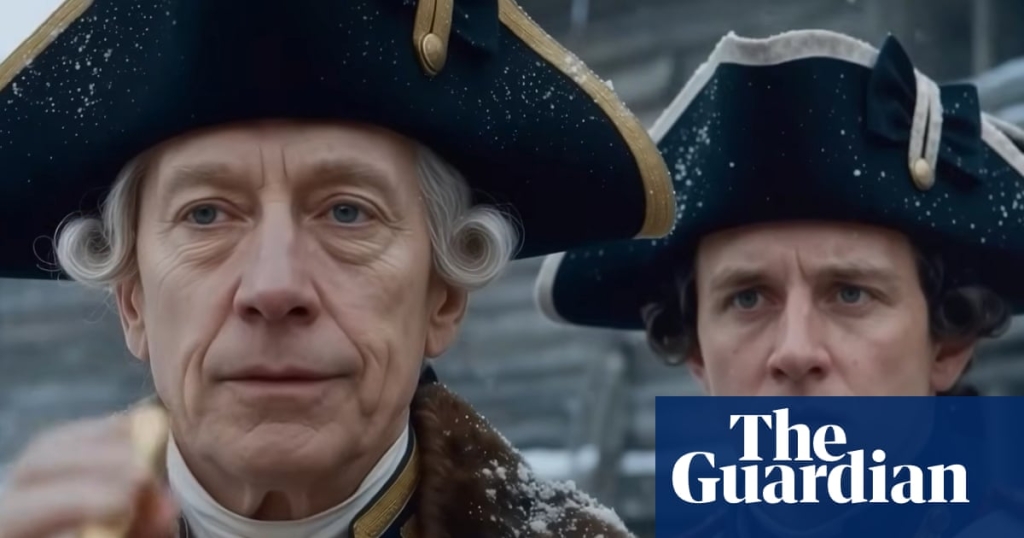
The premiere episode, a three-and-a-half-minute depiction of George Washington raising a new flag over Prospect Hill, is meant to capture the moment when “rebellion becomes resolve.” However, the execution falls dramatically short of the ambitious vision. The video opens with a shot of King George III that can only be described as nightmarish—his hair resembles “a melted and hardened plastic badger,” setting the tone for what becomes an increasingly unsettling viewing experience.
The technical limitations of current AI generation technology are painfully evident throughout the series. The characters’ faces, particularly those of the elderly historical figures, suffer from what can only be described as a severe case of the “uncanny valley” syndrome. Their features appear to be constructed from multiple layers of tissue paper that never quite align properly, creating a disconcerting effect where wrinkles shift in color and depth from frame to frame.
Benjamin Franklin’s depiction stands out as particularly disturbing, appearing as if “someone has genetically spliced Hugh Laurie with Anthony Hopkins, and then covered the resulting monstrosity in a thin layer of roving liver spots.” The overall aesthetic falls somewhere between “an animatronic sex toy convention” and “those old Taiwanese news cartoons,” creating a viewing experience that many find genuinely traumatic.
Despite these significant visual shortcomings, the series does showcase some progress in AI technology. When compared to earlier AI-generated content like the infamous “Tilly Norwood” character, “On This Day… 1776” demonstrates measurable improvement in rendering quality and movement fluidity. This rapid advancement raises both exciting possibilities and troubling questions about the future of human involvement in entertainment production.
The voice acting presents an interesting paradox within the production. While all vocal performances are delivered by human actors—a decision that has drawn criticism from those who believe the project missed an opportunity to fully embrace AI technology—these human elements prove to be the most convincing aspects of the series. The disconnect between the natural-sounding voices and the artificial movements of the characters’ mouths creates an additional layer of cognitive dissonance for viewers.
Industry observers note that the day is fast approaching when even these human voice performances may become unnecessary. As AI technology continues to advance at its current pace, we may soon witness the creation of entirely AI-generated content, from writing and acting to directing and editing, all produced through simple text prompts.
This technological progression raises significant legal and ethical questions, particularly regarding the use of actors’ likenesses. Several characters in the series appear to draw inspiration from recognizable Hollywood faces, with Thomas Paine’s portrayal seemingly channeling elements of Ralph Fiennes, Daniel Day-Lewis, and Matthew Macfadyen. This practice has already led to legal challenges in the industry, as evidenced by Scarlett Johansson’s recent legal action against OpenAI for creating a voice “eerily similar” to her own.
The release of “On This Day… 1776” comes at a crucial moment in the entertainment industry’s relationship with AI technology. While some view it as a necessary step in exploring the capabilities and limitations of artificial intelligence in creative fields, others see it as a troubling indication of where the industry might be headed—a future where human creativity and performance become increasingly marginalized.
Darren Aronofsky, known for his provocative and often disturbing films, may have inadvertently created his most unsettling work yet. The series represents not just a technological experiment, but a cultural moment that forces us to confront questions about the nature of art, the value of human creativity, and the ethical implications of replacing human performers with artificial intelligence.
As the debate surrounding AI in entertainment continues to evolve, “On This Day… 1776” serves as both a milestone and a cautionary tale. It demonstrates both the potential and the current limitations of AI-generated content while raising important questions about the future of human involvement in creative industries.
Tags & Viral Phrases:
AI-generated content, historical drama, Darren Aronofsky, Time magazine, artificial intelligence entertainment, uncanny valley, revolutionary war series, AI limitations, voice acting controversy, Scarlett Johansson legal battle, future of filmmaking, machine learning in media, digital actors, entertainment industry disruption, AI technology advancement, creative automation, human vs AI performance, digital likeness rights, entertainment evolution, technological singularity in media
,


Leave a Reply
Want to join the discussion?Feel free to contribute!