
Reverend Jesse Jackson dies at age 84
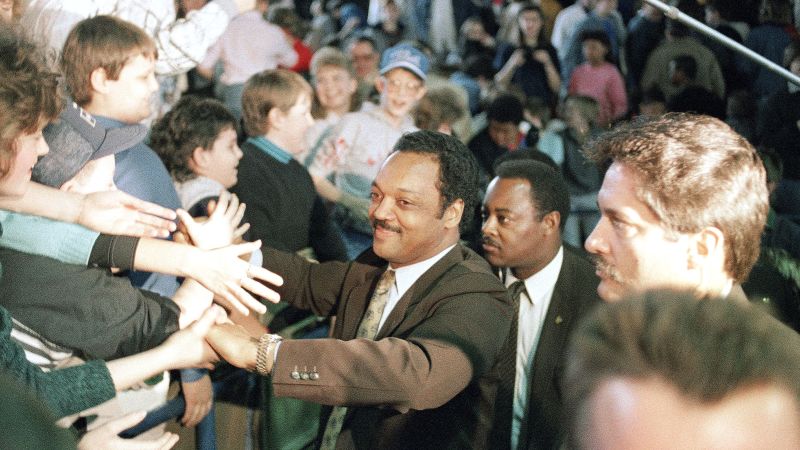
Jesse Jackson, Civil Rights Icon and Political Trailblazer, Dies at 84
Jesse Louis Jackson, the charismatic civil rights leader whose fiery oratory and moral vision reshaped American politics and inspired generations, has died at the age of 84, according to a statement from his family and the Rainbow PUSH Coalition.
Jackson, who rose from humble beginnings in the segregated South to become one of the most influential figures in American history, passed away Tuesday morning surrounded by family members at his Chicago home. The cause of death was not immediately disclosed, though he had been hospitalized in recent months while being monitored for progressive supranuclear palsy, a rare brain disorder.
“His unwavering commitment to justice, equality, and human rights helped shape a global movement for freedom and dignity,” the Rainbow PUSH Coalition stated. “A tireless change agent, he elevated the voices of the voiceless—from his Presidential campaigns in the 1980s to mobilizing millions to register to vote—leaving an indelible mark on history.”
Born on October 8, 1941, in Greenville, South Carolina, to an unwed teenage mother during the Jim Crow era, Jackson’s journey to becoming a civil rights icon reads like an American epic. His biological father was his married next-door neighbor, Noah Robinson, and he was adopted by his mother’s husband, Charles Jackson, when he was just one year old.
Jackson’s childhood was marked by the sting of segregation and the pain of being called “a nobody who had no daddy” by classmates. Yet these early experiences of marginalization would fuel his lifelong crusade for equality and his ability to connect with the downtrodden.
A protégé of Dr. Martin Luther King Jr., Jackson first rose to national prominence in the 1960s as a young activist in the Southern Christian Leadership Conference. He was standing just feet away from King when the civil rights leader was assassinated on the balcony of the Lorraine Motel in Memphis on April 4, 1968. The traumatic event would shape Jackson’s approach to activism and leadership for decades to come.
Following King’s death, Jackson emerged as one of the most prominent voices in the civil rights movement, though his ambition and sometimes brash style created tensions with other King lieutenants. Undeterred, he founded Operation PUSH (People United to Save Humanity) in 1971 and later merged it with the National Rainbow Coalition in 1996 to form the Rainbow PUSH Coalition.
Jackson’s political career reached its zenith with his groundbreaking presidential campaigns in 1984 and 1988. These bids for the Democratic nomination transformed American politics in ways that still resonate today. He became the first viable Black presidential candidate, shocking political observers with his ability to attract White working-class voters in states like Michigan and Vermont.
His 1988 campaign was particularly historic. Jackson won five primaries and caucuses, including Georgia, Virginia, and Louisiana, and finished second in the delegate count behind eventual nominee Michael Dukakis. More importantly, he fundamentally altered the Democratic Party’s demographic makeup and policy priorities.
“Jesse Jackson didn’t just participate in the Democratic Party—he remade it,” said David Masciotra, author of “I Am Somebody: Why Jesse Jackson Matters.” “A Democratic Party that now represents a multicultural America and has someone like Kamala Harris as the (former) Vice President and Obama as the former President began in many ways with those Jackson campaigns.”
Jackson’s political innovations were numerous and lasting. He successfully fought to change the Democratic primary system from winner-take-all to proportional representation, a reform that would later benefit Barack Obama in his 2008 primary battle against Hillary Clinton. He made support for gay rights a central part of his campaign platform decades before it became mainstream Democratic policy.
His signature phrase, “I Am Somebody,” became a rallying cry for marginalized communities across America. Delivered in his distinctive preacher’s cadence, it was both a personal affirmation and a collective declaration of human dignity. Jackson’s speeches were masterclasses in rhetorical power, blending biblical imagery, street vernacular, and political analysis in ways that could move crowds to tears or to action.
Beyond electoral politics, Jackson became America’s foremost freelance diplomat, traveling to trouble spots around the world to negotiate the release of hostages and prisoners. His successful missions included securing the freedom of Navy Lieutenant Robert Goodman from Syria in 1984, winning the release of 48 Cuban and Cuban-American prisoners from Fidel Castro’s Cuba, and negotiating the release of three American soldiers held in Yugoslavia in 1999.
These diplomatic efforts earned him both praise and criticism. Some saw him as an ego-driven self-promoter interfering in complex international situations, while others viewed him as a courageous peacemaker willing to go where governments feared to tread.
Jackson’s personal life was as complex and controversial as his public career. In 2001, he acknowledged fathering a daughter, Ashley, with a former staffer during an extramarital affair. The revelation came amid financial pressures from a paternity suit and created a painful chapter for his family. Through it all, his wife of 62 years, Jacqueline Lavinia Brown Jackson, stood by his side, raising their five children—Santita, Jesse Jr., Jonathan, Yusef, and Jacqueline—and maintaining the family’s stability through decades of public tumult.
In his later years, Jackson continued to be a voice for justice, though Parkinson’s disease, diagnosed in 2017, gradually limited his physical capabilities. He remained active in social causes, participating in protests for voting rights, criminal justice reform, and economic equality. His arrest in 2021 while advocating for voting rights protections demonstrated that even in his 80s, he was willing to put his body on the line for the causes he believed in.
The arc of Jackson’s life spanned the entire modern civil rights movement. He was old enough to remember legally segregated water fountains and buses, yet lived to see the election of the first Black president—a moment that moved him to tears in Chicago’s Grant Park in 2008. When asked if it hurt that he never became president himself, Jackson responded with characteristic grace: “No, it doesn’t, because I was a trailblazer, I was a pathfinder. I had to deal with doubt and cynicism and fears about a Black person running.”
Jackson’s influence extended far beyond the boundaries of civil rights and politics. He was a cultural figure who appeared on Saturday Night Live, recorded spoken-word albums, and became a fixture in American popular culture. His ability to move between the pulpit, the protest march, the negotiating table, and the television studio made him one of the most recognizable faces in America for over five decades.
As news of his death spread, tributes poured in from across the political spectrum. President Joe Biden called Jackson “a transformative figure who turned the moral imperatives of the Civil Rights Movement into real progress for millions of Americans.” Former President Barack Obama noted that “without the pioneering work of Jesse Jackson, my journey and so many others would have been much more difficult.”
Reverend Al Sharpton, who considered Jackson a mentor, said: “Jesse Jackson was to the second half of the 20th century what Dr. King was to the first half. He carried the baton of justice when many thought the race was over.”
Civil rights attorney Benjamin Crump observed: “Jesse Jackson taught us that the fight for justice is never finished. He showed us how to keep hope alive even in the darkest times.”
Jackson’s death marks the end of an era in American civil rights leadership. He was the last of the civil rights titans who marched with King, yet his vision of a Rainbow Coalition—a multiracial, multiethnic alliance united by common economic and social justice goals—remains as relevant today as when he first articulated it in 1984.
In his final years, as Parkinson’s disease gradually limited his public appearances, Jackson continued to receive recognition for his lifetime of activism. In 2024, he was honored on stage at the Democratic National Convention, a poignant moment that connected the party’s civil rights roots with its present-day diversity.
The Rainbow PUSH Coalition announced plans for a public memorial service in Chicago, followed by burial in his beloved South Carolina. In lieu of flowers, the family requested donations to the organization Jackson founded, ensuring that his work for justice and equality will continue beyond his lifetime.
Jesse Jackson’s life was a testament to the power of persistence, the importance of hope, and the possibility of redemption. From the segregated South to the corridors of power, from the streets of Chicago to the world stage, he never stopped believing that America could live up to its highest ideals. In a career spanning six decades, he transformed American politics, expanded the boundaries of possibility for millions of Americans, and kept hope alive through some of the nation’s most turbulent times.
As America grapples with ongoing struggles over voting rights, economic inequality, and racial justice, Jackson’s legacy serves as both inspiration and challenge. He showed that change is possible through persistence, coalition-building, and an unwavering commitment to justice. His life reminds us that while the road to equality is long and difficult, it is a journey worth taking—and that each generation must pick up the baton and continue the march toward a more perfect union.
JesseJackson #CivilRightsLegend #RainbowCoalition #KeepHopeAlive #AmericanIcon #PoliticalPioneer #SocialJusticeWarrior #Trailblazer #DemocraticParty #CivilRightsMovement #HistoricFigure #Activism #Leadership #ChangeMaker #Equality #Justice #Legacy #RIPJesseJackson #AmericanHistory #InspirationalLeader #RainbowPUSH #JesseJacksonDead #CivilRightsIcon #PoliticalHistory #AmericanOriginal
,


Leave a Reply
Want to join the discussion?Feel free to contribute!