
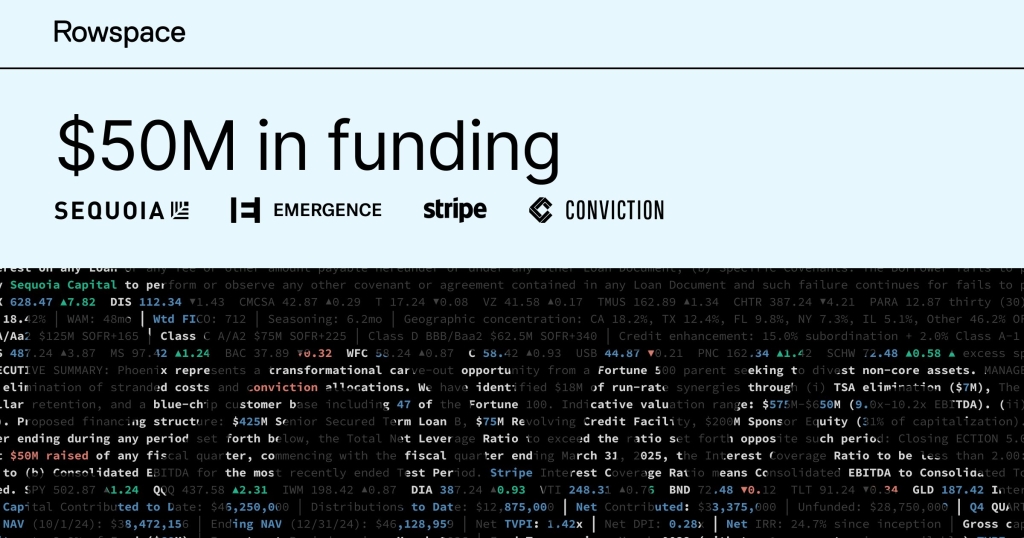
Rowspace Raises $50M to Bring AI for Private Equity Out of the Back Office
Rowspace: The AI Platform That’s Rewriting the Rules of Private Equity
In the high-stakes world of private equity, where billions of dollars ride on split-second decisions, there’s an invisible bottleneck that’s been choking the industry for decades. Imagine having decades of accumulated wisdom—thousands of deals, countless due diligence reports, mountains of market analysis—but being unable to actually use it effectively. That’s the problem Rowspace is solving, and they just raised a staggering $50 million to do it.
The Hidden Crisis in Private Equity
Private equity runs on something far more valuable than capital: judgment. But here’s the brutal truth that nobody talks about—judgment is extraordinarily hard to scale. Every single time a new deal crosses a firm’s desk, analysts are essentially starting from scratch, reinventing the wheel, even though the answers to their most pressing questions are buried somewhere in their own firm’s history.
Think about it: decades of deal memos, underwriting models, partner notes, and portfolio data scattered across systems that were never designed to communicate with each other. It’s like having a massive library where every book is in a different language, and you need to find the exact paragraph that answers your question—every single day.
Meet the MIT Duo Taking on Wall Street
Rowspace was founded by Michael Manapat and Yibo Ling, two MIT graduates who took very different paths before converging on this singular problem. Manapat built the machine learning systems at Stripe that process billions of transactions, then helped drive Notion’s expansion into AI as its CTO. Ling, on the other hand, became a two-time CFO who led finance teams at Uber and Binance, spending years making investment decisions by manually synthesizing data across fragmented systems.
When ChatGPT launched in late 2022, Ling tested it on due diligence tasks and hit a wall. “Clearly there was a lot of promise, but it just wasn’t working,” he told Fortune. “You need the right information in the right context.” That gap—between AI’s potential and the messy, proprietary, institution-specific data reality of finance—became the founding thesis.
What Makes Rowspace Different
Here’s where it gets interesting. Rowspace isn’t just another AI wrapper or chatbot. The platform connects structured and unstructured data across a firm’s entire history—document repositories, investment and accounting systems, old PowerPoints, deal memos—and applies what Manapat calls a “finance-native lens.”
But the real magic? It processes all of this inside a client’s own cloud environment. The firm’s data never leaves its control. This isn’t some black box where you feed in data and hope for the best. This is AI that learns how your firm thinks, how it makes decisions, how it reconciles information.
The Sequoia and Emergence Bet
The investor conviction behind this $50 million raise is itself a signal worth reading. Alfred Lin, the Sequoia partner who led the investment, is making a bold claim: that vertical AI systems built on deep, proprietary data layers are precisely where durable competitive advantage will compound.
Jake Saper from Emergence Capital puts it even more bluntly: “They’re doing the previously impossible work of connecting proprietary data, and reconciling and reasoning over it with real rigour. Without this foundation, it doesn’t matter what other AI tools you’re using.”
Why This Matters Now
The back office of investment management has quietly been one of the last frontiers general AI has struggled to crack. The reason is simple: private equity deals aren’t just about data—they’re about judgment, context, and institutional knowledge that’s been accumulated over decades.
Rowspace is betting that the future of finance isn’t about having more data, but about being able to actually use the data you already have. It’s about turning institutional knowledge into compounding edge.
Early Traction That Speaks Volumes
Here’s the kicker: early customers—unnamed but described as name-brand private equity and credit firms managing hundreds of billions to nearly a trillion dollars in assets—are already living on the platform, with about ten top firms on seven-figure annual contract values.
These aren’t small pilot programs. These are firms betting millions that Rowspace can fundamentally change how they make decisions.
The Vision: A Firm That Never Forgets
Manapat captures the ambition perfectly: “Imagine a firm that never forgets. Where an experienced investor’s workflows—touching many different tools in specific ways—can be codified and multiplied. When that’s possible, a first-year analyst can tap into decades of institutional knowledge, and judgment scales with a firm instead of being diluted.”
This isn’t just about efficiency. It’s about fundamentally changing the economics of private equity. It’s about ensuring that when a firm makes a decision, it’s making that decision with the full weight of its accumulated wisdom behind it.
The Vertical AI Thesis
What makes this particularly fascinating is how it fits into the broader AI landscape. While much of the tech world is worried that foundation models will eventually commoditize applications, Lin’s view is the opposite: that vertical AI systems built on deep, proprietary data layers are where the real value will be created.
For private equity specifically, where alpha is by definition firm-specific and non-replicable, that logic is particularly hard to argue with. The data moat here isn’t just valuable—it’s essential.
Tags: AI for private equity, Rowspace funding, Sequoia investment, private equity AI, institutional knowledge, vertical AI, finance technology, deal-making AI, investment decision-making, AI platform, private equity technology, machine learning finance, data integration, judgment scaling, private equity innovation
Viral Sentences:
- “Private equity runs on judgment—and judgment is extraordinarily hard to scale.”
- “Imagine a firm that never forgets.”
- “Most tech tools aren’t comprehensive or nuanced enough for finance.”
- “Finance is full of high-stakes decisions. There used to be a tradeoff between moving quickly and making fully informed decisions.”
- “Without this foundation, it doesn’t matter what other AI tools you’re using.”
- “The back office of investment management has quietly been one of the last frontiers general AI has struggled to crack.”
- “A first-year analyst can tap into decades of institutional knowledge.”
- “Judgment scales with a firm instead of being diluted.”
- “They’re doing the previously impossible work of connecting proprietary data.”
- “The data moat here isn’t just valuable—it’s essential.”
,


Leave a Reply
Want to join the discussion?Feel free to contribute!