
Russian Soldiers Seen Surrendering to Gun-Wielding Robot
Ukraine’s Robot Warriors: How AI-Powered Machines Are Reshinking Modern Warfare on the Battlefield
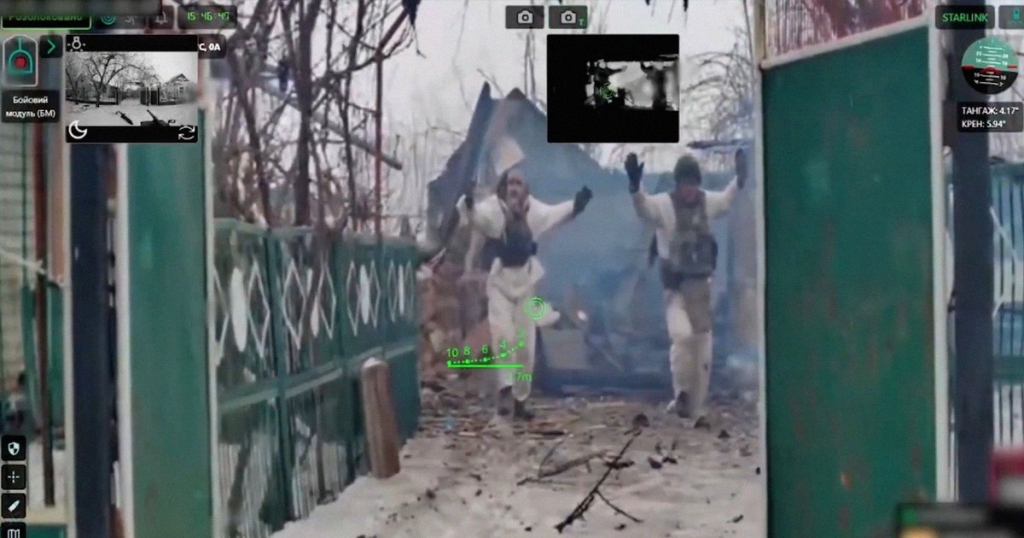
In what military analysts are calling a watershed moment in modern warfare, a chilling video has emerged from the front lines of Ukraine showing three Russian soldiers surrendering to a heavily armed robot—marking what could be one of the first documented instances of AI-powered ground machines compelling enemy forces to capitulate.
The footage, which has gone viral across social media platforms, depicts the surreal scene of armed Russian troops emerging from a building with their hands raised, seemingly surrendering to a washing machine-sized robot platform equipped with a mounted machine gun. The robot, identified as the Droid TW-7.62 built by Ukrainian defense company DevDroid, represents the cutting edge of Ukraine’s rapidly evolving unmanned ground vehicle (UGV) program.
According to military observers, one of the surrendering soldiers appears to be covered in blood, adding a grim layer to this unprecedented moment in combat history. A separate drone hovers nearby, documenting the encounter from above, creating a multi-layered surveillance operation that would have been unthinkable just years ago.
The Droid TW-7.62 is no ordinary machine. Developed at the request of Ukraine’s First Medical Battalion, this AI-enabled platform was originally designed to evacuate wounded soldiers under heavy fire. However, as the conflict has evolved, so too has the robot’s role on the battlefield. The platform can autonomously identify targets and fire 7.62mm caliber rounds with precision, representing a significant leap in robotic warfare capabilities.
Ukraine’s transformation into a world leader in unmanned ground vehicles has been driven by necessity. With over 200 different UGV models now in production across 40 Ukrainian defense companies, the country has essentially become a real-world laboratory for autonomous warfare technologies. These range from AI-enabled anti-drone laser systems to ground-based machine-gun platforms, each designed to reduce human casualties while maintaining tactical superiority.
The economic implications are equally striking. Ukrainian defense firms now produce 99 percent of their UGV systems domestically, creating a robust indigenous defense industry that has attracted attention from Western partners. German company ARX Robotics, for instance, is manufacturing a fleet of small tank-like UGVs to support Ukrainian operations, highlighting the international dimension of this technological evolution.
Beyond the psychological impact of forcing enemy surrender, these robots serve multiple critical functions on the battlefield. Some are equipped to lay anti-tank mines, while others can transport tons of supplies to front-line troops under conditions too dangerous for human convoys. Perhaps most remarkably, certain models are outfitted with explosives capable of self-destructing near enemy fortifications or bridges, essentially turning them into remote-controlled demolition units.
The tactical advantages are clear. As the Jamestown Foundation noted in its recent assessment, Ukrainian UVGs are “increasingly replacing infantry in high-risk missions, providing sustained firepower, engineering support, and resilience against electronic warfare, terrain challenges, and prolonged deployments.” This shift represents a fundamental reimagining of how modern conflicts are fought, with robots taking on roles traditionally reserved for human soldiers.
The evolution of robotic warfare in Ukraine hasn’t gone unnoticed by Russia, though the larger adversary has struggled to match Ukraine’s technological advancements. While Russian forces have their own UGV programs, the effectiveness and sophistication of Ukrainian systems have provided a significant tactical edge that has helped offset Russia’s numerical superiority in conventional forces.
Military strategists are watching this conflict closely, as it offers unprecedented insights into how autonomous systems might reshape warfare in the coming decades. The ability of machines to not only engage enemy forces but to compel their surrender raises profound questions about the future of combat, international law, and the role of human decision-making in warfare.
As this robotic revolution continues to unfold on Ukrainian soil, one thing is certain: the future of warfare has arrived, and it’s being written in code, circuits, and steel rather than just bullets and blood.
UkraineWar #RoboticWarfare #AIinCombat #MilitaryTechnology #UGV #AutonomousWeapons #FutureOfWarfare #UkraineDefense #TechInnovation #MilitaryAI #DroneWarfare #ModernCombat #DefenseTechnology #AIrobots #WarInnovation
,

Leave a Reply
Want to join the discussion?Feel free to contribute!