
Rust Coreutils 0.6 Brings Increased Compatibility, Removing Some Unsafe Code & More Perf
Rust Coreutils 0.6 Unleashes Performance and Safety Improvements in GNU Toolset Reimplementation
The Rust programming language continues to make significant inroads into system utilities with the release of Rust Coreutils 0.6, marking another milestone in the ambitious project to reimplement the GNU Coreutils suite using Rust’s memory-safe paradigms. Following the high-profile presentation at FOSDEM 2026, where developers showcased the project’s progress and future roadmap, this latest release demonstrates substantial advancements in both compatibility and performance.
Near-Perfect Compatibility Achieved
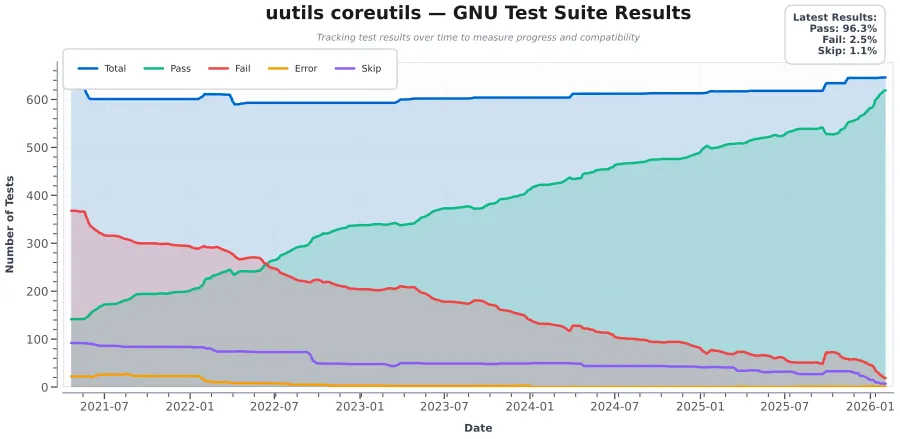
The most striking achievement in Rust Coreutils 0.6 is the remarkable compatibility rate, with the suite now passing 622 out of 646 GNU Coreutils test suite tests. This translates to an impressive 96.28% compatibility rate, bringing the project tantalizingly close to its ultimate goal of 100% pass rate across all test scenarios. The development team has been methodical in their approach, systematically addressing edge cases and compatibility issues that arise during the testing process.
This level of compatibility is particularly noteworthy given the complexity of the GNU Coreutils suite, which forms the backbone of countless Linux and Unix-like systems worldwide. The utilities included in Coreutils are fundamental to system administration, scripting, and everyday command-line operations, making perfect compatibility essential for any viable alternative implementation.
Enhanced Safety Through Code Modernization
One of the most significant technical achievements in this release involves the systematic elimination of unsafe code blocks throughout the codebase. Developers have successfully removed unsafe code from critical utilities including the date command, which handles complex time zone calculations and calendar operations, and the sort command, which processes large datasets with intricate comparison algorithms.
The replacement of raw libc calls with safe Nix crate equivalents represents a fundamental shift in how the utilities interact with the underlying operating system. This architectural change not only improves safety but also enhances portability across different Unix-like platforms. The Nix crate provides a safe, idiomatic Rust interface to system calls, eliminating many of the memory safety concerns that plague traditional C implementations.
Localization and Internationalization Improvements
Rust Coreutils 0.6 introduces enhanced localization support, making the utilities more accessible to users worldwide. The development team has implemented comprehensive internationalization features that allow the tools to adapt to different languages, character encodings, and cultural conventions. This work builds upon Rust’s excellent Unicode support and extends it to the domain of system utilities, where proper handling of international text is crucial for global usability.
The localization improvements extend beyond simple text translation to include proper handling of locale-specific formatting rules, date and time representations, and numeric formatting conventions. These enhancements ensure that Rust Coreutils can serve as a drop-in replacement for GNU Coreutils in diverse international environments.
Expanded Platform Support and Testing
The 0.6 release significantly expands the project’s platform support, with particular emphasis on improving compatibility with less common architectures and operating systems. Enhanced Cygwin support ensures that Windows users running the Cygwin compatibility layer can take full advantage of the Rust-based utilities. The increased focus on RISC-V 64-bit testing demonstrates the project’s commitment to supporting emerging hardware architectures, positioning Rust Coreutils as a forward-looking alternative to traditional implementations.
The expanded testing infrastructure now includes more comprehensive coverage of edge cases and platform-specific behaviors, ensuring that the utilities behave consistently across different environments. This rigorous testing approach has been instrumental in achieving the high compatibility rate while maintaining the safety guarantees that Rust provides.
Performance Optimizations Across Multiple Utilities
Performance improvements in Rust Coreutils 0.6 span multiple utilities and encompass various optimization strategies:
The base64 utility has received significant performance enhancements through reduced memset optimizations, resulting in faster encoding and decoding operations. These improvements are particularly noticeable when processing large files or streaming data through pipelines.
The shuf command, which generates random permutations of input lines, now produces optimized numeric output, reducing computational overhead and improving throughput for data processing tasks. This optimization is especially valuable for users who rely on shuf for generating test data or randomizing input streams.
The uniq utility, which filters out repeated lines from sorted input, has seen memory usage optimizations for ignore-case comparisons. This enhancement reduces the memory footprint when processing large datasets with case-insensitive matching requirements, making the tool more efficient for data deduplication tasks.
The df command, which reports file system disk space usage, has been optimized for better file-system handling. These improvements result in more accurate and responsive disk usage reporting, particularly when dealing with network file systems or complex storage configurations.
Development Philosophy and Future Directions
The Rust Coreutils project embodies a modern approach to systems programming that prioritizes safety without sacrificing performance or compatibility. By leveraging Rust’s ownership model, type system, and zero-cost abstractions, the developers have created an implementation that addresses many of the security vulnerabilities and memory safety issues that have historically plagued C-based system utilities.
The project’s commitment to achieving 100% compatibility with GNU Coreutils while maintaining Rust’s safety guarantees represents a significant technical challenge. Each utility must not only produce identical output to its GNU counterpart but also handle the same edge cases, error conditions, and platform-specific behaviors. This rigorous compatibility requirement ensures that Rust Coreutils can serve as a true drop-in replacement for existing systems.
Community and Ecosystem Impact
The release of Rust Coreutils 0.6 has generated considerable excitement within the open-source community, particularly among developers interested in systems programming and security. The project serves as a compelling demonstration of Rust’s capabilities for systems-level software development, showcasing how the language’s safety features can be applied to fundamental system utilities without compromising on performance or compatibility.
The FOSDEM presentation that preceded this release helped raise awareness of the project and attracted new contributors to the effort. The open-source nature of the project encourages community participation, with developers from around the world contributing bug fixes, performance improvements, and platform-specific enhancements.
Technical Implementation Details
Under the hood, Rust Coreutils 0.6 leverages several key Rust features and ecosystem components:
The project makes extensive use of Rust’s pattern matching and iterator combinators to implement complex text processing algorithms in a safe and efficient manner. The ownership system ensures that memory management is handled correctly without the need for manual memory allocation and deallocation.
The use of the Nix crate for system interactions demonstrates how Rust’s ecosystem can provide safe alternatives to traditional C system programming patterns. This approach eliminates entire categories of memory safety bugs while maintaining the low-level control necessary for system utilities.
The project’s testing infrastructure makes heavy use of Rust’s built-in testing framework, with comprehensive unit tests, integration tests, and property-based tests ensuring correctness across a wide range of scenarios. The test suite’s compatibility with the GNU Coreutils test suite provides an objective measure of the project’s progress toward its compatibility goals.
Download and Installation
Rust Coreutils 0.6 is available for download through the project’s GitHub releases page, where users can find pre-built binaries for various platforms as well as source code for compilation. The project maintains detailed installation instructions and documentation to help users get started with the Rust-based utilities.
The installation process is designed to be straightforward, allowing users to gradually migrate from GNU Coreutils to Rust Coreutils or to run both implementations side-by-side for comparison and testing purposes. This approach facilitates adoption while ensuring that users can maintain their existing workflows during the transition period.
Looking Ahead
As Rust Coreutils continues its march toward 100% compatibility with GNU Coreutils, the development team is already looking ahead to future enhancements and optimizations. The success of the 0.6 release demonstrates that the project’s ambitious goals are achievable, and the growing community of contributors suggests that momentum will continue to build.
The project’s progress has implications beyond just providing an alternative implementation of system utilities. It serves as a proof of concept for applying modern programming language features to traditional systems programming domains, potentially influencing how future system software is developed and maintained.
Tags
Rust programming language, system utilities, GNU Coreutils, memory safety, FOSDEM 2026, open-source software, systems programming, cross-platform compatibility, performance optimization, internationalization, RISC-V support, Cygwin compatibility, Nix crate, safe systems programming, command-line tools, software modernization
Viral Sentences
Rust is eating the world, one core utility at a time! Memory safety meets system administration in this groundbreaking project. The future of Unix utilities is written in Rust, and it’s coming faster than you think. 96.28% compatibility isn’t just a number—it’s a revolution in systems programming. Say goodbye to buffer overflows and use-after-free errors in your favorite command-line tools. The Rust Coreutils team is proving that safety and performance aren’t mutually exclusive. This isn’t just a reimplementation—it’s a reimagining of how system utilities should work in the 21st century. When your df command is written in Rust, you know things are getting interesting in the world of systems programming. The GNU Coreutils test suite has met its match in this Rust-powered alternative. Forget everything you knew about system utilities—Rust Coreutils is here to change the game.
,

Leave a Reply
Want to join the discussion?Feel free to contribute!