
Rust Coreutils 0.8 Brings Significant Performance Gains
Rust Coreutils 0.8: A Quantum Leap in Performance and WebAssembly Integration
In a landmark release that’s sending ripples through the open-source development community, Rust Coreutils 0.8 has officially dropped, delivering what the project team describes as “significant” performance enhancements across its suite of core utilities. This latest iteration represents not just incremental improvements, but a substantial leap forward in both functionality and cross-platform compatibility.
Performance Gains That Matter
The headline feature of this release is undoubtedly the dramatic performance improvements. The venerable dd command, a staple for Unix system administrators for decades, now executes approximately 45% faster than its predecessor. This isn’t just a marginal improvement—it’s the kind of optimization that translates directly into time savings for developers and system administrators managing large-scale data transfers and disk operations.
Beyond the star performer, the release brings faster startup times across all utilities, addressing a common pain point for users who frequently invoke these tools in scripts and interactive sessions. The sort command, essential for data processing and log analysis, now handles path sorting with noticeably improved efficiency. Even the numfmt utility, which converts numbers to human-readable formats, sees a solid 3% performance boost—seemingly small, but these optimizations compound when utilities are chained together in complex pipelines.
WebAssembly Support Reaches New Heights
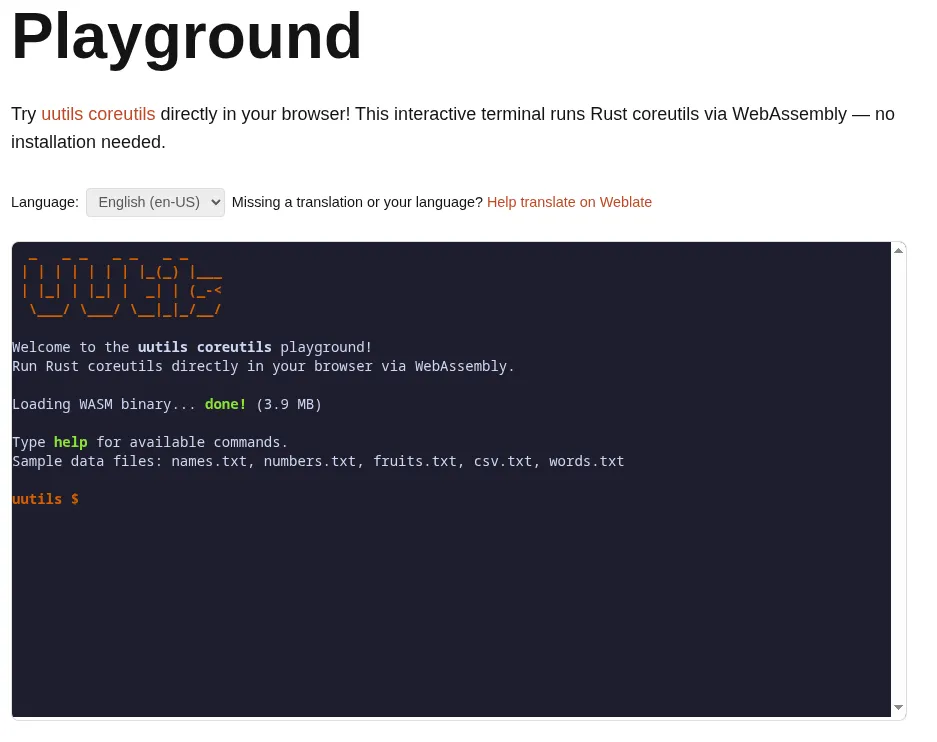
Perhaps the most exciting development is the expanded WebAssembly (WASM) support, culminating in the introduction of an interactive online playground. This browser-based environment allows developers to experiment with Rust Coreutils without any local installation, democratizing access to these powerful tools and potentially introducing them to a broader audience.
The WASM support leverages the WebAssembly System Interface (WASI), enabling these traditionally command-line utilities to run in web browsers with remarkable fidelity. This represents a significant step toward making Unix-style tooling more accessible to developers working in constrained environments or those who prefer cloud-based development workflows.
The playground, accessible at https://uutils.github.io/playground/, offers an intuitive interface where users can select from various core utilities, input their parameters, and immediately see results. This live demonstration of Rust Coreutils’ capabilities could prove invaluable for educational purposes and for convincing skeptics of the project’s maturity and utility.
Reliability and Compatibility Improvements
The development team has made substantial progress in compatibility, with Rust Coreutils now passing approximately 94.74% of the GNU Coreutils test suite—a marginal but meaningful improvement of 0.15% over the previous release. While complete parity with GNU Coreutils remains an aspirational goal, this level of compatibility ensures that scripts and workflows designed for the traditional toolset can often be migrated with minimal friction.
Equally important is the continued reduction of unsafe code throughout the codebase. Each iteration of Rust Coreutils moves further away from the unsafe Rust constructs that, while sometimes necessary for performance, introduce potential security vulnerabilities and maintenance challenges. This commitment to safety aligns perfectly with Rust’s core philosophy and makes the project more attractive for security-conscious organizations and critical infrastructure deployments.
The Rust Advantage
Rust Coreutils exemplifies the advantages of the Rust programming language in systems programming. The memory safety guarantees inherent to Rust eliminate entire categories of bugs that have plagued C-based utilities for decades. Combined with Rust’s excellent tooling, strong type system, and modern language features, this project demonstrates that systems software can be both safe and performant.
The project’s architecture also benefits from Rust’s strong ecosystem, including robust testing frameworks, comprehensive documentation tools, and a growing collection of crates (libraries) that accelerate development. This foundation positions Rust Coreutils for continued rapid evolution and improvement.
Community and Future Prospects
Available for download through the project’s GitHub releases page, Rust Coreutils 0.8 represents the collective effort of a dedicated open-source community. The project’s transparent development process, comprehensive testing, and regular release cadence have earned it respect within the broader Unix and Linux ecosystems.
Looking ahead, the combination of performance improvements, expanded WebAssembly support, and continued compatibility work suggests a bright future for Rust Coreutils. As more organizations adopt Rust for systems programming and as WebAssembly continues its march toward ubiquity, tools like these will become increasingly valuable.
Tags
Rust Coreutils 0.8, performance optimization, WebAssembly WASI, online playground, systems programming, open-source development, GNU Coreutils alternative, Rust programming language, command-line utilities, cross-platform compatibility, memory safety, Unix tools, browser-based development, software engineering innovation, DevOps tools, data processing utilities
Viral Phrases
“45% faster dd command changes everything”
“Unix utilities in your browser—the future is now”
“Rust proves systems programming can be safe AND fast”
“The WebAssembly revolution reaches command-line tools”
“When GNU meets Rust: a match made in systems heaven”
“Finally, a Coreutils alternative that doesn’t compromise”
“Command-line tools without installation? Yes, please!”
“The 0.15% that matters: compatibility marches forward”
“Unsafe code reduction: security by default”
“Performance gains that actually impact your workflow”
“Democratizing Unix tools through the browser”
“The Rust advantage: where safety meets speed”
“Systems programming’s next big thing is already here”
“WebAssembly playground makes experimentation effortless”
“Command-line evolution in the age of Rust”
,


Leave a Reply
Want to join the discussion?Feel free to contribute!