
Saturn’s rings may have formed after a huge collision with Titan
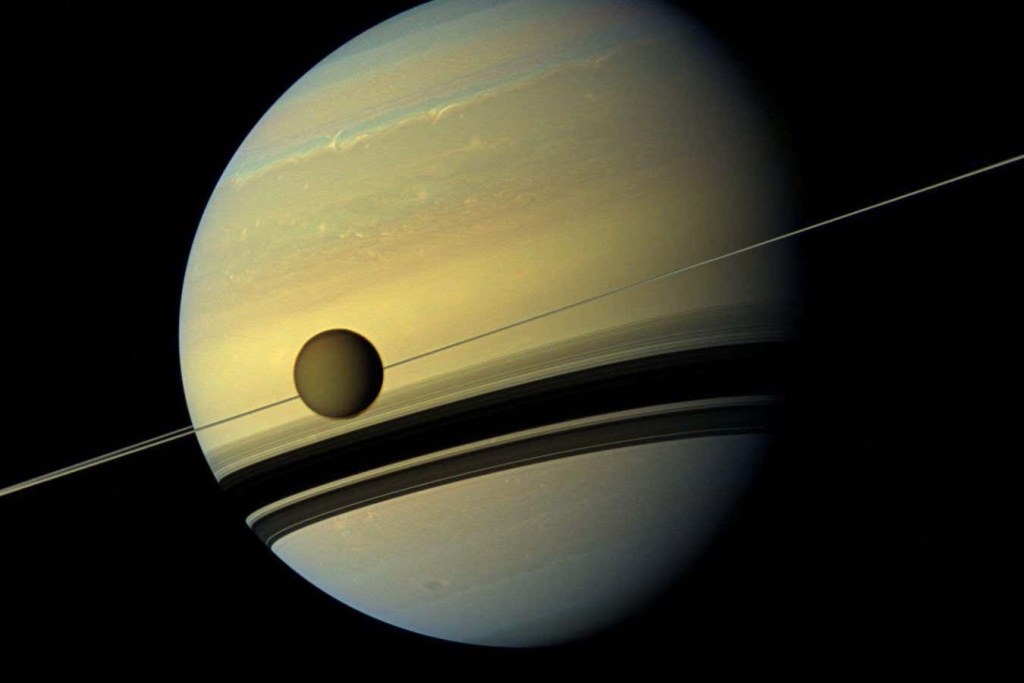
Titan’s Cosmic Crash: The Epic Collision That Shaped Saturn’s Rings and Moons
In a stunning revelation that could rewrite the history of our solar system, scientists have uncovered a cosmic drama that unfolded 400 million years ago—a colossal collision that not only transformed Saturn’s largest moon, Titan, but also gave birth to the planet’s iconic rings and solved long-standing mysteries about its celestial dance.
Saturn, the jewel of our solar system, has always been a source of fascination and mystery. Its shimmering rings, its tilted moon Iapetus, and its peculiar wobble have puzzled astronomers for decades. Now, a groundbreaking study led by Matija Ćuk at the SETI Institute in California suggests that all these enigmas might trace back to a single, cataclysmic event: a head-on collision between Titan and a smaller moon, once dubbed Chrysalis.
The Cosmic Puzzle: Saturn’s Unsolved Mysteries
Saturn’s system is a cosmic riddle. Its rings, once thought to be ancient, appear surprisingly young. The planet’s wobble doesn’t align with the gravitational influence of Neptune, as simulations had predicted. Iapetus, one of Saturn’s moons, orbits at a bizarre tilt, and Titan itself has an oddly elliptical orbit with far fewer craters than expected. For years, scientists have scratched their heads over these anomalies, but now, a “grand unified theory” may hold the answers.
The Collision: A Tale of Two Moons
The story begins with Chrysalis, a hypothetical moon proposed in 2022 to explain Saturn’s decoupled wobble. The original theory suggested that Chrysalis was flung toward Saturn, shattered into pieces, and formed the rings. However, Ćuk and his team noticed a critical flaw: in most simulations, Chrysalis didn’t break apart—it collided with Titan.
“If there was a collision with Titan, it could not have become the rings,” Ćuk explained. This realization led the team to explore what would happen if Chrysalis smashed into Titan 400 million years ago. The results were astonishing.
The Aftermath: A Chain Reaction of Cosmic Events
The collision would have erased Titan’s craters, reshaped its orbit from circular to elliptical, and sent a shower of debris hurtling through space. One piece of that debris, the moon Hyperion, could explain its surprisingly young age compared to Saturn’s other moons.
But the drama didn’t end there. Over time, Titan’s altered orbit destabilized the smaller inner moons, causing them to collide and grind each other into the fine particles that now form Saturn’s rings. “It all starts from Titan and then trickles down to a second catastrophe in the inner system,” Ćuk said.
A Unified Theory: Solving Saturn’s Mysteries
This collision theory elegantly ties together multiple mysteries. It explains Titan’s youthful surface, its eccentric orbit, the formation of Saturn’s rings, and even the tilted orbit of Iapetus. “If a collision with Titan 1.0 can explain many other things about the Saturn system, then I think that would really center Titan as being pivotal to how we see the system today,” said Sarah Hörst, a planetary scientist at Johns Hopkins University.
The Next Chapter: NASA’s Dragonfly Mission
The evidence to confirm or refute this theory may soon be within reach. NASA’s Dragonfly mission, set to launch in 2028 and arrive at Titan in 2034, will provide an unprecedented close-up look at the moon’s surface. If Titan’s terrain reveals signs of a massive collision, it could validate this cosmic tale and finally solve the riddles of Saturn’s system.
Conclusion: A Cosmic Legacy
The story of Saturn’s rings and moons is a testament to the dynamic and often violent nature of our solar system. What we see today—a serene, ringed planet—may have been born from chaos and collision. As we await the findings of Dragonfly, one thing is clear: Titan, Saturn’s largest moon, is not just a passive observer in this cosmic drama—it is the protagonist, the catalyst, and the key to unlocking the secrets of the Saturn system.
Tags: Saturn, Titan, Chrysalis, Saturn’s rings, cosmic collision, NASA Dragonfly, planetary science, SETI Institute, Sarah Hörst, Matija Ćuk, solar system mysteries, Hyperion, Iapetus, elliptical orbit, planetary formation, space exploration, cosmic drama, grand unified theory, planetary collision, celestial mechanics.
Viral Sentences:
- “Saturn’s rings may have been born from a cosmic crash 400 million years ago!”
- “Titan: The moon that shaped Saturn’s destiny.”
- “A single collision that solved multiple cosmic mysteries.”
- “NASA’s Dragonfly mission could confirm the epic tale of Titan’s transformation.”
- “Saturn’s wobble, rings, and moons—all tied to one ancient collision.”
- “The grand unified theory of Saturn’s system is here, and it’s mind-blowing.”
- “From chaos to beauty: How Titan’s collision created Saturn’s iconic rings.”
- “The solar system’s greatest unsolved mysteries, solved by one cosmic event.”
,


Leave a Reply
Want to join the discussion?Feel free to contribute!