
Say Goodbye to the Undersea Cable That Made the Global Internet Possible
The Internet’s True Guardians: The Unsung Heroes Behind Our Digital World
In the vast, mysterious depths of our oceans lies a network that most of us never think about—until it stops working. This network isn’t run by sharks, sabotaged by foreign powers, or maintained by satellites orbiting high above. Instead, it’s tended to by a dedicated community of engineers, technicians, and maritime workers who ensure that our digital lives continue uninterrupted, day after day, year after year.
Debunking the Great Shark Myth
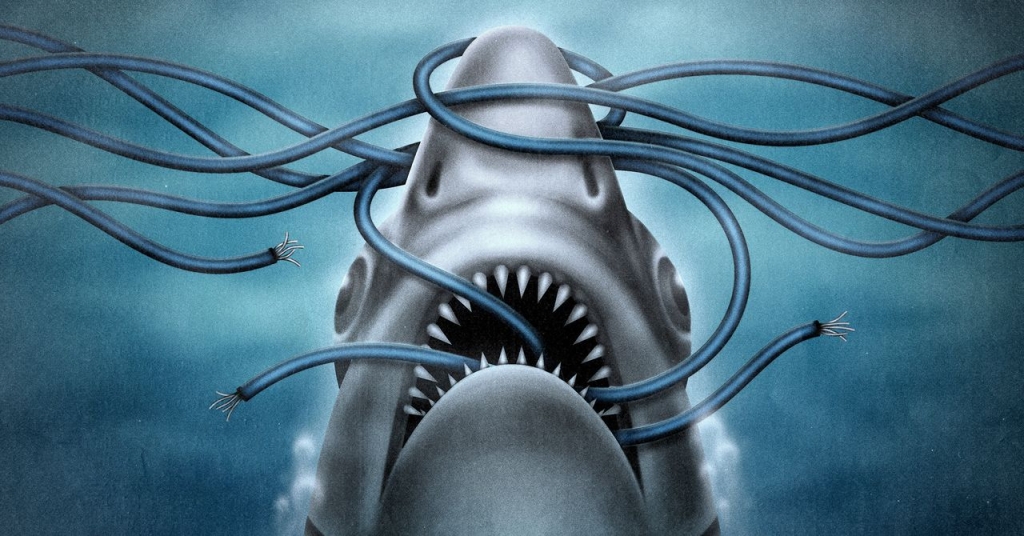
Let’s address the elephant—or rather, the shark—in the room first. Despite decades of persistent rumors and internet memes, sharks are not systematically attacking the underwater cables that form the backbone of our global communications infrastructure. This myth, which has circulated since the 1980s, has become something of an inside joke among the professionals who actually build and maintain these critical systems.
The reality is far more mundane but equally fascinating. When sharks do interact with undersea cables, it’s usually out of curiosity rather than malice. A shark might “gum” a cable that’s suspended above the seabed as it explores its environment, or occasionally lunge at one being pulled from the water. But for a shark to actually bite through a cable, you’d need to wrap it in fish first—essentially the same principle as hiding medication in cheese for your dog.
What’s truly ironic is how this myth has overshadowed more legitimate concerns. Rats, for instance, pose a genuine threat to terrestrial cables because their incisors never stop growing, leading them to gnaw on anything that might help file them down. Yet nobody ever asks about rats, perhaps because, as one industry insider wryly observed, “sharks make you cool, but rats sound like you have a problem.”
The Real Story: TAT-8 and the Birth of Modern Connectivity
The myth gained traction around the development of TAT-8, the eighth transatlantic telephone cable system that practically invented the concept of internet cables as we know them today. As this pioneering system approaches retirement, I had the opportunity to spend time with the offshore workers, crew members, and engineers who are currently pulling it from the seabed—a process that reveals the true story of subsea cables.
This isn’t a tale of sabotage or shark attacks, but rather one of human ingenuity, dedication, and the complex logistics required to maintain the physical infrastructure that keeps our digital communication flowing. These are the people who work tirelessly, sometimes at sea for weeks at a time, other times buried under mountains of permits, surveys, and purchase orders for thousands of kilometers of cables.
The Magic of Fiber-Optic Transmission
Fiber-optic transmission represents a near-magical method of carrying information through pulses of light. For most people, instantaneous global communication has become so normalized that we rarely stop to consider how remarkable it truly is. Even those of us old enough to remember when international phone calls had to be booked days in advance have largely accepted this technological marvel as simply “the way things are.”
The more I’ve learned about this industry—this intricate network of networks connecting people and technology—the more dismissive it sounds when people claim “we only notice it when it breaks.” Who exactly is this “we”? Billions of people can go about their daily lives without thinking about this infrastructure precisely because of the daily work of a few thousand dedicated professionals.
These individuals ensure that our planet is continuously being hugged by light, with millions of kilometers of cables crisscrossing the ocean floor, carrying the vast majority of our intercontinental traffic. Every swipe, tap, Zoom call, and doomscroll you’ve ever made has likely traveled through this invisible web beneath the waves.
From Telephone Calls to Digital Revolution
It’s worth noting that most people refer to these as “internet cables,” but technically, fiber-optic transmission was originally developed for telephone calls. One of the key figures in this development was Alec Reeves, an English scientist who also dabbled in psychokinesis and telepathy. There’s something almost poetic about the connection between these seemingly disparate interests—after all, with fiber optics, voices become light, pulse across spiderweb-thin strings of glass, and become voices again on the other end. Perhaps the conceptual leap from that to moving objects with your mind isn’t as vast as it might seem.
TAT stands for Trans-Atlantic Telephone, and TAT-8—built through a collaboration between AT&T, British Telecom, and France Telecom—represented the first transoceanic system across the Atlantic to use optical fibers for traffic between Europe and the United States. The development of fiber optics for communication had only been theorized in the 1960s, with terrestrial cables first deployed in the 1970s. Using this technology to span continents was practically equivalent to human galactic expansion.
A Historic Moment in Digital History
When TAT-8 went into service on December 14, 1988, science fiction author Isaac Asimov participated in a video link from New York to audiences in Paris and London, declaring, “Welcome everyone to this historic transatlantic crossing, this maiden voyage across the sea on a beam of light.”
AT&T even produced a television advertisement featuring earnest voiceovers promising a “worldwide intelligent network” where people could send information in any format to anyone they desired. The ad showcased telephone operators managing international calls: “This is the AT&T operator. You have a call booked for Poland?” “I have your call to Russia.” “What city in Cuba are you calling?”
Interestingly, if AT&T was attempting to inspire viewers, they weren’t necessarily doing so with visions of the internet—which was still too niche for most people to comprehend—but rather with the promise of the end of the Cold War. The commercial captured a moment of optimism and global connection that transcended mere technological advancement.
The Human Element: Unsung Heroes of the Digital Age
What emerges from this history is a profound appreciation for the human element in our digital infrastructure. While we often think of the internet as an abstract, ethereal concept—something that exists in “the cloud”—it’s fundamentally grounded in physical reality. Every email, every video stream, every financial transaction relies on these tangible cables, maintained by real people working in often challenging conditions.
These are the true guardians of our digital world: the engineers who design systems capable of withstanding the immense pressures of the deep ocean; the maritime crews who lay cables across thousands of miles of treacherous seafloor; the technicians who troubleshoot problems in environments where a single mistake could have catastrophic consequences; and the project managers who navigate the complex web of international regulations, environmental concerns, and logistical challenges.
Their work represents a perfect blend of cutting-edge technology and old-fashioned human expertise. It requires understanding not just the physics of light transmission through glass fibers, but also the geology of the ocean floor, the biology of marine ecosystems, the politics of international telecommunications, and the practical realities of life at sea.
Looking to the Future
As we continue to demand more bandwidth, faster speeds, and greater reliability from our digital infrastructure, the work of these professionals becomes increasingly critical. New cable systems are being planned and deployed to meet growing demand, incorporating advances in fiber optic technology, materials science, and network architecture.
Yet despite these technological advances, the fundamental challenge remains the same: creating reliable, high-capacity connections across vast distances while contending with the unpredictable and often hostile environment of the deep ocean. It’s a challenge that requires not just technological innovation, but also human creativity, perseverance, and dedication.
The next time you send an email, join a video call, or stream your favorite show, take a moment to consider the incredible journey that data has taken—through glass fibers thinner than a human hair, across thousands of miles of ocean floor, tended to by a global community of professionals who ensure that our digital world keeps turning. And remember: it’s not sharks you need to worry about, but rather the remarkable humans who make it all possible.
Tags:
fiber optic cables, undersea internet infrastructure, TAT-8 cable, transatlantic communication, digital infrastructure, shark myths debunked, internet cable maintenance, global connectivity, optical fiber technology, maritime engineering, submarine cable systems, internet backbone, Alec Reeves, Isaac Asimov, AT&T history, British Telecom, France Telecom, cold war technology, deep sea cables, internet myths
Viral Sentences:
Sharks aren’t eating the internet, they’re just curious about it.
The real threat to internet cables isn’t sharks—it’s rats with growing teeth.
We notice the internet only when it breaks, but thousands keep it running daily.
Voices become light, pulse across glass threads, and become voices again.
The internet isn’t in the cloud—it’s in cables on the ocean floor.
TAT-8 was practically intergalactic expansion for human communication.
Every swipe, tap, and doomscroll travels through a web beneath the waves.
The planet is continuously being hugged by light, thanks to fiber optics.
AT&T promised the end of the Cold War, not the beginning of the internet.
Alec Reeves worked on both fiber optics and telepathy—maybe they’re connected.
The conceptual leap from light-pulsing voices to moving things with your mind isn’t that big.
Millions of kilometers of cable ensure billions never have to think about infrastructure.
The true guardians of our digital world work in challenging maritime conditions.
Every email, video stream, and financial transaction relies on physical cables maintained by real people.
The next time your internet works perfectly, thank the unsung heroes beneath the waves.
,


Leave a Reply
Want to join the discussion?Feel free to contribute!