
Scientists Create Chip That Generates Brand-New Colors of Light, Cracking a Decades-Old Nonlinear Optics Challenge
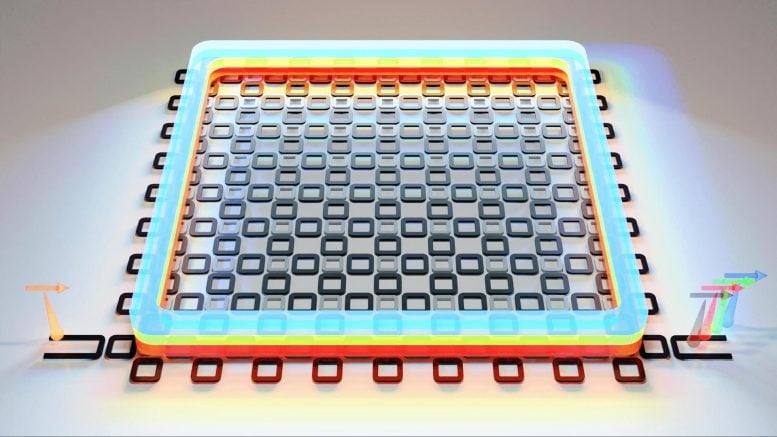
Breakthrough in Photonics: Scientists Engineer Chip That Generates Entirely New Colors of Light, Solving a Decades-Old Nonlinear Optics Challenge
In a landmark achievement that could redefine the future of optical technologies, researchers have unveiled a revolutionary photonic chip capable of generating brand-new colors of light—a feat that has eluded scientists for decades. This breakthrough, achieved by leveraging the intricate interplay of two natural timescales within resonator arrays, marks a pivotal moment in the field of nonlinear optics and promises to unlock a new era of innovation across industries ranging from telecommunications to quantum computing.
The challenge of generating multiple harmonics of light—essentially creating new colors by manipulating the frequency of existing light—has long been a holy grail in photonics. Traditional methods have relied on bulky, energy-intensive systems that often require active compensation to maintain stability. However, the new photonic chip, developed by a team of researchers, overcomes these limitations by harnessing the natural dynamics of resonator arrays, eliminating the need for external intervention.
At the heart of this innovation lies the chip’s ability to exploit two distinct timescales within its structure. By carefully engineering the interactions between these timescales, the researchers have created a system that can reliably produce multiple harmonics of light with unprecedented efficiency and precision. This not only simplifies the design of photonic devices but also opens the door to a host of new applications that were previously thought to be impractical or impossible.
One of the most exciting implications of this breakthrough is its potential to revolutionize telecommunications. As data centers and global networks continue to expand, the demand for faster, more efficient data transmission has never been greater. The ability to generate new colors of light on-chip could enable the development of next-generation optical communication systems that are both faster and more energy-efficient, helping to meet the insatiable appetite for data in our increasingly connected world.
Beyond telecommunications, this technology could also have a profound impact on fields such as quantum computing and precision sensing. In quantum computing, for example, the ability to generate and manipulate light at specific frequencies is crucial for controlling qubits and performing complex computations. The new photonic chip could provide a more compact and efficient solution for these tasks, bringing us one step closer to realizing the full potential of quantum technologies.
The implications for precision sensing are equally compelling. Many of today’s most advanced sensors, from atomic clocks to gravitational wave detectors, rely on the precise control of light. By enabling the generation of new colors of light with greater ease and accuracy, this breakthrough could lead to the development of sensors that are even more sensitive and reliable, with applications ranging from navigation to fundamental physics research.
What makes this achievement particularly remarkable is the elegance of its solution. By working with the natural dynamics of the system rather than against them, the researchers have created a technology that is not only more efficient but also more robust. This approach could serve as a model for future innovations in photonics and beyond, demonstrating the power of harnessing nature’s inherent properties to solve complex engineering challenges.
The development of this photonic chip is the result of years of painstaking research and collaboration among scientists and engineers from around the world. It represents a significant milestone in the ongoing quest to harness the power of light for practical applications, and it underscores the importance of sustained investment in fundamental research. As industries continue to push the boundaries of what is possible, breakthroughs like this one will be essential for driving progress and unlocking new opportunities.
Looking ahead, the potential applications of this technology are vast and varied. From enabling faster internet speeds to advancing the frontiers of quantum science, the ability to generate new colors of light on-chip could have a transformative impact on our world. As researchers continue to explore the possibilities opened up by this breakthrough, one thing is clear: the future of photonics has never looked brighter.
Tags: Photonic Chip, Nonlinear Optics, Light Generation, Resonator Arrays, Quantum Computing, Telecommunications, Precision Sensing, Optical Technologies, Breakthrough, Innovation, Scientific Discovery, Engineering, Photonics, Data Transmission, Quantum Science, Atomic Clocks, Gravitational Wave Detection, Next-Generation Technology, Energy Efficiency, Compact Design, Robust Systems, Natural Dynamics, Fundamental Research, Global Networks, Qubit Control, Advanced Sensors, Future of Photonics, Scientific Milestone, Engineering Marvel, Light Manipulation, Harmonic Generation, Optical Communication, Data Centers, Connected World, Scientific Collaboration, Practical Applications, Transformative Impact, Brighter Future.
Viral Phrases: “Revolutionizing the way we harness light,” “A game-changer for telecommunications,” “Unlocking the secrets of quantum computing,” “Precision sensing like never before,” “Harnessing nature’s inherent properties,” “The future of photonics has never looked brighter,” “A breakthrough that could redefine industries,” “From atomic clocks to global networks,” “Compact, efficient, and robust,” “Solving a decades-old challenge,” “The holy grail of photonics,” “A new era of innovation,” “Faster, more efficient data transmission,” “Bringing quantum technologies closer to reality,” “Sensors that are more sensitive and reliable,” “Elegance in engineering,” “The power of sustained investment in research,” “Transforming the way we connect,” “A model for future innovations,” “The insatiable appetite for data,” “Advancing the frontiers of science,” “A milestone in the quest to harness light,” “Opening doors to new possibilities,” “The quest for faster internet speeds,” “A pivotal moment in nonlinear optics,” “The potential to reshape our world,” “A technology that works with nature, not against it,” “The elegance of simplicity,” “A breakthrough that could change everything,” “The next step in the evolution of photonics,” “A brighter future for optical technologies,” “The dawn of a new era in light manipulation.”
,


Leave a Reply
Want to join the discussion?Feel free to contribute!