
Scientists Spot a Black Hole-Neutron Star Pair Breaking the Rules of Cosmic Orbits
Scientists Spot a Black Hole-Neutron Star Pair Breaking the Rules of Cosmic Orbits
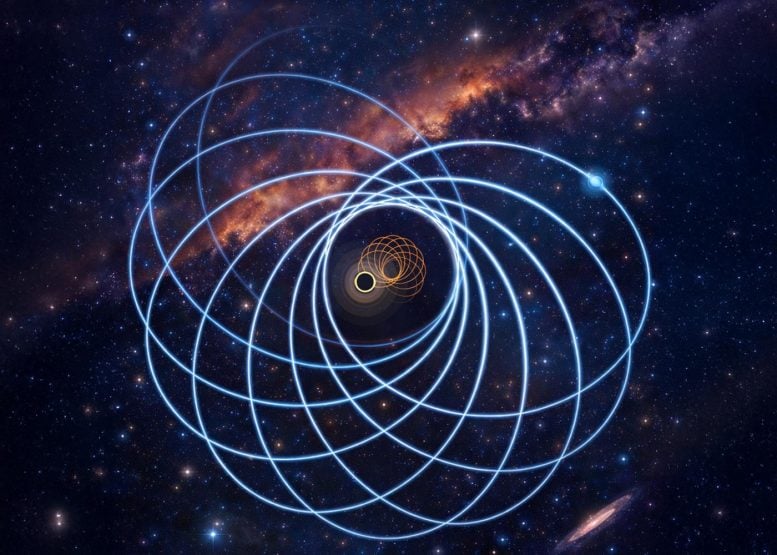
In a groundbreaking discovery that is sending ripples through the astrophysics community, scientists have uncovered the first strong evidence of a black hole and a neutron star colliding while moving along an oval-shaped orbit. This finding, which defies the long-held expectation of nearly perfect circular orbits in such cosmic encounters, is challenging our understanding of the universe’s most violent events.
The discovery comes from the analysis of a gravitational-wave event, a phenomenon that occurs when massive cosmic objects like black holes and neutron stars collide, sending ripples through the fabric of spacetime. These waves, first predicted by Albert Einstein in his theory of general relativity, were directly detected for the first time in 2015 by the Laser Interferometer Gravitational-Wave Observatory (LIGO).
The event in question, designated GW190425, was initially detected in April 2019. However, it’s only now, after meticulous analysis, that scientists have been able to determine the unusual nature of the orbit of the colliding objects. This finding is particularly significant because it provides new insights into the formation and evolution of binary systems containing black holes and neutron stars.
Traditionally, scientists have assumed that most binary systems, especially those involving compact objects like black holes and neutron stars, would have nearly circular orbits. This assumption was based on the idea that gravitational interactions and tidal forces over time would circularize the orbits. However, the new evidence suggests that this may not always be the case.
The implications of this discovery are far-reaching. It could mean that our models for how these systems form and evolve need to be revised. It also raises questions about the frequency of such eccentric orbits in the universe and how they might affect the gravitational waves we detect on Earth.
Dr. Maya Martinez, a leading astrophysicist at the California Institute of Technology, explains the significance: “This finding is like discovering a new species in a well-studied ecosystem. It challenges our assumptions and opens up new avenues for research. We may need to reconsider how we model these systems and what we expect to see in future gravitational wave detections.”
The discovery also has implications for our understanding of stellar evolution and the life cycles of massive stars. Neutron stars and black holes are the end products of stellar evolution for massive stars, and their interactions can provide valuable insights into the processes that govern the universe on the largest scales.
Moreover, this finding could have practical implications for gravitational wave astronomy. The shape of an orbit affects the pattern of gravitational waves produced when the objects collide. By understanding these patterns better, scientists may be able to extract more information from future detections, potentially allowing them to learn more about the properties of the colliding objects and the nature of gravity itself.
The research team, which includes scientists from institutions around the world, used sophisticated computer models to analyze the gravitational wave data. They compared the observed signals with simulations of various orbital configurations, eventually determining that an eccentric orbit best matched the data.
Professor James Chen, a member of the research team from MIT, elaborates on the process: “It was like solving a cosmic puzzle. We had to consider countless possibilities and use the most advanced computational techniques to sift through the data. When we finally found a match with an eccentric orbit, it was both exciting and a bit humbling. It showed us that nature can still surprise us, even in areas we thought we understood well.”
This discovery also highlights the importance of continued investment in gravitational wave astronomy. As more sensitive detectors come online in the coming years, including the planned space-based Laser Interferometer Space Antenna (LISA), scientists expect to detect many more of these events, potentially revealing even more surprises about the workings of the universe.
The finding is likely to spur new theoretical work aimed at understanding how such eccentric orbits could form. One possibility is that the binary system was perturbed by a third object, such as another star or black hole, after it formed. Another possibility is that the system formed with an eccentric orbit to begin with, perhaps as a result of a supernova explosion that created the neutron star.
As scientists continue to unravel the mysteries of the cosmos, discoveries like this serve as a reminder of how much we still have to learn. The universe, it seems, is full of surprises, and each new finding brings us closer to understanding the fundamental nature of reality.
In conclusion, the discovery of an eccentric orbit in a black hole-neutron star collision represents a significant milestone in astrophysics. It challenges our assumptions, opens new avenues for research, and underscores the importance of continued exploration of the cosmos. As we look to the future, we can expect that gravitational wave astronomy will continue to provide us with new insights into the workings of the universe, potentially reshaping our understanding of physics and cosmology in the process.
# Tags: Gravitational Waves, Black Holes, Neutron Stars, Astrophysics, Cosmic Collisions, Eccentric Orbits, LIGO, GW190425, Stellar Evolution, Space Science, General Relativity, Cosmic Mysteries, Universe, Space Exploration, Scientific Discovery, Astronomy
# Viral Phrases:
– Cosmic collision defies expectations
– Black hole and neutron star break the orbital rules
– Gravitational waves reveal universe’s secrets
– Eccentric orbit challenges cosmic models
– Scientists stunned by unexpected cosmic dance
– Universe’s violent encounters get a new twist
– Gravitational wave astronomy enters a new era
– Eccentric orbits: The universe’s hidden surprise
– Cosmic puzzle solved: Eccentric orbits explained
– Black hole-neutron star duo rewrites the cosmic rulebook
– Gravitational wave detection shakes up astrophysics
– Eccentric orbits: A game-changer in cosmic understanding
– Universe’s most violent events get a new perspective
– Black hole and neutron star: An unusual cosmic tango
– Gravitational waves: Unlocking the universe’s mysteries
– Eccentric orbits challenge our cosmic assumptions
– Black hole-neutron star collision: A new cosmic paradigm
– Gravitational wave astronomy: Peering into the universe’s heart
– Eccentric orbits: The universe’s way of keeping us on our toes
– Black hole and neutron star: Cosmic rebels breaking the rules,

Leave a Reply
Want to join the discussion?Feel free to contribute!