
Seattle-area startup turns industrial emissions into high-performance battery materials
Seattle Startup Homeostasis Turns CO2 Into Battery-Grade Graphite—Here’s Why It Matters More Than Ever
In the heart of Tacoma, Washington, a bold new startup is quietly rewriting the rules of the battery supply chain. Homeostasis, co-founded by Makoto Eyre and Julien Lombardi, is pioneering a radical approach to producing graphite—one of the most critical materials in modern batteries—by transforming captured carbon dioxide into high-purity synthetic graphite. And as global trade wars, climate policy whiplash, and the race for energy independence intensify, their work couldn’t be more timely.
The Eisenhower Principle in Action
Eyre, who serves as CEO, frames the company’s mission with a quote from former U.S. President Dwight D. Eisenhower: “Plans are worthless, but planning is everything.” It’s a mantra that captures the company’s adaptive mindset in an era where geopolitical winds shift overnight. Whether it’s the Trump administration’s pivot away from climate-focused carbon removal or its sudden enthusiasm for domestic graphite production, Homeostasis is learning to surf the turbulence rather than be crushed by it.
Why Graphite? Why Now?
Graphite is the unsung hero of the battery world. It forms the anode in lithium-ion batteries, which power everything from electric vehicles (EVs) to drones to grid-scale energy storage. Yet, more than 90% of the world’s battery-grade graphite comes from China, leaving the U.S. and its allies dangerously dependent on a single source.
Commercial graphite mining in the U.S. effectively died in the 1950s. While synthetic graphite can be produced as a byproduct of crude oil refining, the process is notoriously expensive, energy-intensive, and slow. That’s where Homeostasis steps in with a disruptive alternative.
Turning CO2 Into Cash—And Batteries
Homeostasis has developed a molten salt electrolysis process that uses electricity to break down a high-temperature salt mixture containing dissolved CO2—captured from industrial operations. The result? Carbon deposits onto an electrode as crystalline graphite, with oxygen released as a harmless byproduct.
It’s a closed-loop marvel: waste CO2 becomes a valuable resource, and the U.S. inches closer to battery material independence. The process is not only innovative but also scalable, with the potential to be deployed at existing carbon capture sites.
Funding, Partnerships, and a Saudi Connection
In December, Homeostasis announced a strategic partnership and funding from LAB7, the investment arm of Saudi Aramco. This collaboration will help the startup scale operations and refine its graphite to meet the exacting “drop-in” standards required by battery manufacturers. The partnership is part of Saudi Arabia’s broader strategy to rapidly build a domestic EV supply chain—a move that could reshape global battery geopolitics.
Back home, Homeostasis raised $600,000 in pre-seed investment and an additional $700,000 from Washington’s Climate Commitment Act. The company is actively hiring engineers in Washington State and plans to double its team by the end of the year.
From Prototype to Pilot: The Road Ahead
Currently, Homeostasis is building a prototype capable of producing 1 kilogram (about 2.2 pounds) of graphite per day—enough to supply samples to Aramco and potential partners. Within two years, the team aims to open a pilot plant capable of producing tens of tons annually.
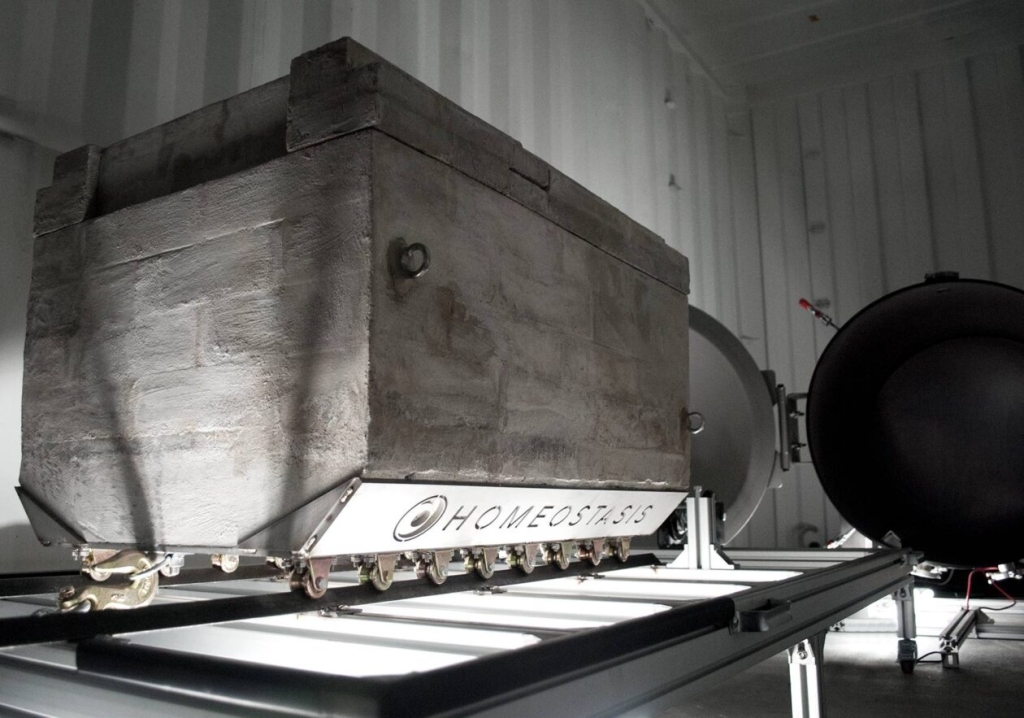
The long-term vision? A self-contained, 40-foot shipping container-sized system that can produce 100 tons of graphite per year. These modular units could be deployed at automakers or energy companies with existing carbon capture infrastructure, creating a distributed network of domestic graphite production.
The Bigger Picture: A $1 Million Ton Market
The U.S. currently traps an estimated 30 to 50 million metric tons of CO2 annually, though most is used for enhanced oil recovery. If the economics align, this represents a vast potential feedstock for Homeostasis’ technology.
Based on battery demand projections, the U.S. and Canada will need roughly 1 million tons of graphite per year by the end of this decade. That’s a massive market opportunity—and a strategic imperative for energy independence.
Navigating the Noise
For Eyre, the current volatility in trade policy, tariffs (which now hit Chinese graphite at roughly 200%), and shifting federal priorities is just “noise.” What matters is the underlying trend: a global shift toward electrification that will require energy storage at a scale the world has never seen.
“To support that we need critical materials, and they need to be low cost,” Eyre said. “While the policy details might be shifting over time, we’re building solid fundamentals. We are setting the course.”
The Future Is Local, Clean, and Circular
Homeostasis isn’t just building a company—it’s building a new paradigm for how we think about waste, resources, and energy. By turning CO2 into a valuable commodity, they’re not only addressing the battery supply crunch but also contributing to a circular carbon economy.
As the world races to decarbonize and electrify, the question isn’t just who will control the battery supply chain—but how it will be built. With Homeostasis, the answer may be cleaner, smarter, and more homegrown than anyone expected.
Tags: #Homeostasis #Graphite #BatteryTech #CarbonCapture #EVSupplyChain #CleanEnergy #Sustainability #TechInnovation #ClimateTech #EnergyIndependence #SaudiAramco #LAB7 #MoltenSaltElectrolysis #CO2Conversion #BatteryAnode #TradeWars #Geopolitics #Electrification #CircularEconomy #WashingtonState #StartupSpotlight #FutureOfEnergy #BatteryMaterials #Decarbonization #EnergyStorage #TechNews #ViralTech #GreenTech #ManufacturingRevolution #SupplyChainSecurity
Viral Sentences:
- “Turning CO2 into cash—and batteries—one molten salt reaction at a time.”
- “Homeostasis is making graphite so American, it practically waves the flag.”
- “The future of batteries might just be cooked up in a 40-foot shipping container.”
- “Saudi oil money meets Seattle innovation in the race for battery dominance.”
- “Graphite used to be a mining game. Now it’s a chemistry experiment.”
- “If Eisenhower were alive today, he’d probably invest in this.”
- “Trade wars, tariffs, and tech: Homeostasis is surfing the storm.”
- “One kilogram at a time, they’re building the backbone of the EV revolution.”
- “CO2: from climate villain to battery hero.”
- “The U.S. wants battery independence. Homeostasis is drawing the map.”
,
Leave a Reply
Want to join the discussion?Feel free to contribute!