
Small U.S. town grew a big company. Now it’s in a tariff storm : NPR
DigiKey: The Unstoppable Tech Giant in Rural Minnesota Battling Trump’s Tariffs
THIEF RIVER FALLS, Minn. — In the quiet, sprawling fields of northern Minnesota, a global tech giant is fighting for survival. DigiKey, the world’s largest marketplace for electronic components, is more than just a warehouse—it’s the lifeblood of a small town. But as President Trump’s tariffs wreak havoc on global trade, DigiKey’s future hangs in the balance.
Every few nights, Teri Ivaniszyn, DigiKey’s vice president of operational excellence and trade compliance, jolts awake in a cold sweat. The once-sleepy role of managing tariffs has become a high-stakes game of chess, with billions of dollars and thousands of jobs on the line. “I wake up in cold sweats about tariffs,” Ivaniszyn admits, laughing nervously. “It’s a new thing.”
DigiKey is the unsung hero of the tech world. Think of it as Amazon, but for millions of electronic parts—capacitors, circuits, semiconductors—shipped to engineers worldwide from a single warehouse in rural Minnesota. The company’s 3,800 employees make up half the workforce of Pennington County, a community that has thrived thanks to DigiKey’s presence.
But the tariffs are taking their toll. About a quarter of DigiKey’s products come from China, and since 2018, the company has spent half a billion dollars on tariffs from Trump’s first term. The situation has only worsened. In 2025 alone, tariffs have yo-yoed from 10% to 145%, with electronics and semiconductors caught in the crossfire. “What’s coming next? How are we going to handle it?” Ivaniszyn asks, her voice tinged with exhaustion. “The yo-yo effect that we’re having: It’s on, it’s off, this is in, this is out.”
DigiKey’s story is one of resilience and innovation. Founded in 1972 by Ron Stordahl, a ham radio enthusiast, the company started by selling leftover parts from his “Digi-Keyer” invention. Stordahl discovered a niche market of engineers and hobbyists who wanted to buy small quantities of components, not bulk reels. Today, DigiKey ships an average of 25,000 orders daily to a million customers in nearly every country.
The company’s success has transformed Thief River Falls. The town now boasts a cargo hangar, a longer runway for larger planes, seven hotels, and daily flights to Minneapolis. While many rural communities are shrinking, Pennington County has been growing. Locals who leave often return, drawn by the stability and opportunities DigiKey provides.
But the tariffs are threatening this delicate balance. DigiKey’s next-door neighbor, Arctic Cat, a snowmobile factory, is shutting down in May, leaving the community even more reliant on DigiKey. “So you have a community that just lost one of its top two employers, and now you have the surviving employer heavily hamstrung by these tariffs,” says Tim Carroll, DigiKey’s vice president of digital business. “We’re trying to figure out: How do you make sure you’re doing right by the community that grew DigiKey up?”
To navigate the tariff maze, DigiKey has become a master of innovation. The company operates a foreign trade zone (FTZ), a designation that allows some products to enter the U.S. duty-free. This strategy has saved tens of millions of dollars annually, but it’s not a perfect solution. Suppliers must meet strict requirements, and only a fraction of DigiKey’s imports qualify. “Honestly, we didn’t know whether we’d get our bang for our buck,” Ivaniszyn admits.
The tariff chaos has forced DigiKey to adapt in real-time. The online team has built a toggle for the website that lets shoppers see only nontariffed options. Customer service reps are trained to answer tariff-related questions. Pricing, accounting, and inventory-planning teams are crunching tariff-altered numbers. Ivaniszyn’s tariff team has doubled in size, but fatigue is building. “Nobody wakes up in the morning thinking, ‘Yeah, I’m gonna have a great day today updating systems to charge customers tariffs,'” Carroll says.
DigiKey is also exploring duty drawbacks, a process that allows companies to recoup tariffs on goods that pass through the U.S. on their way to another country. Since 2018, DigiKey has recouped about 60% of its $500 million in tariffs this way. But many of the newest tariffs no longer allow duty drawbacks, leaving DigiKey at a disadvantage against European and Asian rivals. Will foreign customers simply shop locally if DigiKey starts charging them for U.S. tariffs? Will domestic customers move operations abroad to avoid the costs?
The stakes are high. DigiKey’s survival is not just about a company—it’s about a community. “You have to ask yourself questions,” says Dave Doherty, DigiKey’s president. “We’re the lifeblood of northwest Minnesota.” The company has resisted pressure to open warehouses in Europe and Asia, choosing instead to stay rooted in Thief River Falls. “We’re the lifeblood of northwest Minnesota,” Doherty says.
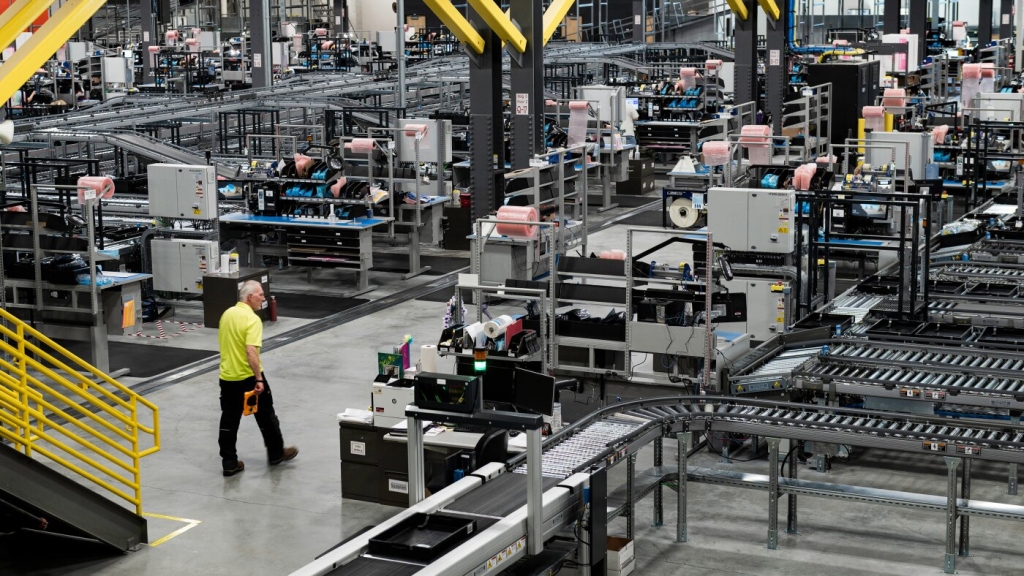
Inside the sprawling 2.2 million-square-foot warehouse, black crates whiz by on conveyors like the hectic interchanges of a futuristic metropolis. Workers wear grounding strips to protect static-sensitive components, wielding tweezers and magnifying glasses to pack orders with precision. The warehouse is not the town’s tallest building—that honor goes to the grain elevator by the train track—but it is the largest.
Trump’s key argument in favor of tariffs is that they’d force more manufacturers to return to the U.S. But as Tom Wichert, a supplier from TDK-Lambda Americas, points out, “There is no tariff that any manufacturer could truly absorb.” The new tariffs are instant, while building new plants takes years. “Imagine you’re in a football game and it’s blizzard-like conditions,” Wichert says. “The winner of the game is the one who can manage through the conditions the best. Right now, we’re in blizzard-like conditions.”
For northern Minnesotans, blizzards are nothing new. As Mayor Mike Lorenson, who is also an IT manager at DigiKey, puts it, “If anyone is used to weathering blizzards, it’s northern Minnesotans.” But this blizzard is unlike any other. It’s a storm of tariffs, uncertainty, and economic upheaval that threatens to upend a community and a company that have thrived together for decades.
DigiKey’s story is a testament to the resilience of rural America and the power of innovation. But as the tariffs continue to mount, the question remains: Can this tech giant weather the storm, or will it be forced to abandon the town that made it great?
Tags: #DigiKey #Tariffs #TrumpTariffs #TechIndustry #Minnesota #TradeWar #EconomicImpact #SmallTownAmerica #SupplyChain #ForeignTradeZone #DutyDrawbacks #GlobalTrade #RuralEconomy #Innovation #Resilience
Viral Phrases:
- “I wake up in cold sweats about tariffs.”
- “The yo-yo effect that we’re having: It’s on, it’s off, this is in, this is out.”
- “We’re the lifeblood of northwest Minnesota.”
- “Imagine you’re in a football game and it’s blizzard-like conditions.”
- “Nobody wakes up in the morning thinking, ‘Yeah, I’m gonna have a great day today updating systems to charge customers tariffs.'”
- “If anyone is used to weathering blizzards, it’s northern Minnesotans.”
- “The winner of the game is the one who can manage through the conditions the best.”
- “There is no tariff that any manufacturer could truly absorb.”
- “We’re trying to figure out: How do you make sure you’re doing right by the community that grew DigiKey up?”
- “The way Lorenson sees it: If anyone is used to weathering blizzards, it’s northern Minnesotans.”
,


Leave a Reply
Want to join the discussion?Feel free to contribute!