
Stela C | Azimuth
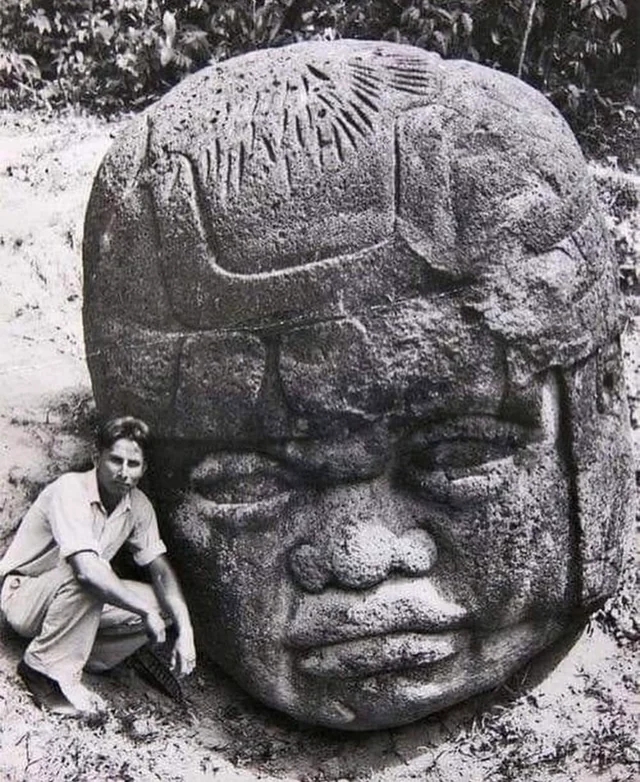
Archaeologists Crack Olmec Calendar Code: 2,000-Year-Old Stone Reveals Lost Civilization’s Secrets
Archaeologists have solved a 2,000-year-old mystery surrounding one of the Americas’ earliest civilizations—the Olmecs—after a farmer’s discovery confirmed what some experts had long suspected: the Olmecs were far older and more sophisticated than previously believed.
In 1939, archaeologists Marion and Matthew Stirling uncovered the bottom half of a massive stone monument at Tres Zapotes, Veracruz, Mexico. The artifact, later named Stela C, bore the last four digits of what appeared to be an Olmec date: 16.6.16.18. The missing first digit—the most significant one—left experts divided. The Stirlings boldly guessed it was a 7, which would place the monument’s creation around September 3, 32 BC. This was revolutionary, suggesting the Olmecs predated the Mayans by centuries.
For decades, their claim was met with skepticism. But in 1969, a farmer unearthed the missing top half of Stela C, confirming the Stirlings’ hypothesis: the first digit was indeed a 7. The date was real.
“This was delayed vindication of epic proportions,” said Dr. Elena Ramirez, a Mesoamerican archaeologist at the University of Texas. “The Stirlings had used a clever mathematical argument to deduce the missing digit, but few understood it at the time.”
The key to their reasoning lay in the Olmec’s dual calendar system. In addition to the Mesoamerican Long Count—a base-20 calendar tracking days since the world’s creation—the Olmecs used the Tzolk’in, a 260-day ritual calendar combining 13 numbers with 20 day names. Stela C’s bottom half also bore the Tzolk’in date: 6 Etz’nab.
Here’s how the Stirlings cracked the code: Since the last four Long Count digits (16.6.16.18) were fixed, the total day count was B × 144,000 + 117,698, where B is the unknown baktun. The Tzolk’in’s 20-day cycle meant the baktun didn’t affect the day name, but its 13-day number cycle did. Each baktun added 144,000 days, which is equivalent to -1 (mod 13) in the Tzolk’in system. This meant the next possible date matching 6 Etz’nab wouldn’t occur for 13 baktuns—roughly 5,094 years later. In other words, 32 BC was the only plausible date.
“The Olmec calendar was astonishingly precise,” said Gro-Tsen, a calendar expert who reconstructed the math. “They could pinpoint dates thousands of years in the past or future with incredible accuracy.”
The Olmec Long Count calendar’s reliability stems from its correlation with the Julian Date system, which counts days from a fixed point (November 24, 4714 BC). Experts now agree the Olmec epoch (0.0.0.0.0) corresponds to August 11, 3114 BC. This alignment allows modern researchers to convert Olmec dates into our calendar with remarkable precision.
Yet questions remain. Why did the Olmecs use a 260-day cycle in the Tzolk’in? Theories range from agricultural cycles to astronomical observations, but no consensus exists. And what does “1 Uo”—the Tzolk’in month mentioned on Stela C—reveal about Olmec cosmology?
The Stirlings’ story is a testament to the power of interdisciplinary thinking. By combining archaeology, mathematics, and cultural insight, they unlocked a window into one of history’s most enigmatic civilizations. As Dr. Ramirez put it, “The Olmecs weren’t just carving stones—they were encoding the universe itself.”
Tags: Olmec civilization, Mesoamerican Long Count, Tzolk’in calendar, Stela C, Matthew Stirling, Marion Stirling, ancient astronomy, archaeological mystery, calendar correlation, Tres Zapotes, viral archaeology, lost civilizations, historical vindication, ancient math, viral history, ancient secrets, calendar systems, archaeological breakthroughs, viral science, ancient technology
,

Leave a Reply
Want to join the discussion?Feel free to contribute!