
Stone Age symbols may push back the earliest form of writing
Stone Age Breakthrough: 40,000-Year-Old Symbols Reveal Early Writing System
In a stunning revelation that is rewriting the history of human communication, archaeologists have uncovered evidence that Stone Age people in Europe developed a proto-writing system over 40,000 years ago—pushing back the emergence of symbolic communication by more than 30,000 years.
The groundbreaking study, published in Cambridge Archaeological Journal, analyzed hundreds of artifacts from the Aurignacian period (43,000-34,000 years ago) discovered in caves across Germany’s Swabian Jura region. These objects—including mammoth ivory figurines, tools, and pendants—bear sequences of engraved symbols that researchers say share remarkable similarities with the earliest known writing system, Mesopotamian cuneiform.
“What we’re seeing is not random decoration,” explains Ewa Dutkiewicz, archaeologist at the Museum of Prehistory and Early History in Berlin. “These are deliberate, systematic sequences of distinct marks—crosses, dots, lines, and notches—that appear repeatedly across different objects and time periods.”
The research team, led by Dutkiewicz and linguist Christian Bentz from Saarland University, used computer modeling to analyze the complexity and information density of these ancient symbol sequences. Their findings were astonishing: the statistical patterns matched those of proto-cuneiform tablets from 3500 BC, despite being separated by tens of thousands of years.
“This suggests these Aurignacian people had developed a symbolic system capable of recording information,” Bentz notes. “While it’s not writing in the modern sense, it represents a crucial step toward human communication through visible marks.”
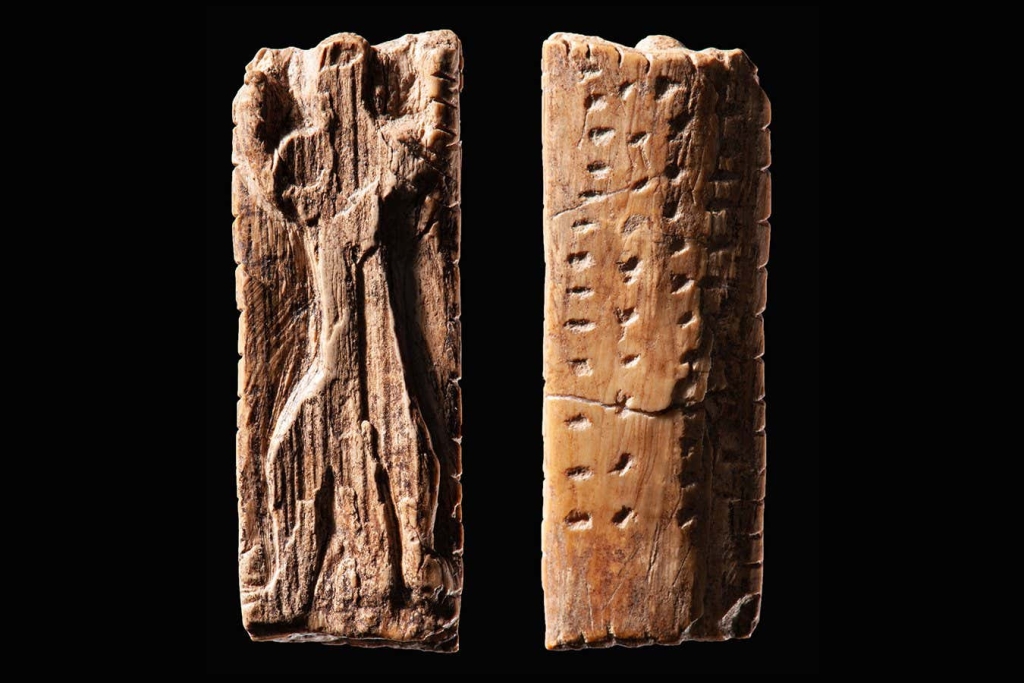
Among the most intriguing artifacts is the Adorant figurine—a 38,000-year-old mammoth ivory plaque featuring an anthropomorphic figure surrounded by rows of 12 and 13 notches. Researchers speculate these could represent lunar calendars or seasonal tracking systems, essential knowledge for hunter-gatherer societies.
The study also revealed fascinating patterns in symbol usage. Crosses appeared exclusively on animal carvings and tools but never on human figures, while dots were absent from tools entirely. These consistent patterns persisted for 10,000 years, suggesting the symbolic system was passed down through generations.
“This wasn’t just art—it was communication,” says paleoanthropologist Genevieve von Petzinger, who was not involved in the study. “These marks had meaning to the people who made them, even if we can’t decipher it yet.”
The discovery challenges long-held assumptions about when and where writing emerged. While cuneiform is traditionally considered the world’s first writing system (dating to around 3200 BC), this research suggests its conceptual roots extend back to the dawn of modern human culture in Europe.
As researchers continue to decode these ancient symbols, one thing is clear: the human drive to communicate, record, and preserve knowledge is far older than we ever imagined.
Tags & Viral Phrases:
40,000-year-old writing system, Stone Age symbols, earliest human communication, proto-writing discovery, Aurignacian artifacts, ancient calendars, cuneiform origins, mammoth ivory carvings, prehistoric communication, rewriting history, hunter-gatherer writing, cave art symbols, ancient information systems, human symbolic thought, archaeological breakthrough, Paleolithic writing, early human intelligence, decoding ancient symbols, 30,000 years earlier, human communication evolution, ancient knowledge preservation
,


Leave a Reply
Want to join the discussion?Feel free to contribute!