
systemd 260-rc3 Released With AI Agents Documentation Added
Systemd 260 Release Candidate 3 Arrives with AI Agent Support and Bug Fixes
The systemd development team has just released the third release candidate for systemd 260, marking another step forward in the evolution of this critical Linux system and service manager. Following the initial release candidate that introduced exciting new features like mstack and the controversial decision to drop System V service scripts support, and a second release candidate that refined those changes, systemd 260-rc3 arrives as a more polished, bug-fixed version ready for final testing before the stable release.
What’s New in Systemd 260-rc3?
While systemd 260-rc3 doesn’t introduce any groundbreaking new features at this stage—that’s not unusual for a third release candidate—it brings several important refinements and, most notably, new support for AI development agents that’s generating significant buzz in the open-source community.
The development team has focused primarily on addressing bugs discovered during the extensive testing of the first two release candidates. This attention to stability and reliability demonstrates the maturity of the systemd project and its commitment to delivering a robust final release.
AI Agent Support: A Revolutionary Step for Open Source Development
The most talked-about addition in systemd 260-rc3 isn’t a technical feature at all, but rather a strategic move to embrace the future of software development: comprehensive support for AI coding agents.
The AGENTS.md File: Your AI Assistant’s New Best Friend
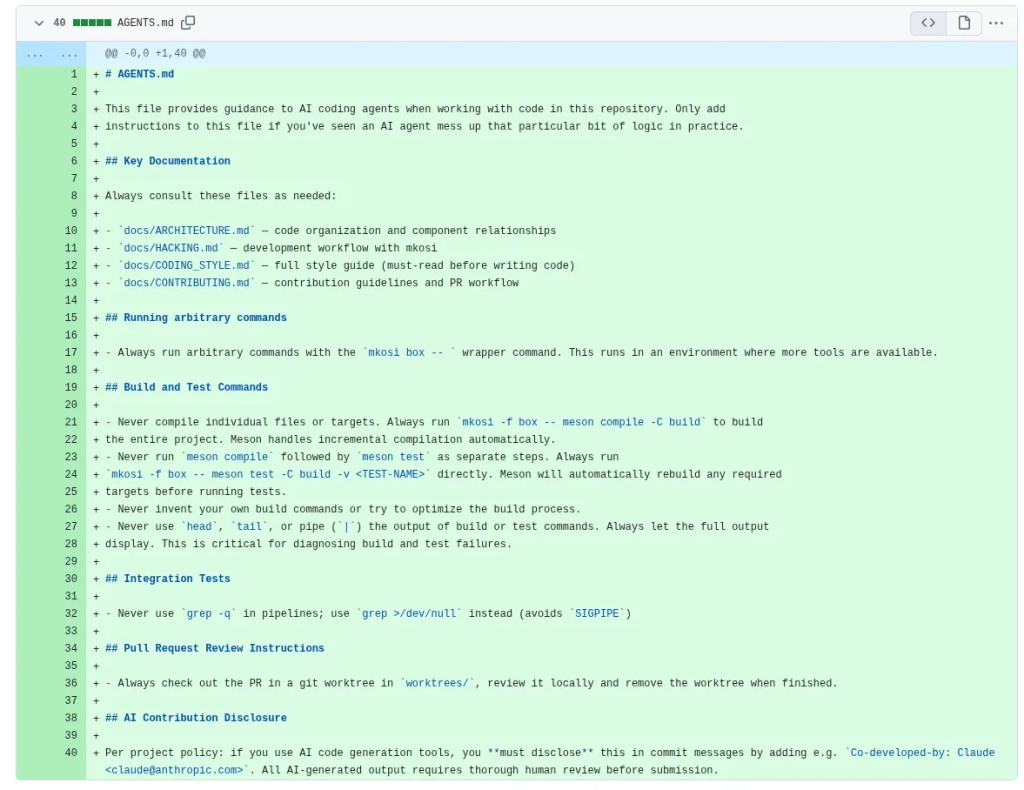
For the first time in its history, systemd now includes an AGENTS.md file in its Git repository. This documentation serves as a comprehensive guide specifically designed to help AI agents navigate and understand the complex systemd codebase. Think of it as a “welcome manual” for artificial intelligence systems that want to contribute to or modify systemd.
The AGENTS.md documentation covers everything an AI agent needs to know:
- Systemd’s sophisticated architecture and how its various components interact
- The established development workflow that systemd contributors follow
- The project’s strict coding style guidelines that ensure consistency across thousands of lines of code
- Detailed contribution guidelines that outline how to submit patches and improvements
- Instructions for running various systemd commands and performing integration testing
- Important disclosure requirements for AI contributions, including the use of “Co-developed-by” tags on patches
This move represents a significant acknowledgment from the systemd team that AI-assisted development is becoming mainstream and that the project wants to make it as easy as possible for AI systems to contribute effectively.
Claude Code Gets Special Treatment
In a particularly interesting development, the systemd team has also created a CLAUDE.md file that specifically references the AGENTS.md documentation as a helper for Claude Code, Anthropic’s AI coding assistant. This suggests that the systemd developers have been working closely with or testing Claude Code, and want to ensure optimal integration between this specific AI tool and the systemd codebase.
GitHub Workflows for AI Review
Beyond just documentation, systemd 260-rc3 introduces a new claude-review.yml file in the .github/workflows directory. This YAML configuration file outlines how systemd pull requests should be reviewed using Claude Code as an AI assistant. This automated review workflow could significantly accelerate the development process by providing immediate, AI-powered feedback on proposed changes.
Bug Fixes and Stability Improvements
While the AI-related additions are grabbing headlines, the core purpose of any release candidate remains addressing bugs and stability issues. The systemd team has been diligently working through the feedback and testing results from the first two release candidates, fixing numerous issues that were discovered.
These bug fixes span the entire systemd ecosystem, from the core init system functionality to the various utilities and tools that make up the systemd suite. While specific bug details aren’t listed in the release announcement, the comprehensive nature of systemd means that these fixes likely address issues ranging from service startup reliability to logging accuracy to resource management efficiency.
The Road to Systemd 260 Stable
With the third release candidate now available, the systemd development team is signaling that they’re approaching the final stages of the 260 development cycle. Release candidates typically indicate that the major new features are complete and the focus has shifted to polishing, bug fixing, and ensuring compatibility across the vast array of Linux distributions that use systemd.
The fact that systemd 260-rc3 doesn’t introduce major new features suggests that the development team is satisfied with the current state of the codebase and is now focused on eliminating any remaining issues before the stable release. This conservative approach during the release candidate phase is exactly what users and distributions expect when dealing with such a fundamental system component.
Why This Matters for Linux Users
Systemd is the backbone of most modern Linux distributions, handling everything from boot processes to service management to logging. Improvements in systemd directly impact system performance, reliability, and security for millions of users worldwide.
The AI agent support, while perhaps seeming niche, could have significant long-term implications. By making it easier for AI systems to understand and contribute to systemd, the project is potentially opening the door to more rapid development cycles and more sophisticated automated testing and bug detection.
Meanwhile, the bug fixes and refinements in this release candidate will translate directly into more stable and reliable systems for end users, even if they never interact with the underlying systemd components directly.
Looking Ahead
As systemd 260 moves closer to its stable release, the Linux community will be watching closely to see how these AI-related additions are received and utilized. The success of these features could influence how other major open-source projects approach AI integration in the future.
For developers and system administrators, the availability of the release candidate provides an opportunity to test their systems and applications against the upcoming stable release, ensuring a smooth transition when systemd 260 finally arrives.
The systemd project continues to evolve, balancing the need for innovation with the critical requirement for stability in one of Linux’s most essential components. With systemd 260-rc3, they’re demonstrating both technical progress and strategic vision for the future of open-source development.
systemd, Linux, release candidate, AI agents, AGENTS.md, Claude Code, mstack, System V scripts, open source, development workflow, bug fixes, stable release, GitHub workflows, CLAUDE.md, AI disclosure, Co-developed-by, YAML configuration, init system, service management, Linux distributions, software development, automated review, integration testing, coding style, contribution guidelines, systemd suite, boot process, logging, resource management, development cycle, technical progress, strategic vision, open-source evolution, AI integration, software stability, community development
,


Leave a Reply
Want to join the discussion?Feel free to contribute!