
Systing 1.0 Released For Rust-Based eBPF-Based Tracing Tool Leveraging AI
Systing 1.0: The AI-Powered Linux Tracing Tool That’s Revolutionizing System Debugging
In a groundbreaking development that’s sending shockwaves through the Linux kernel community, Josef Bacik—the mastermind behind Btrfs and a former Meta engineer who stepped away from kernel development last year—has unveiled Systing 1.0, a revolutionary eBPF-tracing tool that marries traditional system analysis with cutting-edge artificial intelligence.
This isn’t just another incremental update to an existing tool. Systing 1.0 represents a paradigm shift in how developers approach system debugging and performance analysis. By integrating AI capabilities directly into the tracing workflow, Bacik has created what many are calling the “perfect tool” for understanding complex system behavior in real-time.
From Manual Scripts to AI-Powered Insights
The journey to Systing 1.0 began as a modest project to generate Perfetto traces of Linux systems. However, what started as a simple tracing utility has evolved into something far more sophisticated. The latest iteration has shed its Perfetto-based origins in favor of DuckDB databases, making data querying significantly more accessible and powerful.
But the real game-changer? The integration of Claude Code, Anthropic’s AI coding assistant, which now powers Systing’s analysis capabilities. Instead of manually crafting scripts to parse through mountains of trace data, developers can now feed DuckDB-based traces directly into Claude Code for instant, intelligent analysis.
“Imagine having a brilliant systems engineer at your side 24/7, ready to answer any question about your system’s behavior,” Bacik explains in his announcement. “That’s what Systing 1.0 with Claude Code integration feels like.”
Real-Time AI Analysis That Actually Works
The magic of Systing 1.0 lies in its ability to feed DuckDB traces into Claude Code and receive intelligent, context-aware answers in real-time. Developers can ask natural language questions about their system’s behavior, and the AI will analyze the trace data to provide actionable insights.
This isn’t just about getting raw data dumped back at you. The AI understands system architecture, performance patterns, and can identify anomalies that might take human engineers hours or even days to spot. It’s like having a senior kernel developer who never gets tired and can process terabytes of data in seconds.
Proven Results: From Theory to Practice
Systing 1.0 isn’t just theoretical vaporware. Bacik has already demonstrated its practical value through real-world case studies. The tool has been successfully used to improve the performance of a networking application, identifying bottlenecks and optimization opportunities that were previously hidden in the noise of system activity.
In another compelling demonstration, Systing helped debug a complex performance regression that had stumped engineers for weeks. The AI-powered analysis quickly pinpointed the root cause, saving countless hours of manual investigation.
A Tool Born from Experience
What makes Systing particularly noteworthy is its creator’s pedigree. Josef Bacik isn’t some newcomer to the Linux kernel world. His work on Btrfs, the modern copy-on-write file system, has been foundational to Linux storage for years. His experience at Meta working on infrastructure at massive scale gave him unique insights into the challenges of debugging complex distributed systems.
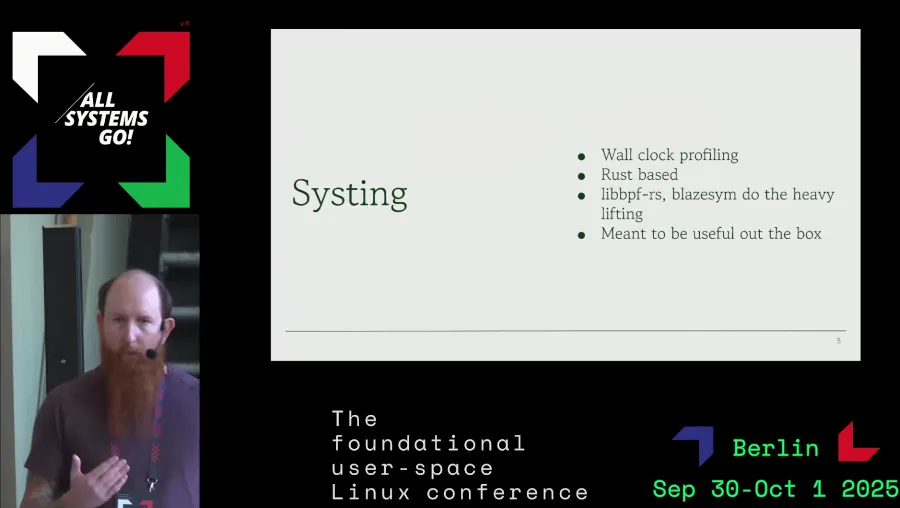
“Last year at the systemd-aligned All Systems Go conference, I talked about Systing’s potential,” Bacik recalls. “But what we have now in version 1.0 is light-years beyond what I presented then.”
The Technical Architecture
Under the hood, Systing 1.0 is built with Rust, leveraging libbpf for its eBPF capabilities. This modern approach ensures memory safety and performance while maintaining the low-level system access necessary for effective tracing.
The DuckDB integration is particularly clever. By storing trace data in a columnar database format, Systing enables complex queries that would be impossible or extremely slow with traditional trace formats. This makes the AI analysis not just possible, but practical and fast.
A “Playground” That Became Essential
Bacik describes Systing as always being a “playground” tool for him to explore different methods of visualizing and analyzing system behavior. This experimental approach has paid off tremendously, leading to innovations that the broader community can now benefit from.
“I’ve always had this vision in my head of the perfect tool for system analysis,” Bacik shares. “Systing 1.0 is the closest I’ve ever come to that ideal. Every time I use it, I discover new ways it can make my job easier.”
The Future of System Debugging
The implications of Systing 1.0 extend far beyond just making one engineer’s life easier. This tool represents a glimpse into the future of system debugging, where AI assistants become integral parts of the development workflow.
As systems grow increasingly complex—with microservices, containers, and distributed architectures becoming the norm—the traditional approaches to debugging are becoming unsustainable. Systing 1.0 offers a compelling vision of how AI can augment human expertise, making it possible to understand and optimize systems that would be overwhelming for any individual to analyze manually.
Community Impact and Availability
The Rust-based Systing code is available on GitHub, with Bacik encouraging the community to experiment with and contribute to the project. This open approach ensures that the benefits of AI-powered system analysis can be widely distributed throughout the Linux and broader open-source community.
For developers working on Linux systems, whether they’re optimizing database performance, debugging network issues, or simply trying to understand complex system behavior, Systing 1.0 represents a powerful new addition to their toolkit.
The Bottom Line
Systing 1.0 isn’t just another tool—it’s a statement about the future of systems engineering. By successfully integrating AI into the core of system analysis, Josef Bacik has created something that could fundamentally change how we approach debugging and optimization.
As systems continue to grow in complexity, tools like Systing may become not just useful, but essential. The question isn’t whether AI will transform system debugging—it’s how quickly the industry will embrace these new capabilities.
For now, Systing 1.0 stands as a testament to what’s possible when deep systems expertise meets modern AI capabilities. It’s a tool that doesn’t just make existing workflows faster—it enables entirely new ways of understanding and interacting with complex systems.
The Linux kernel community, and indeed the entire field of systems engineering, will be watching closely to see how Systing evolves from here. One thing is certain: the bar for system analysis tools has been raised, and AI is now an integral part of the equation.
Tags and Viral Phrases:
AI-powered Linux tracing, eBPF revolution, Josef Bacik Systing, Claude Code integration, DuckDB system analysis, Linux kernel debugging, AI system optimization, real-time performance analysis, Rust eBPF tools, Systing 1.0 release, Meta engineer breakthrough, system behavior AI, performance regression debugging, open-source AI tools, All Systems Go conference, Btrfs creator new project, Linux tracing game changer, AI debugging workflow, system analysis future, eBPF tracing AI, DuckDB database tracing, Claude Code system analysis, Systing GitHub repository, Linux performance optimization, AI-powered system debugging, kernel development innovation, distributed systems analysis, container performance tracing, microservices debugging AI, systems engineering AI, eBPF Rust implementation, AI systems engineer assistant, performance bottleneck identification, system behavior visualization, Linux infrastructure debugging, AI trace analysis, real-time system insights, Systing case studies, networking application optimization, systems playground tool, perfect system analysis tool, AI kernel development, Linux community innovation, system complexity management, AI debugging assistant, performance regression solution, systems behavior understanding, AI systems optimization, eBPF data analysis, Linux debugging revolution, Systing community impact, open-source AI integration, system analysis paradigm shift, AI systems engineering future.
,


Leave a Reply
Want to join the discussion?Feel free to contribute!