
The big AI job swap: why white-collar workers are ditching their careers | AI (artificial intelligence)
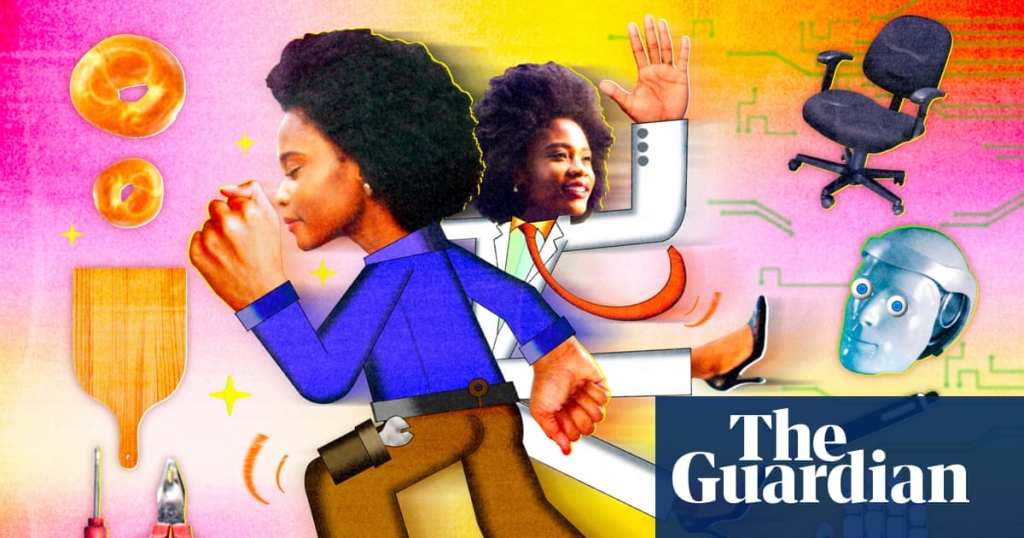
The Great AI Job Swap: White-Collar Workers Ditching Their Careers
In a world where artificial intelligence is advancing at breakneck speed, a quiet revolution is taking place in offices, studios, and cubicles across the globe. White-collar workers, once secure in their professional identities, are now abandoning careers they spent years building—not because they want to, but because they feel they have to.
When the Dream Job Becomes a Nightmare
For Jacqueline Bowman, writing was never just a job—it was her calling. From her first internship at 14 to her journalism degree, the California-based writer had always known her path. But 2024 marked a turning point. Publications shuttered, layoffs mounted, and suddenly, clients weren’t just cutting budgets—they were cutting people entirely.
“I started getting clients talking about AI,” Bowman recalls, her voice tinged with disbelief. “Some were brazen enough to tell me how great it was that we don’t need writers anymore.”
The final insult came when she was offered editing work—polishing AI-generated content for half her previous rate. The math was brutal: what once took two hours now consumed four, for half the pay. “I had to fact-check everything, and at least 60% was completely made up,” she says. “I’d end up rewriting most of it.”
The irony cuts deep. Bowman’s distinctive voice, honed over years of practice, has been inadvertently absorbed by the very AI systems threatening her livelihood. “I’ve noticed AI-produced copy can seem eerily similar to my own writing,” she says. “I suspect it’s because large language models were trained on some of my previous work.”
By January 2025, the financial reality became impossible to ignore. Unable to afford her own health insurance, Bowman made a decision that would have seemed unthinkable just months earlier: she married her partner earlier than planned, solely to access his benefits. But she knew this was merely a stopgap.
The Therapist’s Couch Beckons
Remembering a psychology elective she’d enjoyed in college, Bowman saw an opportunity. “It’s not AI-proof,” she admits, acknowledging that AI therapy services already exist. “But there’s a subsection of people who are going to say: ‘Hey, AI took my job, AI ruined my life. I’m not going to go to an AI therapist.'”
The logic is compelling. While some embrace algorithmic counseling, others will crave human connection more than ever. Bowman is now back in university, studying to become a marriage and family therapist. “I’m incredibly lucky,” she says, “because I can rely on my husband and any writing work I can still get to make ends meet.” Still, she’s had to take out loans—a financial burden she wouldn’t have considered if her writing career hadn’t become untenable.
From Editor to Baker: A Doughy Escape
Janet Feenstra’s journey from academic editor to baker in Malmö, Sweden, tells a similar story of forced reinvention. For nearly a decade, the 52-year-old had built a reputation as a specialist in language editing—helping researchers whose first language wasn’t English publish in international journals. “The standard of English here in Sweden is very, very high,” she explains. “This was very specialized academic editing.”
But whispers of AI adoption within her university grew louder. “I felt like the writing was on the wall,” Feenstra says. “If a manuscript is already quite good, an AI system prompted to meet academic journal requirements might be able to do the work I was doing.”
The fear was visceral. “I’m divorced, I have two children to look after, and I need financial security,” she says. Rather than wait for redundancy, Feenstra chose to retrain in something she was “fairly sure that AI would not replace anytime soon.”
She enrolled in culinary school, trading her desk for a bakery where she now “rolls out the dough by hand and it feels amazing.” The work is physically demanding—she’s had to move to a smaller flat, and her sons now live full-time with their father—but there’s joy in the simplicity. “We listen to music and we dance and sing whenever we want,” she says. “I have a lot more fun now, but I don’t want to be grateful to AI for this—I’m still a little bit bitter.”
The transition has forced Feenstra to confront class assumptions she’d never questioned. “White-collar work isn’t all it’s cracked up to be, I’ve realized,” she says. “But it requires an adjustment. We’re so defined by our jobs and our class.”
The Trades: Last Bastion Against the Algorithm?
Angela Joyce, CEO of Capital City College in London, has noticed a significant shift in student demographics. “We’re seeing a steady growth in students of all ages coming to us to do trades-based qualifications,” she says, pointing to courses in engineering, culinary arts, and childcare. “There’s definitely a shift away from traditional academic routes.”
Joyce attributes this partly to high unemployment among graduates—”a good proportion of those are graduates,” she notes—but also to AI anxiety. “People are looking for jobs that AI can’t replace.”
Richard, a 39-year-old former occupational health and safety professional from Northampton, made precisely this calculation. After 15 years climbing the career ladder, he watched as AI began automating policies and safety procedures. “Health and safety isn’t going to disappear any time soon because organizations can’t name AI as a responsible person or a duty holder for businesses legally,” he explains. “But I started to hear mumblings of AI within the industry.”
His decision to retrain as an electrical engineer was driven by more than self-preservation. “My primary concern was that the implementation of AI might be more of a cost-cutting exercise than it is about safety,” he says. His friend had died in a gas explosion at work—a tragedy that drew him to the field initially. “I care deeply about the health and safety industry.”
The financial sacrifice has been substantial. “I’ve taken a huge cut,” Richard admits, though he sees potential for future earnings. The physical demands are also challenging. “Their recovery rates are a hell of a lot quicker than mine,” he says of the younger electricians he works alongside. “If I pick up an injury, it takes me far longer to recuperate.”
Yet Richard remains pragmatic about the future. Even electrical work isn’t entirely safe—he mentions BMW’s testing of humanoid robots as evidence that no trade is completely automation-proof. “Companies are capitalizing on AI to remove one of their biggest costs, which is human overheads,” he says. “You need to pick something which has resilience. Statistically, that is not your roles that are bureaucratic by nature, heavy in data, and are just a bunch of processes which you repeat end on end. It needs to be something with high dexterity and some high problem-solving skills.”
The AI-Proof Paradox
Carl Benedikt Frey, associate professor of AI and work at the Oxford Internet Institute, offers a nuanced perspective. While manual work “is going to be harder to automate,” he predicts AI will impact “across a very wide range of industries”—trades included. “If the dishwasher breaks down in my home, I can take a picture and I can quiz the large language model of my choice, and I’m more likely to be able to fix it myself these days without calling an engineer,” he says.
Yet Frey cautions against panic. “We have to go by what’s actually happening in the labor market. As AI gets better, and its capabilities improve, I think it’s likely that we will see it on a bigger slice of the labor market. But we’re not seeing it yet.”
His reassessment of his own research is telling. In the 2013 paper “The Future of Employment,” co-authored with Michael Osborne, Frey famously claimed that 47% of roles were at risk of computerization. “In that study, a lot of the jobs that we deem are highly exposed to automation are jobs in transportation and logistics because of autonomous vehicles,” he explains. “It’s fair to say that it’s taken much longer for that technology to materialize.”
For those early in their careers, Frey’s advice is clear: “It might be a good idea to take the time that you still have to invest in training and figuring out other more viable career paths,” particularly if you work as a translator—”one profession where we’re already seeing that AI is having an impact, although we’re not seeing mass displacement by any means.” Those nearing retirement, however, might “ride the wave for a few more years.”
The New AI Economy
While some flee from AI, others are rushing toward it. Birmingham-based entrepreneurs Fayyaz Garda and Arun Singh Aujla, both 25, are launching an AI consulting business, teaching themselves through YouTube videos. “It’s a growing market, and there’s definitely a space for it,” Garda says. “I’m hoping to try and get in there early.”
Their plan involves employing engineers to create AI systems that handle phone calls, respond to mail, and fulfill other business tasks. “The AI consulting business is one way I’m upskilling to move with the times,” Singh Aujla adds. “AI won’t replace me, but it may take a large market share out of my business. So it’s always good to make an extra stream of revenue.”
Yet even these AI evangelists draw lines. “I would not replace my management team,” Singh Aujla insists. “You need that human interaction with your team. But roles the team don’t want to do, like email outreach and cold calling, we can get AI agents to do that.”
Dreams Deferred, Not Destroyed
For some, AI hasn’t just changed their career—it’s eliminated their dream entirely. Paola Adeitan, 31, had her heart set on becoming a solicitor. She obtained undergraduate and master’s degrees in law, planning to complete the legal practice course that would qualify her as a solicitor. “But I decided not to pursue that path because I felt like, with the change in technology, the AI, that might not be a viable path for me to carry on with,” she says.
Friends struggling to secure entry-level law roles reinforced her decision. “It felt like we were getting completely ignored,” she says of attempts to defend human roles in the face of automation. “They went ahead with it because they said they had to get a certain number of cuts to the budget.”
Adeitan still volunteers as a legal adviser, but her day job is now in the health sector—though even that role could be affected by AI. “I do feel a sense of disappointment,” she admits, “but the nature of work is changing. It’s very difficult now to decide what you want to do; you have to think carefully. It’s not about what you want anymore; it’s about what is going to be there, what’s going to work.”
Faz, 23, faced a similar reckoning during a break from his geography degree at the University of Manchester. “I had to think about what was future-proof, I had to think about what was AI-proof,” he says. “It seemed like a lot of entry-level roles in the corporate sector were being taken over by AI.”
He’s now training for a Level 2 qualification in electrical installation, a choice he describes as “100%, God willing, the correct choice.” His ideal scenario would combine part-time council or charity work with electrical jobs on the side. “Right now, a tradie job is the right choice. I’m fairly certain it will be future-proofed against AI.”
The Human Cost
Not everyone finds fulfillment in their AI-proof pivot. Bethan, 24, from Bristol, took a job in a local cafe after her university IT helpdesk position was replaced by an AI kiosk. The helpdesk had been “the first job that I didn’t come home in pain from,” she says, but the physical demands of hospitality exacerbate her hypermobility spectrum disorder.
“Feeling like I had to go back to hospitality, which was so bad for my body, was a horrible feeling,” she says. She’s searching for office work but finds that “those are the jobs that are vanishing because they’re the easiest to replace.” The paradox is cruel: entry-level positions disappear to AI, but without that experience, higher-level roles remain out of reach.
Bethan worries about a future where even office jobs aren’t safe. “Is it worth all the effort of applying, getting my CV up to date, and potentially doing a couple of rounds of interviews just to find out at the end we’re going to be replaced again?”
The New Class Divide
The AI revolution is creating a new kind of class divide—not between rich and poor, but between those whose skills complement AI and those whose skills compete with it. Frey notes that social skills will remain crucial precisely because they’re hard to automate. “There are just categories where we prefer to interact with humans, right?”
Klein Teeselink, author of the King’s College London study on AI’s early impact, agrees. “I have students who use AI naively, and therefore they have no idea whether the reports they produce are good or bad,” he says. “You need to have that expertise to be able to guide the AI to get it to do what you need it to do. So in that sense, I think the value of expertise might actually go up.”
But the question remains: how will that expertise be developed if entry-level positions vanish? And who will be able to afford ballet tickets or therapy sessions if AI displaces large segments of the workforce?
Frey’s advice is characteristically measured: “It could well arrive, but it matters a great deal if that happens in five years or 20.” While acknowledging “there are reasons to be concerned,” he doesn’t think it’s time to “paint a scenario where everybody’s going to be out of work five years from now, and we need to rethink everything.”
The Tags and Viral Phrases
- AI-proof careers
- The Great AI Job Swap
- White-collar workers fleeing automation
- When your dream job becomes obsolete
- Forced career reinvention in the AI age
- The trades as AI sanctuary
- Therapy as the new writing
- Baking your way out of the algorithm
- Electrical engineering against the machine
- AI consulting gold rush
- Dreams deferred by artificial intelligence
- The human cost of automation
- New class divide: AI complementors vs competitors
- Social skills as AI resistance
- Expertise in the age of algorithms
- Entry-level extinction
- The paradox of AI-proof work
- Physical labor as technological refuge
- When AI takes your helpdesk
- The bitter taste of AI-driven reinvention
- Future-proofing your career against robots
- The silent revolution in office cubicles
- Abandoning your calling for survival
- The new career advice: forget your passion
- AI as the ultimate career counselor
- The end of white-collar security
- Trading keyboards for wrenches
- When YouTube becomes your career advisor
- The AI-proof paradox: more physical, less prestigious
- The invisible hand of algorithmic unemployment
,

Leave a Reply
Want to join the discussion?Feel free to contribute!