
The Billionaire Space Race Is Really Heating Up
Blue Origin’s Bold Lunar Gambit: The Tortoise’s Secret Weapon Against SpaceX’s Hare
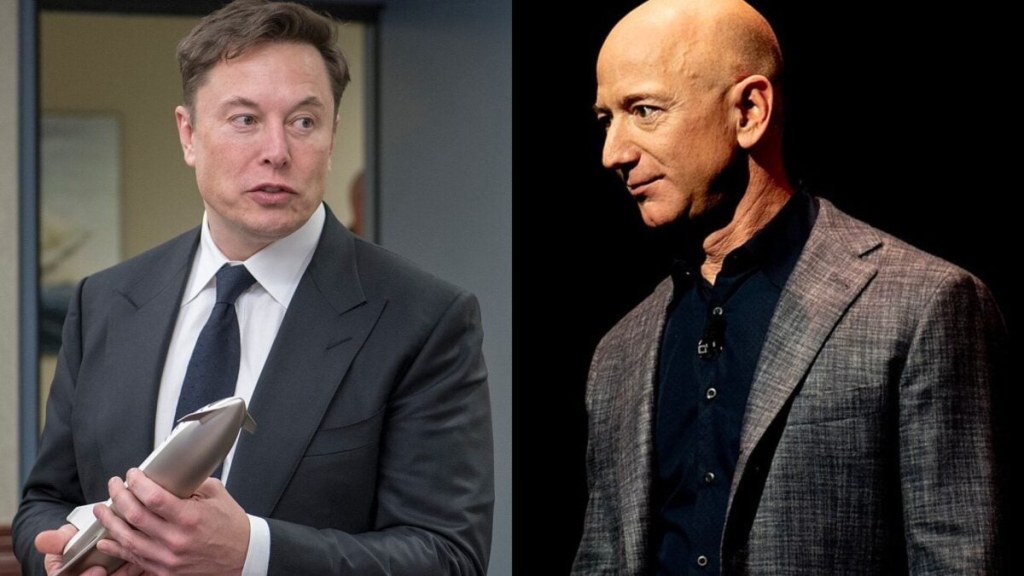
The celestial chessboard is set, and two of Earth’s most ambitious billionaires are making their moves in humanity’s return to the Moon. While NASA races against time—and China—to establish a permanent lunar presence, the real drama unfolds in the private sector where Jeff Bezos and Elon Musk are locked in a high-stakes duel that could determine who plants the next human footprints in lunar soil.
The Billionaire Space Race Heats Up
The rivalry between Blue Origin and SpaceX has transcended mere competition; it’s become a defining narrative of modern space exploration. When NASA reopened its Artemis 3 lunar lander contract in October 2024 after SpaceX’s Starship HLS faced significant delays, it wasn’t just a business decision—it was an invitation to chaos in the form of two competing visions for humanity’s return to the Moon.
SpaceX, the company built on Elon Musk’s dream of Martian colonization, shocked the aerospace world when Musk announced a strategic pivot toward lunar development. This marked a dramatic reversal from his previous stance, where he had dismissed the Moon as a “distraction” just a year earlier. The timing couldn’t be more critical, as SpaceX faces the very real possibility of losing its Artemis 3 contract to Blue Origin.
But Jeff Bezos wasn’t about to let this moment pass without making his own statement. The morning after Musk’s lunar announcement, Bezos posted a cryptic image on X (formerly Twitter): a turtle peering out from shadowy foliage. No caption, no explanation—just the enigmatic reptile. For those familiar with Blue Origin’s branding, the message was crystal clear: the tortoise is coming for the hare.
Bezos has long embraced the tortoise as Blue Origin’s mascot, drawing inspiration from Aesop’s classic fable “The Tortoise and the Hare.” In this cosmic retelling, slow and steady development might just win the race to the Moon, even against SpaceX’s seemingly insurmountable technological advantages.
NASA’s Artemis 3: The Ultimate Prize
Artemis 3 represents more than just another Moon landing—it’s NASA’s ambitious plan to return humans to the lunar surface for the first time since Apollo 17 in 1972. The mission aims to land astronauts near the Moon’s south pole, an area of particular scientific interest due to the potential presence of water ice in permanently shadowed craters.
In 2021, NASA awarded SpaceX a $2.89 billion contract to develop the Starship Human Landing System (HLS) for Artemis 3. The agency’s original timeline called for a 2024 landing, but the complexity of SpaceX’s approach quickly became apparent. The Starship HLS requires multiple in-orbit refueling operations—a technological feat that has proven far more challenging than initially anticipated.
By 2023, delays had pushed Artemis 3 to 2028, and NASA’s confidence in SpaceX’s ability to deliver on time began to waver. The agency’s decision to reopen the lander contract wasn’t just about having a backup plan; it was a recognition that the path to the Moon might require multiple approaches rather than a single, all-or-nothing strategy.
Blue Origin’s Revolutionary Approach
What Ars Technica’s Eric Berger uncovered through internal documents reveals a lunar strategy that could fundamentally alter the dynamics of the space race. Blue Origin’s approach, while perhaps less flashy than SpaceX’s, offers a compelling alternative that sidesteps some of the most challenging technical hurdles facing Starship.
The architecture centers around Blue Origin’s New Glenn rocket and a series of specialized transfer stages designed to move vehicles between different orbits. This approach eliminates the need for complex orbital refueling operations, instead relying on a carefully choreographed sequence of launches and dockings.
The Uncrewed Demonstration Mission
Blue Origin’s path to proving its lunar capabilities begins with an uncrewed demonstration mission that showcases the company’s innovative approach. The mission requires three New Glenn launches, each serving a specific purpose in the complex ballet of lunar exploration.
The first two launches deliver transfer stages into low Earth orbit. These specialized vehicles are designed to perform the critical task of moving payloads from one orbit to another—a capability that forms the backbone of Blue Origin’s lunar strategy. The third launch delivers the Blue Moon MK2-IL lander, a smaller version of the crewed vehicle that will test the fundamental technologies required for lunar operations.
Once in orbit, these three vehicles must perform a series of precise dockings. The first transfer stage then boosts the entire stack into an elliptical orbit around Earth, demonstrating Blue Origin’s ability to perform deep space maneuvers. After separation and atmospheric reentry, the second transfer stage takes over, pushing the MK2-IL lander toward lunar orbit.
The lander then separates and performs the most critical test: descending to the lunar surface and ascending back to low lunar orbit. Success here would prove that Blue Origin can handle the most challenging aspects of lunar operations without the need for Starship’s complex refueling architecture.
The Crewed Landing Mission
If the uncrewed demonstration succeeds, Blue Origin’s crewed mission architecture takes the complexity to another level. This mission requires four New Glenn launches, each contributing to a larger stack that will carry astronauts to the Moon.
Three launches deliver transfer stages to low Earth orbit, while the fourth launches both the MK2-IL lander and a specialized docking port. The precision required for these dockings cannot be overstated—any failure in this phase would cascade through the entire mission.
The first transfer stage boosts the stack toward an elliptical Earth orbit, demonstrating Blue Origin’s capability for deep space propulsion. The second transfer stage then performs the critical maneuver of rendezvousing with NASA’s Orion spacecraft, which carries the crew in a highly stable orbit around the Moon.
This rendezvous represents one of the most technically challenging aspects of the mission. Orion must dock with the MK2-IL lander, allowing astronauts to transfer between vehicles in deep space. The third transfer stage then moves the combined stack into low lunar orbit, where the MK2-IL can separate and begin its descent to the surface.
The return journey mirrors the outbound trip, with the lander ascending to rendezvous with Orion for the crew’s return to Earth. This entire sequence must work flawlessly, as there are no abort options once the crew is committed to lunar orbit.
The Technical Challenges Ahead
While Blue Origin’s approach eliminates the need for orbital refueling, it introduces its own set of unprecedented challenges. The company must prove it can perform complex dockings in various orbital environments—a capability it has never demonstrated before. The transfer stages must execute precise deep space maneuvers, and the entire system must work together seamlessly across multiple orbital regimes.
Perhaps most critically, Blue Origin must compress what would typically be a decade-long development program into a matter of years. The company’s target of an uncrewed lunar landing later this year is ambitious, to say the least, especially when compared to SpaceX’s more conservative 2027 timeline for Starship HLS.
The technical risks are substantial. Any failure in the docking sequence could doom the mission. The transfer stages must perform flawlessly over extended periods in deep space. The MK2-IL lander must handle the extreme thermal and radiation environments of lunar orbit and the surface.
The Broader Implications
This billionaire space race extends far beyond personal rivalry or corporate competition. The outcome will shape the future of lunar exploration and potentially determine who leads humanity’s expansion into the solar system.
If Blue Origin succeeds, it could validate an approach to lunar exploration that emphasizes reliability and incremental development over technological ambition. This could influence how NASA approaches future missions, potentially favoring proven technologies over cutting-edge but risky innovations.
Conversely, if SpaceX overcomes its challenges and delivers Starship HLS, it would demonstrate the viability of reusable, refuelable spacecraft for deep space missions. This could accelerate plans for Mars colonization and establish SpaceX as the dominant player in commercial spaceflight for decades to come.
The competition also has significant geopolitical implications. As NASA races China to establish a permanent lunar presence, having multiple capable providers ensures that American astronauts can reach the Moon regardless of any single company’s setbacks. This redundancy could prove crucial in maintaining U.S. leadership in space during a period of increasing international competition.
The Race Intensifies
What makes this competition particularly fascinating is how it reflects the different philosophies of its principals. Musk’s approach embodies the Silicon Valley ethos of moving fast and breaking things—accepting high risk in pursuit of revolutionary breakthroughs. Bezos’s strategy represents a more traditional aerospace approach, emphasizing reliability and proven technologies over headline-grabbing innovations.
The turtle and the hare metaphor extends beyond mere branding. It encapsulates two fundamentally different approaches to solving the same problem: how to return humans to the Moon safely, reliably, and on a reasonable timeline.
As both companies push forward with their respective architectures, the space community watches with bated breath. Will Blue Origin’s methodical approach pay off, proving that slow and steady can indeed win the race? Or will SpaceX’s technological audacity ultimately prevail, demonstrating that the biggest risks can yield the greatest rewards?
One thing is certain: the next few years will be critical not just for these two companies, but for the future of human space exploration. The Moon is once again the focal point of humanity’s aspirations, and the path we choose to get there will influence our journey to Mars and beyond.
The race is on, and the stakes couldn’t be higher. As these two visionaries compete to write the next chapter in humanity’s spacefaring story, the entire world stands to benefit from their ambition, their innovation, and their willingness to reach for the stars.
Tags
Blue Origin vs SpaceX, lunar lander contract, Artemis 3 mission, New Glenn rocket, Blue Moon MK2-IL, Starship HLS, space race, Jeff Bezos, Elon Musk, NASA lunar program, crewed Moon landing, orbital docking, transfer stages, lunar exploration, commercial spaceflight, space competition, Moon city, Mars colonization, aerospace innovation, billionaire space race
Viral Phrases
The tortoise is coming for the hare, slow and steady wins the space race, Moon city pivot, orbital refueling nightmare, billionaire space showdown, lunar landing architecture, Artemis 3 contract drama, New Glenn’s secret weapon, SpaceX’s Starship struggles, Blue Origin’s bold gambit, the Moon is back in play, space race 2.0, who will plant the next flag, the future of lunar exploration, commercial crew lander battle, NASA’s backup plan, deep space docking challenge, transfer stage technology, uncrewed lunar demo, crewed Moon mission architecture
,

Leave a Reply
Want to join the discussion?Feel free to contribute!