
The mystery of how volcanic lightning happens has been solved
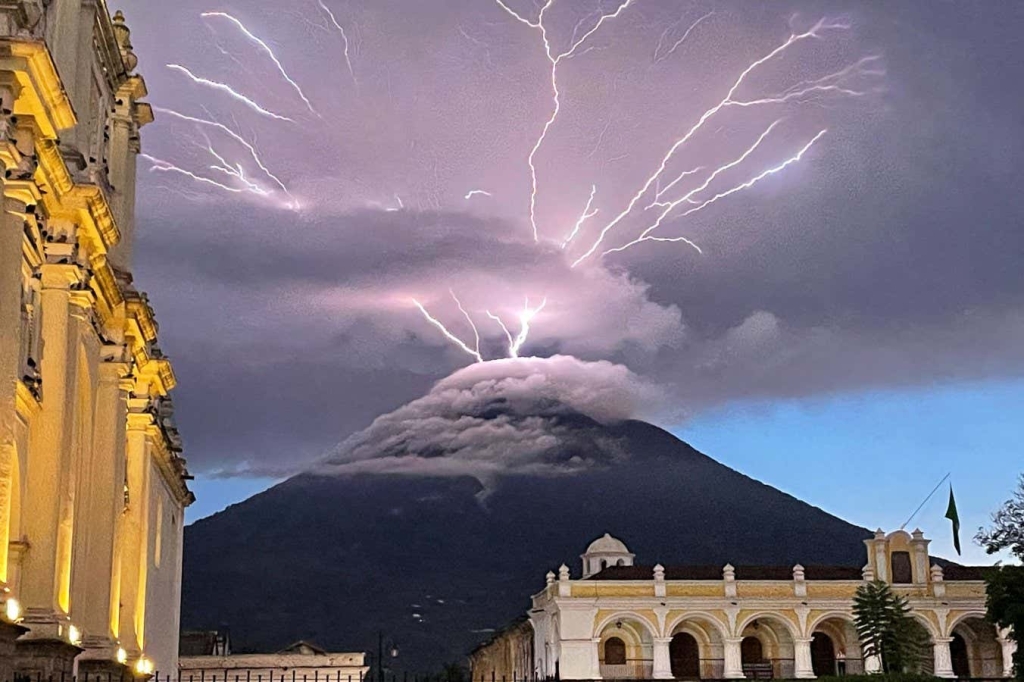
Lightning Strikes in Volcanic Ash: The Hidden Role of Carbon Contamination
A breakthrough in physics has finally cracked one of nature’s most electrifying mysteries—why volcanic lightning forms in ash clouds when identical particles exchange electric charge. This discovery not only illuminates a spectacular natural phenomenon but also challenges our fundamental understanding of how materials interact at the microscopic level.
The Mystery That Baffled Scientists for Decades
When volcanoes erupt, they eject massive clouds of ash and debris into the atmosphere. Within these turbulent plumes, something extraordinary happens: lightning begins to crackle and flash, seemingly from nowhere. The process begins when particles of silicon dioxide—the primary component of volcanic ash—collide and exchange electric charge through a phenomenon called the triboelectric effect.
Here’s where the mystery deepens: when two identical particles collide, physics dictates they should behave symmetrically. If particle A gives up an electron to particle B, particle B should give one back to particle A. The net charge exchange should be zero. Yet in volcanic ash clouds, we observe dramatic charge separation—some particles become positively charged while others become negatively charged, creating the perfect conditions for lightning.
The Carbon Contamination Connection
The solution, surprisingly, came from examining what scientists had long considered a nuisance: surface contamination. Researchers at the Institute of Science and Technology Austria, led by Galien Grosjean (now at the Autonomous University of Barcelona), discovered that carbon-containing molecules coating the surfaces of silicon dioxide particles were the key to breaking this symmetry.
Using an ingenious experimental setup, the team levitated individual silicon dioxide particles with ultrasound, allowing them to bounce once onto a target plate of the same material. They then measured the charge of the particle after impact. The results were striking: the same particle would sometimes emerge positively charged, sometimes negatively charged, depending on its surface contamination.
“We would clean the particle, and it would charge the opposite way,” Grosjean explains. “It was like flipping a switch.” Analysis revealed that removing carbon contaminants made particles more likely to charge positively, while allowing them to reacquire a carbon coating over approximately 24 hours made them charge negatively again.
Why This Changes Everything
This discovery has profound implications that extend far beyond volcanic lightning. The triboelectric effect is fundamental to countless everyday phenomena—from the static electricity that makes your hair stand up after rubbing a balloon to the operation of photocopiers and laser printers.
Daniel Lacks, a materials scientist at Case Western Reserve University, emphasizes the significance: “People know surfaces have a lot of contaminants. But I’ve never seen that come up in triboelectric charging.” The finding suggests that the seemingly random nature of static electricity generation may actually be governed by microscopic surface chemistry that we’ve been overlooking.
The Prediction Problem
Perhaps most unsettling for physicists is what this means for our ability to predict and control charge transfer. If carbon contamination—which varies based on environmental conditions, handling, and countless other factors—determines charging direction, then calculating these interactions with precision becomes extraordinarily difficult.
“Prediction may just be something that will never happen,” Lacks warns. This challenges the very foundation of materials science, where the goal has always been to understand and predict how materials behave based on their fundamental properties.
Volcanic Lightning: Nature’s Spectacular Light Show
Volcanic lightning occurs when the charge-separated ash particles create strong electric fields. When these fields become intense enough, they overcome the air’s resistance and create conductive pathways for electrical discharge—lightning. This phenomenon can occur both within the eruption column and in the ash clouds that spread downwind from the volcano.
The process is similar to how thunderstorms generate lightning, but with a crucial difference: volcanic lightning doesn’t require ice particles or atmospheric convection. It can occur even in the hottest parts of an eruption, making it one of the most dramatic and mysterious displays of electrical activity in nature.
Beyond Volcanoes: Everyday Implications
The discovery’s implications ripple through numerous fields. In manufacturing, where static electricity can damage sensitive electronics or cause materials to stick together unpredictably, understanding the role of surface contamination could lead to better control methods. In atmospheric science, it may help explain charge separation in dust storms and other particle-laden phenomena.
Even in space exploration, where spacecraft encounter dust particles in extraterrestrial environments, this knowledge could prove crucial for protecting equipment from electrostatic discharge.
The Beauty of Accidental Discovery
What makes this story particularly compelling is that it emerged from careful observation of what many would have dismissed as experimental noise or contamination. The researchers’ willingness to investigate anomalies rather than eliminate them led to a fundamental breakthrough.
“It might charge positive or negative. If positive, we would bake or clean it and redo the experiment—and then it would charge negative,” Grosjean recalls. This persistence in the face of apparent randomness ultimately revealed an underlying pattern.
Looking Forward: A New Era of Surface Science
This discovery marks the beginning of what could be a new era in surface science and materials engineering. Rather than trying to create perfectly clean surfaces—an impossible task in most real-world conditions—scientists may need to learn to work with, or even harness, the effects of surface contamination.
Future research will likely focus on understanding exactly how carbon molecules influence charge transfer at the molecular level, potentially leading to new materials designed specifically to control static electricity generation.
Tags: #VolcanicLightning #TriboelectricEffect #SurfaceContamination #PhysicsBreakthrough #SiliconDioxide #CarbonMolecules #ElectricCharge #MaterialsScience #NatureMysteries #ScientificDiscovery
Viral Phrases: “Nature’s electric secrets revealed”, “The contamination that controls lightning”, “Physics meets chemistry at the atomic level”, “When dirt becomes the answer”, “The microscopic switch that flips charge”, “Breaking symmetry in particle collisions”, “From volcanic ash to everyday static”, “The hidden hand of carbon”, “Prediction may never happen”, “Accidental discoveries that change everything”
Viral Sentences: “Scientists finally understand why volcanic lightning forms when identical particles collide”, “The answer was hiding in the dirt all along”, “What if contamination isn’t a problem, but the solution?”, “A discovery that makes physicists question everything”, “The microscopic battle between carbon and silicon”, “How surface chemistry controls nature’s most spectacular light shows”, “The end of predictability in materials science?”, “From volcanic eruptions to your morning hair static”, “When cleaning makes things worse instead of better”, “The 24-hour cycle of electrical charge”
,
Leave a Reply
Want to join the discussion?Feel free to contribute!