
The rise of adaptive displays: How Lenovo is redefining productivity & play
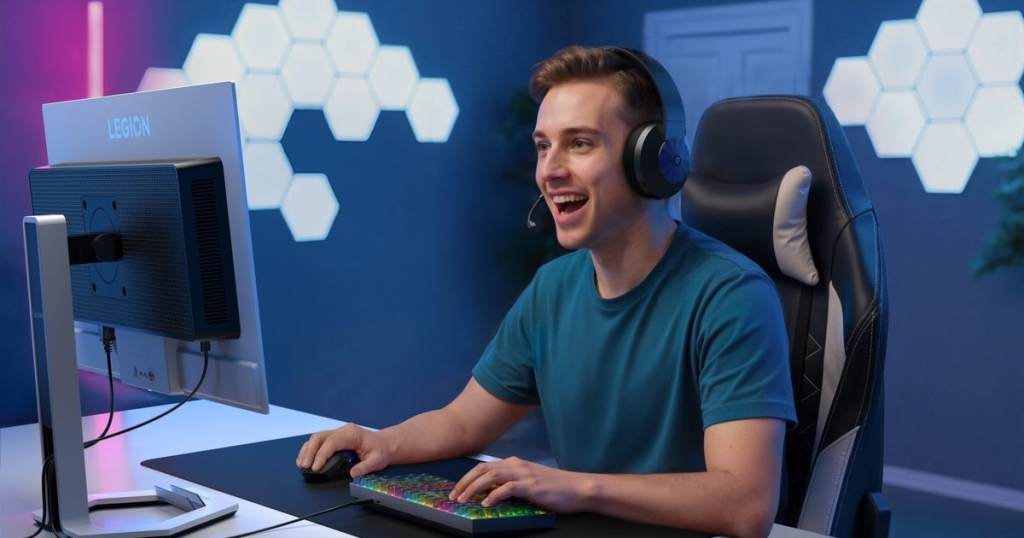
The Dawn of Intelligent Displays: How AI is Transforming the Way We See
The humble display has come a long way from its origins as a simple, passive screen. For years, the evolution was measured in incremental improvements—higher resolutions, faster refresh rates, thinner bezels. But we’re now entering a revolutionary phase where displays are no longer just windows into content; they’re becoming intelligent, adaptive companions that respond to our needs throughout the day.
“If you look at the history of displays, they have always been passive surfaces that simply rendered whatever the device sent to them,” explains George Toh, Vice President and General Manager of Lenovo’s Visual Business Unit. “What is changing now is that screens are becoming adaptive interfaces that react to what the user is doing in real time.”
From Fixed Panel to Fluid Interface
The leap from static screen to smart display represents a paradigm shift far beyond traditional spec improvements. With breakthroughs in panel technologies like OLED, mini-LED, and oxide-based designs, combined with sophisticated AI capabilities, modern displays can now dynamically respond to content, user behavior, and even ambient conditions.
Imagine a screen that automatically shifts its refresh rate from 24Hz to 120Hz based on whether you’re reading an article or launching a game. Or a monitor that quietly adjusts its brightness and contrast as sunlight moves across your workspace throughout the day. These aren’t futuristic concepts—they’re the new foundation of display intelligence.
As modern users constantly shift between productivity tasks, video calls, and entertainment, this transformation is essential to keep pace with evolving workflows and work/life integration. One moment you’re in deep-focus mode, the next you’re on a team call, then scrolling through news. Smart displays are being engineered to anticipate these transitions and adapt instantly, providing an unparalleled user experience.
AI Makes the Screen Smarter—and Invisible
AI is revolutionizing how we create content, and now it’s reshaping how we consume it. In intelligent displays, AI is deployed to recognize scenes, upscale content in real time, tune backlighting, and reduce latency—all without users touching a single setting in the menu.
“AI is allowing displays to respond in ways that used to require manual adjustment,” Toh notes. “These refinements are subtle, but they make a meaningful difference in how natural and immersive the screen feels.”
Lenovo’s display concepts are pushing this evolution even further. The Smart Sense Display concept functions as a multi-device hub, connecting wirelessly to up to three personal devices and automatically waking when the user approaches. With natural language interaction and drag-and-drop content management, the display becomes an orchestrator rather than just another endpoint.
Gaming Gets an AI Upgrade
Gaming displays have traditionally been optimized for raw performance metrics: frame rates, response times, and color accuracy. Lenovo’s AI Frame Gaming Display concept is revolutionizing this space by integrating AI directly to personalize and amplify gameplay. Next-generation technology enables the display to detect game types (MOBA, FPS, etc.), automatically zoom into key areas, surface them in dedicated screen regions, track cursor movements, and dynamically adapt visuals.
Through AI scene detection, the display can identify game genres and auto-adjust visuals in critical areas to benefit the player. From zooming in for FPS precision to enlarging maps in MOBA titles for better situational awareness, the gaming experience is getting a major upgrade.
The goal isn’t to distract gamers with overlays. Cursor tracking highlights focus areas in simulation games, while spatial audio heightens immersion. The display quietly adapts alongside players, delivering a personalized experience that enhances performance without pulling them out of the moment.
A More Personal, Predictive Workspace
For professionals, display intelligence translates to improved clarity, speed, and seamless device connectivity. The Smart Sense Display, for instance, eliminates friction points. You won’t need to dig out your laptop or manually pair devices—you simply walk up, and the system is ready.
“The most noticeable change for users will be that the display feels more intuitive,” Toh explains. “They will realize they are spending less time adjusting brightness, color, window layouts, or modes because the display is already reacting to what they need.”
The ultimate goal is what Toh calls “companionship” with devices—less interface friction with improved personalization. A truly smart display should understand context, recognize patterns, and reduce the effort needed to achieve focus.
Beyond Spec Sheets: Rethinking Metrics and Design
As intelligent displays gain prominence, “Traditional specs will always matter,” Toh acknowledges, “but they are no longer the full story.”
Instead, expect to see experience-focused benchmarks take center stage: responsiveness to context, adaptability, and exceptional integration with user habits. Displays will increasingly be compared not just by sharpness but by how attuned they are to user needs.
This shift also opens the door for radical new form factors. Lenovo’s rollable OLED concept, for example, transitions from a compact laptop into a full-sized canvas. Foldables, rollables, and transformables demonstrate what becomes possible when displays are no longer locked into a single shape or use case.
The Next Frontier: Contextual Intelligence
What’s next? Toh sees a shift from content-aware to context-aware screens. Future displays will know not just what’s on them but understand why it’s there. A device might detect when a user is concentrating and adjust layout or color tone to minimize distractions. It could recognize a user’s posture and detect eye fatigue, triggering subtle changes in color temperature to reduce strain.
Concepts like Lenovo’s AI-Powered Personalized Display demonstrate this direction, offering personalized visual profiles, circadian-aware lighting, and real-time health cues based on posture and screen usage. These features don’t just improve quality of life—they pave the way for a world where displays are as thoughtful as they are powerful.
“The frontier is not about dramatic features,” Toh says. “It’s about displays that support people in a more intuitive and adaptive way.”
A Seamless Vision for Smarter Screens
This moment in display innovation is defined by convergence. Hardware is evolving. AI is becoming ambient. And user expectations are rising. What used to be about spec sheets and calibration tools is now a holistic experience built around the individual.
“For the first time, the screen can understand what the user is doing and adapt in ways that make the experience feel smoother and more personal,” says Toh. “That shift opens up so many possibilities.”
Ultimately, the smartest display is the one you forget about—not because it isn’t working, but because it’s working so well it disappears into the background, quietly enhancing clarity, comfort, and flow.
That’s not science fiction. That’s the next generation of visual technology.
Learn more about how Lenovo’s next-gen displays are elevating everyday workflows and immersive experiences.
Tags & Viral Phrases:
- AI-powered displays
- Smart display revolution
- Next-gen visual technology
- Adaptive screen interfaces
- Gaming display AI upgrade
- Context-aware computing
- Intelligent workspace solutions
- Future of display technology
- AI scene detection gaming
- Seamless device integration
- Rollable and foldable displays
- Display intelligence transformation
- Personalized visual experience
- Ambient computing displays
- Smart Sense Display innovation
- AI Frame Gaming Display
- Revolutionary display technology
- The future is now
- Game-changing display tech
- Displays that think
- Technology that adapts to you
- The end of static screens
- Welcome to the era of smart displays
- Displays that understand context
- The invisible interface
- Computing’s next big leap
- Displays that disappear into experience
- AI meets visual technology
- The display renaissance
- Beyond the spec sheet
- Revolutionary gaming experience
- Workspace of the future
- Technology that serves you
- The smart display evolution
,

Leave a Reply
Want to join the discussion?Feel free to contribute!