
There’s Something Hiding Under Jupiter’s Clouds, Scientists Find
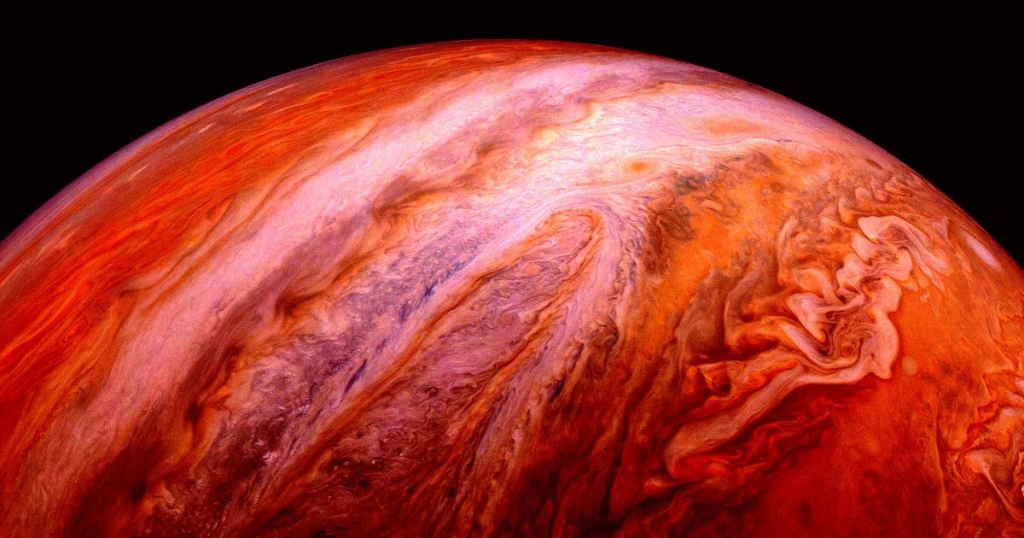
Jupiter’s Hidden Secrets: Scientists Uncover a Shocking Oxygen Surprise Beneath the Gas Giant’s Swirling Clouds
Jupiter, the colossal titan of our solar system, has long guarded its deepest secrets beneath layers of impenetrable storms and swirling gases. For decades, astronomers have gazed at its mesmerizing cloud bands, wondering what mysteries lie hidden beneath the violent tempests that make this gas giant both beautiful and deadly. Now, thanks to groundbreaking research combining data from NASA’s Juno and Galileo missions, scientists have unveiled a startling discovery that could rewrite our understanding of how Jupiter—and perhaps other gas giants—formed billions of years ago.
A team of researchers from NASA’s Jet Propulsion Laboratory and the University of Chicago has developed an unprecedentedly detailed computational model of Jupiter’s atmosphere. Their findings, published in The Planetary Science Journal, reveal something extraordinary: Jupiter contains one-and-a-half times as much oxygen as our Sun—a revelation that dramatically exceeds previous estimates, which suggested the gas giant held only about a third of the Sun’s oxygen content.
This oxygen isn’t floating freely in gaseous form. Instead, much of it is chemically bound within water molecules, creating complex behaviors that vary dramatically with temperature and pressure as you descend through Jupiter’s layers. The discovery provides compelling new evidence supporting the prevailing theory that Jupiter formed by accreting icy material billions of years ago near or beyond what scientists call the “frost line”—the distance from the Sun where temperatures drop low enough for volatile compounds like water, ammonia, and methane to freeze into solid ice.
To unravel these cosmic secrets, the research team had to overcome extraordinary challenges. Jupiter’s atmosphere isn’t just a simple mix of gases—it’s a dynamic, three-dimensional system where chemistry, physics, and meteorology intertwine in ways that defy simple explanation. The planet’s crushing pressures, extreme temperatures, and violent weather patterns create conditions unlike anything we experience on Earth.
The researchers’ computational model represents a quantum leap forward in our ability to simulate planetary atmospheres. Unlike previous models that focused solely on chemical reactions or fluid dynamics in isolation, this new approach integrates both perspectives simultaneously. “You need both,” explains Jeehyun Yang, lead author and postdoctoral researcher at the University of Chicago. “Chemistry is important but doesn’t include water droplets or cloud behavior. Hydrodynamics alone simplifies the chemistry too much. So, it’s important to bring them together.”
What makes this discovery particularly fascinating is how it challenges our assumptions about atmospheric dynamics on gas giants. The model suggests that gases move through Jupiter’s atmosphere far more slowly than scientists previously believed. Instead of molecules zipping through atmospheric layers in mere hours, the new calculations indicate that a single molecule might take several weeks to traverse the same distance. “Our model suggests the diffusion would have to be 35 to 40 times slower compared to what the standard assumption has been,” Yang notes. This dramatically slower movement has profound implications for how we understand energy transfer, weather patterns, and chemical processes on Jupiter and potentially other gas giants throughout the universe.
The implications of this research extend far beyond academic curiosity. Understanding Jupiter’s composition and formation helps scientists piece together the broader story of our solar system’s birth and evolution. Jupiter, being the largest planet, likely played a crucial role in shaping the orbits of other planets and determining which materials ended up where during the solar system’s formative years. The oxygen-rich composition suggests that Jupiter may have formed farther from the Sun than its current orbit—a theory that could explain many puzzling aspects of our solar system’s architecture.
Moreover, Jupiter’s more than 90 known moons, including the intriguing Europa with its potentially habitable subsurface ocean, make understanding the gas giant’s formation and evolution even more critical. The gravitational influence of such a massive planet has undoubtedly shaped the destinies of its satellite family, and any insights into Jupiter’s past could illuminate the histories of these diverse and fascinating worlds.
Yet for all we’ve learned, Jupiter continues to guard its deepest secrets. The planet’s violent storms, crushing pressures, and extreme temperatures make direct exploration nearly impossible with current technology. Every spacecraft we’ve sent to study Jupiter has had to maintain a safe distance, relying on remote sensing and careful orbital mechanics to gather data without being destroyed by the planet’s hostile environment.
This latest discovery serves as a humbling reminder of how much we still have to learn about even our closest cosmic neighbors. “It really shows how much we still have to learn about planets, even in our own solar system,” Yang reflects. As our computational capabilities grow and new missions like NASA’s Europa Clipper prepare to launch, we can expect even more revelations about this magnificent gas giant and its complex, mysterious atmosphere.
The journey to understand Jupiter is far from over. Each new discovery peels back another layer of the cosmic onion, revealing not just the secrets of a single planet, but insights into the fundamental processes that shape worlds throughout the universe. As we continue to explore and model this magnificent gas giant, we edge closer to answering some of humanity’s most profound questions about our place in the cosmos and the incredible diversity of planetary systems that exist beyond our own.
Jupiter #NASA #SpaceDiscovery #OxygenSurprise #GasGiant #PlanetaryScience #CosmicMysteries #SolarSystem #Astronomy #SpaceExploration #JunoMission #Galileo #JPL #UniversityOfChicago #PlanetaryFormation #FrostLine #AtmosphericScience #SpaceResearch #CosmicDiscovery #ScienceNews #UniverseMysteries
,


Leave a Reply
Want to join the discussion?Feel free to contribute!