
This dual-CPU PC from 1995 was so cool, Microsoft had to kill it
The BeBox: The Forgotten Dual-CPU Beast That Almost Changed Computing Forever
In the mid-1990s, when Microsoft was tightening its grip on the PC market and Apple was struggling to find its footing, a daring startup emerged with a revolutionary vision. Be Inc., founded by former Apple executives Jean-Louis Gassée and Steve Sakoman, wasn’t content with creating just another operating system or another computer. They wanted to reimagine what personal computing could be with the BeBox—a machine that would challenge the very foundations of how we thought about processors, multitasking, and user interfaces.
A Machine Ahead of Its Time
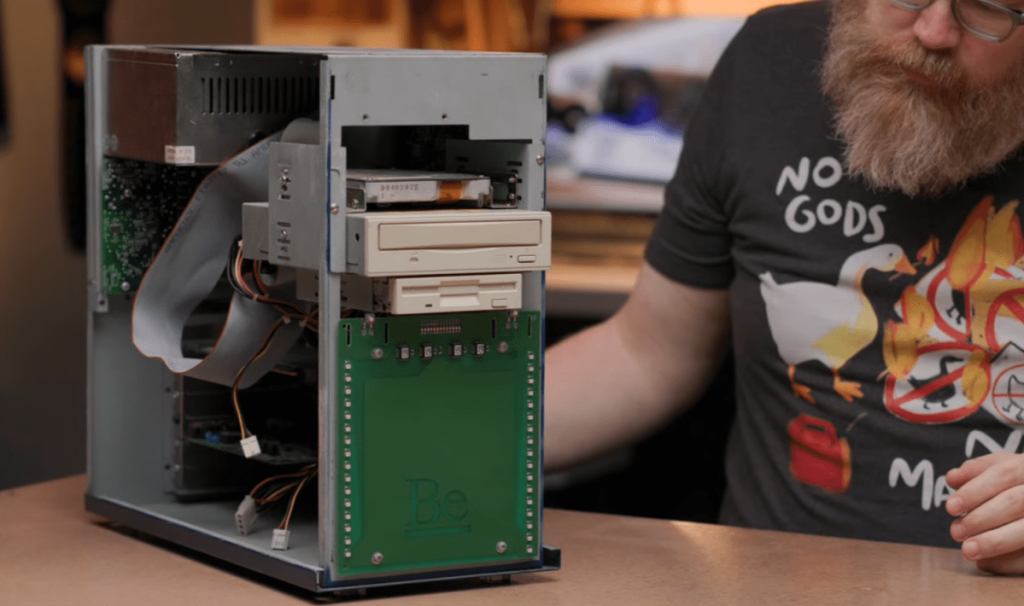
The BeBox looked like any other mid-90s tower PC at first glance, but crack open that case and you’d find something extraordinary: not one, but two PowerPC 603 processors humming away at a modest 67 MHz each. In an era when most computers were still single-tasking and single-processor machines, this was nothing short of revolutionary.
“Think about that for a second,” explains Will Smith, PCWorld’s resident tech historian. “These processors were running at speeds several orders of magnitude slower than what we have in an Apple Watch today. But back in 1995, this was cutting-edge technology that most people couldn’t even conceive of.”
The dual-CPU setup wasn’t just a gimmick—it was the foundation of Be Inc.’s entire philosophy. The company believed that the future of computing lay in true parallel processing, where multiple tasks could be handled simultaneously without the bottlenecks that plagued contemporary systems.
The LED Dance: A Visual Symphony of Processing Power
Perhaps the most iconic feature of the BeBox was its front-panel LED display—two columns of lights that visually represented the load on each processor. As Huxley Dunsay of Retro Roadshow discovered when he brought his BeBox to the PCWorld studio, these lights weren’t just decorative; they were a window into the machine’s soul.
“When I first powered it on, nothing happened,” Huxley recalls. “The LEDs were dead. I thought maybe this was another piece of 90s tech that had simply given up the ghost. But then I replaced the BIOS battery, and suddenly—there it was. The lights started dancing, showing real-time processor activity. It was like watching the heartbeat of a machine that was decades ahead of its time.”
This visual feedback system was more than just cool—it was educational. Users could literally see their computer thinking, watching as different processes lit up different columns, providing an intuitive understanding of how parallel processing worked.
The GeekPort: Where Innovation Met Obscurity
The rear panel of the BeBox reads like a fever dream of connectivity options. Alongside standard audio ports and a Matrox video card, Be Inc. included something truly unique: the GeekPort. This custom interface was designed to handle both digital and analog signals, theoretically allowing the BeBox to interface with virtually any peripheral imaginable.
“It was ambitious to the point of being impractical,” Will notes. “The GeekPort was like a Swiss Army knife that tried to be everything to everyone. In theory, it could connect to scientific instruments, custom hardware, experimental devices—but in practice, it was so ahead of its time that there was almost nothing to actually connect it to.”
This kind of forward-thinking design philosophy permeated every aspect of the BeBox, from its hardware to its software.
BeOS: The Operating System That Could Have Been
If the BeBox hardware was revolutionary, BeOS—the operating system designed specifically for it—was nothing short of visionary. Built from the ground up to take advantage of multiple processors, BeOS introduced concepts that wouldn’t become mainstream for another decade or more.
The user interface, while familiar in its basic layout, hid powerful capabilities beneath its surface. True preemptive multitasking, a microkernel architecture, and a database-like file system called BFS were just the beginning. BeOS could handle massive amounts of digital media with ease, earning it a reputation as the ultimate “multimedia machine.”
“Remember, this was 1995,” Will emphasizes. “Windows 95 had just launched, and it was still fundamentally a single-tasking operating system wearing a multitasking mask. BeOS was doing things that Windows wouldn’t reliably handle until Windows XP in 2001, and even then, not as elegantly.”
The Rise and Fall of a Dream
Despite its technical brilliance, the BeBox was a commercial failure. Only about 1,800 units were sold before Be Inc. discontinued the hardware in 1997. The company pivoted to making BeOS available for Macintosh PowerPC systems, then later for standard x86 PCs—a move that should have opened up massive new markets.
But Microsoft, sensing a threat to its monopoly, leaned heavily on PC manufacturers. The software giant essentially told computer makers that if they shipped machines with BeOS pre-installed alongside Windows, they’d lose their Windows licensing agreements. It was a classic case of monopolistic bullying that would eventually lead to antitrust investigations.
Be Inc. sued Microsoft and won an out-of-court settlement of over $20 million, but the damage was done. The company’s dreams of becoming a third major platform alongside Windows and Mac were shattered. BeOS was eventually sold to Palm, the makers of the once-ubiquitous Palm Pilot, where it faded into obscurity.
The Legacy Lives On
While the BeBox and BeOS might seem like footnotes in computing history, their influence is still felt today. The concepts pioneered by Be Inc.—true multitasking, microkernel architecture, database-like file systems—have become standard features in modern operating systems.
Even more significantly, the BeBox’s dual-processor approach was a direct precursor to the multi-core processors that power everything from smartphones to supercomputers today. Every time your computer smoothly runs dozens of applications simultaneously, you’re experiencing a bit of Be Inc.’s unrealized vision.
The open-source community has kept the BeOS dream alive through Haiku, an operating system that maintains binary compatibility with original BeOS software while adding modern features. It’s a testament to how ahead of its time the original system truly was.
Why The BeBox Still Matters
In an era of disposable technology and annual upgrade cycles, the BeBox stands as a monument to ambitious engineering and uncompromised vision. It wasn’t created to maximize profits or appeal to the lowest common denominator—it was built to push the boundaries of what was possible.
The machine represents a fork in the road of computing history, a path not taken where multiple processors, true multitasking, and innovative hardware interfaces became the norm rather than the exception. While we ultimately got a different version of computing history, the BeBox reminds us that the technology we use today wasn’t inevitable—it was the result of choices, compromises, and sometimes, missed opportunities.
As Huxley Dunsay puts it while watching the BeBox’s LED columns pulse with ghostly life: “This machine was dreaming of a future that we’re only now starting to fully realize. It’s like finding a time capsule from an alternate timeline where computing took a different, perhaps better, path.”
The BeBox may have been a commercial failure, but as a piece of technological art and innovation, it remains absolutely priceless—a reminder that sometimes, the most important computers aren’t the ones that sell the most units, but the ones that dare to imagine something entirely new.
Tags: BeBox, BeOS, retro computing, dual CPU, PowerPC, Jean-Louis Gassée, Steve Sakoman, 90s technology, operating system history, Microsoft monopoly, antitrust, Haiku OS, multimedia PC, GeekPort, LED display, computing history, technological innovation, failed tech products, alternate history, processor technology
Viral phrases: “The computer that could have changed everything,” “Microsoft’s dirty tricks exposed,” “The forgotten dual-CPU beast,” “A time capsule from an alternate timeline,” “The OS that was 10 years ahead of its time,” “When two processors were revolutionary,” “The LED display that showed computing’s future,” “The machine Microsoft tried to kill,” “Why your multi-core CPU owes a debt to the BeBox,” “The most innovative computer nobody bought”
,

Leave a Reply
Want to join the discussion?Feel free to contribute!